Where this sits in AQA chemistry
What makes an element a metal?
The chemist's test is about ions, not shininess:
- Metals react to form positive ions: their atoms lose electrons.
- Non-metals are elements that do not form positive ions. When they react they either gain electrons, becoming negative ions, or share electrons in covalent bonds.
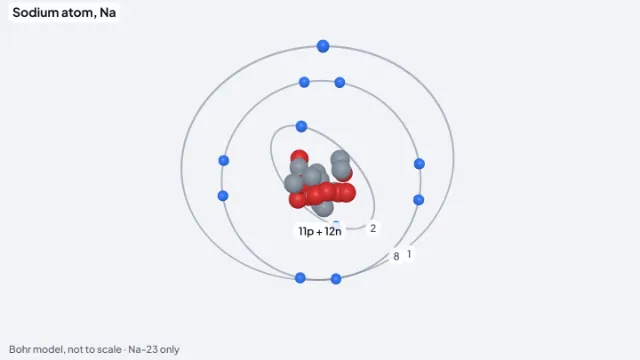
Sodium is a metal because it reacts to give Na⁺. Chlorine is a non-metal: with sodium it becomes Cl⁻, and with hydrogen it shares a pair of electrons to make HCl. Hydrogen itself is the one non-metal you will see as a positive ion, H⁺, which acids release in water; it is still classed as a non-metal.
Where are metals and non-metals in the periodic table?
Roughly four in every five elements are metals. They fill the left-hand side and the bottom of the table, including the whole central block of transition metals. The non-metals are crowded into the top right, plus hydrogen, which is a non-metal despite sitting at the top left. A stepped line running down from boron towards astatine roughly separates the two kinds. Elements next to that line, such as silicon, have some properties of each.
Why does position match atomic structure?
The position of an element tells you how many outer electrons it has (its group) and how far they are from the nucleus (its period). Both decide whether the atom tends to lose electrons.
| Element | Electronic structure | What its atom tends to do | Ion or bond | Type |
|---|---|---|---|---|
| Sodium | 2,8,1 | Lose its 1 outer electron | Na⁺ | Metal |
| Magnesium | 2,8,2 | Lose 2 outer electrons | Mg²⁺ | Metal |
| Aluminium | 2,8,3 | Lose 3 outer electrons | Al³⁺ | Metal |
| Sulfur | 2,8,6 | Gain 2 electrons, or share | S²⁻ or covalent bonds | Non-metal |
| Chlorine | 2,8,7 | Gain 1 electron, or share | Cl⁻ or covalent bonds | Non-metal |
| Argon | 2,8,8 | Nothing: its outer shell is already full | None | Non-metal |
Atoms with few outer electrons (1, 2 or 3) can reach a full outer shell most easily by losing them, which is metallic behaviour. Atoms with many outer electrons (5, 6 or 7) reach one more easily by gaining or sharing. That is why metals sit on the left and non-metals on the right.
Going down a group, each atom has an extra shell, so its outer electrons sit further out, with more inner shells screening them from the nucleus. They are lost more easily, so elements lower down are more metallic. Group 4 shows this clearly: carbon at the top is a non-metal, while tin and lead near the bottom are metals.
How do their physical properties differ?
| Property | Typical metal | Typical non-metal |
|---|---|---|
| Appearance | Shiny when freshly cut or polished | Usually dull |
| State at room temperature | Solid (except mercury) | Many are gases; some solids; bromine is a liquid |
| Melting and boiling points | Mostly high | Mostly low (carbon is a big exception) |
| Electrical and thermal conduction | Good conductors | Poor conductors (insulators), except graphite |
| When hit or bent | Malleable: they bend and can be hammered into shape | Brittle if solid: they shatter |
| Density | Usually high | Usually low |
Most of the metal column comes from metallic bonding: a lattice of positive ions bound by delocalised electrons that move freely between them. The metallic bonding page explains each property from that model.
How do their chemical properties differ?
- Ions: metals form positive ions; non-metals form negative ions or share electrons.
- Compounds: a metal and a non-metal react to give an ionic compound, such as sodium chloride. Two non-metals give a covalent compound, such as water or carbon dioxide.
- Oxides: metal oxides are bases. They react with acids to make a salt and water, and the soluble ones, such as sodium oxide, dissolve to give alkaline solutions. Non-metal oxides, such as carbon dioxide and sulfur dioxide, dissolve in water to give acidic solutions.
Worked example: classifying from data
Question: Use the data to decide whether each element is a metal or a non-metal. Give a reason for each.
| Element | Melting point / °C | Conducts electricity as a solid? | Its oxide in water |
|---|---|---|---|
| P | 1538 | Yes | Does not dissolve, but reacts with acid |
| Q | 115 | No | Dissolves to give a solution of pH 2 |
| R | 98 | Yes | Dissolves to give a solution of pH 13 |
- P is a metal. It conducts, has a high melting point, and its oxide behaves as a base by reacting with acid. (These are the values for iron.)
- Q is a non-metal. It does not conduct and its oxide is acidic. (These match sulfur.)
- R is a metal, despite its low melting point. It conducts and its oxide gives an alkali. (This is sodium: Group 1 metals melt unusually easily.)
The lesson from R is to base your decision on more than one property, and to trust conduction and the oxide over melting point.
See electrons lost and gained in the simulation
In the 3D electron shells simulation, pick sodium from Quick picks or The first 20 elements, then press Make ion. The outer electron leaves, the Electrons card reports one lost, and the Ion panel notes that Na⁺ now has the same arrangement as neon. Do the same for chlorine and watch an electron arrive instead. Try every element from lithium to argon and note where on the table the switch from losing to gaining happens. For the metallic structure itself, choose Magnesium (a metal) in the giant structures simulation and press Apply p.d. to see the delocalised electrons drift. The three kinds of bonding are compared side by side in ionic, covalent and metallic bonding.