Where this sits in AQA chemistry
Why does a scientific model change?
A model is a simplified picture that explains what has been observed and lets you predict what should happen next. It survives for as long as the predictions keep matching the results. When a careful experiment gives a result the model cannot account for, scientists either adjust the model or throw it out for a better one. The atom is the textbook case: every picture of it lasted until somebody measured something it could not explain.
What were the steps in the atomic model?
| Step | The picture of the atom | What came next, and why |
|---|---|---|
| 1. Solid spheres (early 1800s) | Atoms are tiny balls that cannot be divided into anything smaller | The electron was discovered (1897): a negative particle far smaller than an atom, so atoms must have parts |
| 2. Plum pudding (1904) | A ball of positive charge with negative electrons scattered inside it, so the whole atom is neutral | Alpha particles fired at gold foil behaved in a way this model could not explain |
| 3. Nuclear model (1911) | A tiny, positively charged nucleus at the centre holds almost all the mass; the electrons are outside it | Bohr worked out where the electrons could be |
| 4. Bohr's shells (1913) | Electrons move round the nucleus only at set distances (shells, also called energy levels) | Experiments on nuclei showed how their charge is built up |
| 5. Protons (about 1920) | The positive charge of a nucleus is a whole number of identical small particles, each with the same charge | The mass of most nuclei was still bigger than their protons could explain |
| 6. Neutrons (1932) | The nucleus also holds neutral particles, each about as heavy as a proton | This is the model you use for the rest of GCSE |
The years are there to help you keep the order straight. Questions ask about the sequence and the reasons for each change, not dates.
How did alpha scattering overturn the plum pudding model?
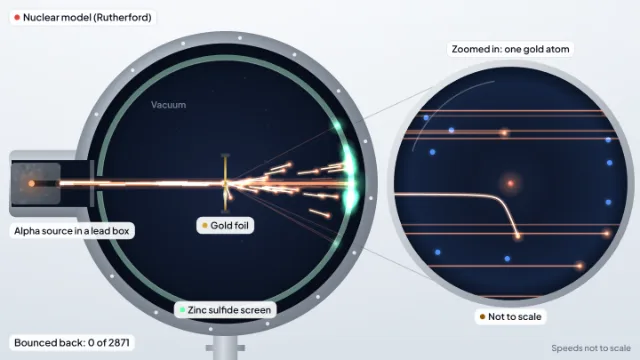
Alpha particles are small, fast and positively charged. In the experiment a narrow beam of them was aimed at an extremely thin sheet of gold foil, and a screen around the foil showed a tiny flash wherever one landed, so the scientists could count how many were turned through each angle.
Start with the prediction. The plum pudding atom has its positive charge smeared thinly over the whole atom, so nowhere in it is there a strong enough push to turn a fast alpha particle sharply. Every alpha particle should pass through, bent by a tiny angle at most.
| What was seen | What it told scientists |
|---|---|
| Almost all the alpha particles went straight through the foil | Atoms are almost entirely empty by volume |
| A small number were turned through large angles | The positive charge is packed into a very small region, which repels a passing alpha particle strongly |
| A very few came back towards the source | That small central region also carries nearly all of the atom's mass: it is a dense nucleus |
The plum pudding model predicted none of the large deflections and none of the rebounds. Because the evidence disagreed with the prediction, the model was replaced by the nuclear model, not just patched.
How do the two models compare?
| Question to ask | Plum pudding model | Nuclear model |
|---|---|---|
| Is there a nucleus? | No | Yes, tiny and at the centre |
| Where is the positive charge? | Spread evenly through the atom | All in the nucleus |
| Where is the mass? | Spread evenly through the atom | Nearly all in the nucleus |
| Where are the electrons? | Embedded in the positive ball | Outside the nucleus, around it |
| Is the atom mostly empty? | No, it is solid charge throughout | Yes |
A good comparison answer makes the same point about both models in one sentence, for example: "In the plum pudding model the mass is spread through the atom, but in the nuclear model it is concentrated in the nucleus."
Worked example: a 4-mark explanation
Question: Explain how the gold foil scattering results changed the accepted model of the atom.
- State the old prediction. The plum pudding model has its positive charge spread out, so it predicts that all alpha particles pass through with only small deflections.
- Link the first result. Most went straight through, so atoms are largely empty.
- Link the large deflections. Some were deflected through big angles, so the positive charge must be concentrated in a small region.
- Link the rebounds. A few bounced back, so the mass is concentrated there too, in a nucleus. These results contradicted the plum pudding prediction, so scientists replaced that model.
Each step pairs an observation with a conclusion. Writing "the experiment proved there was a nucleus" with no evidence attached earns little.
How do Bohr, protons and neutrons link to the rest of chemistry?
- Bohr's shells are the energy levels you fill when you write an electronic structure such as 2,8,1. His calculations matched what experiments measured, which is why the idea was accepted. Real electrons do not follow neat circular tracks; the shell picture is still a model.
- Protons give each element its atomic number, and the periodic table arranges the elements by that number.
- Neutrons explain why atoms of one element can have different masses. Those versions are isotopes, and they are the reason relative atomic masses such as 35.5 for chlorine are not whole numbers.
Chadwick's evidence for the neutron arrived roughly twenty years after scientists had accepted the nucleus: another example of a model growing as new evidence turned up. You can also read the physics take on this topic and a longer account of how Geiger and Marsden's results were read.
Test both models in the simulation
Open the alpha scattering simulation and pick Plum pudding under Atom model. Press Fire several times, then read the Alpha particles detected at each angle chart: every count is crowded at the smallest angles and the Bounced back counter stays at zero. Now switch to Nuclear and fire again. Large angles appear, and every so often an alpha particle returns. The Both models so far table keeps both sets of counts side by side, which is exactly the comparison an exam asks you to describe, and the How the model of the atom changed panel walks through the steps above. The picture is not to scale: compared with its atom, a real gold nucleus is much tinier than drawn.