Skip to content

GCSE Chemistry — AQA (8462) · Atomic structure and the periodic table

Protons, neutrons, electrons and the size of atoms

4.1.1.44.1.1.5

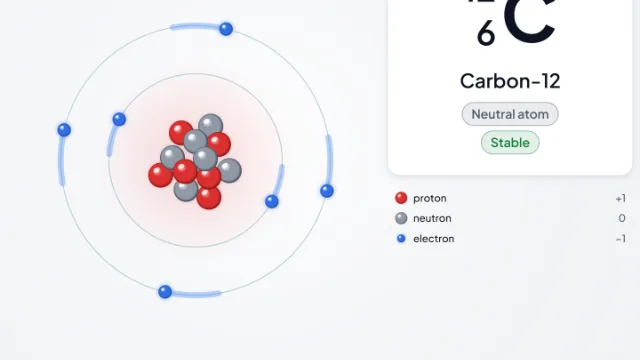
The nucleus holds protons (charge +1) and neutrons (no charge), each of mass 1. Electrons, charge −1 and almost massless, sit in shells around it. Atomic number counts protons; mass number adds the neutrons. An atom's radius is about 0.1 nm, and its nucleus is at least 10 000 times smaller.

Loading simulation…

Symbols match your course. Open the full isotopes and atom builder simulation for more presets and teacher tools.

Where this sits in AQA chemistry

What are the three particles in an atom?

ParticleRelative massRelative chargeLocation
Proton1+1Nucleus
Neutron10Nucleus
ElectronVery small (roughly 1/2000 of a proton)−1Shells (energy levels)

"Relative" means compared with the proton. You do not need the real values in coulombs or kilograms. Learn the table as it stands; one or two marks for it come up in most papers.

Two consequences follow straight from the table:

  • An atom has no overall charge. It holds equal numbers of protons and electrons, so +1 and −1 cancel out exactly. The neutrons add nothing to the charge.
  • Almost all the mass sits in the nucleus. Protons and neutrons are heavy; electrons barely count. In a carbon-12 atom the six electrons make up less than 0.03% of the mass.

What do atomic number and mass number tell you?

The atomic number is how many protons an atom has. It decides the element: any atom holding six protons is carbon, while one with seven is nitrogen instead. Different elements always have different atomic numbers.

The mass number is the total of protons plus neutrons, since those are the particles with real mass. Subtracting gives the neutrons:

neutrons=mass number−atomic number\text{neutrons} = \text{mass number} - \text{atomic number}

Both numbers appear in nuclide notation: the mass number sits at the top left of the symbol, with the atomic number underneath it. For sodium, 1123Na^{23}_{11}\text{Na} means 11 protons and 23 − 11 = 12 neutrons.

What is an isotope?

Isotopes are atoms of one element (same number of protons) with unequal neutron counts, which gives them different mass numbers. Carbon has three natural isotopes:

IsotopeProtonsNeutronsElectrons (neutral atom)
Carbon-12666
Carbon-13676
Carbon-14686

Because the electron count is identical, the isotopes of an element react in the same way. Only their masses (and, for carbon-14, its radioactivity) set them apart. Mixtures of isotopes are why the relative atomic mass of an element is often not a whole number.

How do you count the particles in an ion?

An ion has gained or lost electrons. The nucleus is untouched, so the protons and neutrons stay the same as in the atom. Read the charge as follows: a positive charge means that many electrons were lost, and a negative charge means that many were gained.

ParticleProtonsNeutronsElectrons
1224Mg2+^{24}_{12}\text{Mg}^{2+}121212 − 2 = 10
1327Al3+^{27}_{13}\text{Al}^{3+}131413 − 3 = 10
1632S2−^{32}_{16}\text{S}^{2-}161616 + 2 = 18
1939K+^{39}_{19}\text{K}^{+}192019 − 1 = 18

Why some atoms lose electrons and others gain them is covered in ionic bonding.

How big is an atom?

An atom has a radius of about 0.1 nm. The prefix nano means one billionth, so 1 nm = 1 × 10⁻⁹ m and

0.1 nm=1×10⁻¹⁰ m0.1\ \text{nm} = 1 \times 10^{-10}\ \text{m}

The nucleus is far smaller again. Its radius is under one ten-thousandth (1/10 000) of the atom's, around 1 × 10⁻¹⁴ m. Since nearly all the mass is packed into that tiny centre, an atom is mostly empty space with a minute, very dense core.

Some ways to picture these numbers:

  • A human hair is about 0.1 mm (1 × 10⁻⁴ m) wide. An atom is about 2 × 10⁻¹⁰ m across, so around 500 000 atoms would fit side by side across the hair.
  • If a nucleus were blown up to the size of a 1 mm grain of sand, its atom would be at least 10 m across: roughly the width of a classroom, with the electrons somewhere out by the walls.

Worked example: particles and scale

Question 1: How many of each particle does the chloride ion 1737Cl−^{37}_{17}\text{Cl}^{-} contain?

  1. Protons = atomic number = 17.
  2. Neutrons = 37 − 17 = 20.
  3. A 1− charge means one extra electron: 17 + 1 = 18 electrons.

Question 2: Take an atomic radius of 1 × 10⁻¹⁰ m and a nuclear radius of 1 × 10⁻¹⁴ m. How many times wider is the atom?

1×10⁻¹⁰ m1×10−14 m=1×104=10 000\frac{1 \times 10^{-10}\ \text{m}}{1 \times 10^{-14}\ \text{m}} = 1 \times 10^{4} = 10\,000

Dividing powers of ten means subtracting the indices: −10 − (−14) = 4. The units cancel, so the answer has none.

Build atoms and ions in the simulation

In the atom builder, start in Build mode and use Add a proton, Add a neutron and Add an electron (or the P, N and E keys). Watch the Element card change only when the proton count changes, and see the Neutron number card work out A − Z for you. Remove two electrons from magnesium-24 and the Charge card shows 2+. Switch to Compare to set two isotopes of one element side by side, then open Scale and read the Atom ÷ nucleus card to see the real size gap. The Challenge mode has ten builds to check yourself, such as a 1− ion of chlorine-35. More practice is in a guide to reading nuclide symbols, and the physics course covers the same atom in its structure of the atom notes.
Common mistakes

  • Treating the electron's mass as zero, or as equal to a proton's. It is tiny, roughly 1/2000 of a proton, but not nothing.
  • Using the mass number as the number of neutrons. Take the atomic number away first: neutrons = mass number − atomic number.
  • Altering the proton count for an ion. Ions form by gaining or losing electrons; the nucleus is left exactly as it was.
  • Reading a 2+ charge as 2 electrons gained. A positive charge means electrons were lost, so Mg²⁺ has 12 − 2 = 10 electrons.
  • Calling isotopes different elements. Matching proton numbers make them one element; only the neutron count varies.
  • Writing 0.1 nm as 1 × 10⁻⁹ m. One nanometre is 1 × 10⁻⁹ m, so a tenth of one is 1 × 10⁻¹⁰ m.

Exam practice

Exam-style questions

Original questions written in the style of GCSE AQA Chemistry. Try each one before you reveal the answer.

  1. 1.An atom of fluorine can be shown as ¹⁹₉F.

    1. (a)State how many protons, neutrons and electrons this fluorine atom contains.

      2 marks
      Show the answer

      Answer: 9 protons, 10 neutrons and 9 electrons.

      Marking points

      • 9 protons and 9 electrons
      • 10 neutrons (19 − 9)
    2. (b)Fluorine forms the ion F⁻. How many electrons does this ion have? Explain your answer.

      2 marks
      Show the answer

      Answer: 10. The 1− charge means the atom has gained one electron, so 9 + 1 = 10.

      Marking points

      • 10 electrons
      • A negative ion / 1− charge has gained one electron
    3. (c)Explain why this fluorine atom is electrically neutral.

      2 marks
      Show the answer

      Answer: Its 9 protons are balanced by 9 electrons. Each proton is +1 and each electron −1, so the charges cancel; neutrons carry no charge.

      Marking points

      • Equal numbers of protons and electrons
      • Proton charge +1 and electron charge −1 cancel (neutrons are neutral)
  2. 2.Magnesium has three naturally occurring isotopes: magnesium-24, magnesium-25 and magnesium-26. The atomic number of magnesium is 12.

    1. (a)Define the word isotopes.

      2 marks
      Show the answer

      Answer: They are atoms with equal proton numbers, so the same element, but unequal neutron numbers.

      Marking points

      • Atoms of one element / equal proton numbers
      • Unequal neutron numbers
    2. (b)Work out the neutron count in a magnesium-26 atom.

      1 mark
      Show the answer

      Answer: 14 (26 − 12).

      Marking points

      • 14
    3. (c)Suggest why all three isotopes of magnesium have the same chemical reactions.

      1 mark
      Show the answer

      Answer: They all have 12 electrons arranged in the same way, and chemical reactions depend on the electrons.

      Marking points

      • Same number / arrangement of electrons
  3. 3.The radius of a typical atom is about 0.1 nm, and the radius of a nucleus is about 1 × 10⁻¹⁴ m.

    1. (a)Convert 0.1 nm into metres. Give your answer in standard form.

      1 mark
      Show the answer

      Answer: 0.1 × 10⁻⁹ m = 1 × 10⁻¹⁰ m

      Marking points

      • 1 × 10⁻¹⁰ m
    2. (b)By what factor is the atom's radius bigger than the nucleus's radius?

      2 marks
      Show the answer

      Answer: (1 × 10⁻¹⁰) ÷ (1 × 10⁻¹⁴) = 10⁴, so the atom is 10 000 times wider.

      Marking points

      • Divides the atomic radius by the nuclear radius
      • 10 000 (10⁴)
    3. (c)Use the relative masses of the three particles to explain why an atom's mass is concentrated in its nucleus.

      2 marks
      Show the answer

      Answer: Protons and neutrons, which are both in the nucleus, each have a relative mass of 1. Electrons have a very small relative mass, so they add almost nothing.

      Marking points

      • Protons and neutrons (relative mass 1) are in the nucleus
      • Electrons have a very small mass

Quiz

Quick check

6 questions

  1. 1.Which particle has a relative charge of 0 and a relative mass of 1?
  2. 2.An element's atomic number is equal to which of these?
  3. 3.Calcium-40 has atomic number 20. How many neutrons does each of its atoms contain?
  4. 4.An ion of aluminium has the symbol ²⁷₁₃Al³⁺. How many electrons does it have?
  5. 5.A gold atom has a radius of about 0.14 nm. Which value is this in metres?
  6. 6.Carbon-12 and carbon-14 are isotopes. What is different about their atoms?

Related articles

Next step

Now see it move

Open the full isotopes and atom builder simulation for every preset, graphs and the teacher tools, then test yourself.

Isotopes and atom builder simulation: add protons, neutrons and electrons one at a time