Skip to content

GCSE Chemistry — AQA (8462) · Atomic structure and the periodic table

Group 1: the alkali metals

4.1.2.5

Alkali metals all have one outer electron, which they lose to form 1+ ions. With water they make a metal hydroxide and hydrogen; with oxygen, an oxide; with chlorine, a white chloride. Lower down, that electron sits further out from the nucleus and is lost more easily, so reactivity increases.

Loading simulation…

Symbols match your course. Open the full electron shells in 3d (atoms and ions up to calcium) simulation for more presets and teacher tools.

Where this sits in AQA chemistry

What are the alkali metals like?

Group 1 holds lithium, sodium, potassium, rubidium, caesium and francium. Their family name, the alkali metals, comes from what happens in water: the solution left behind is an alkali. Compared with everyday metals such as iron, they are odd:

  • Soft: you can cut them with a knife, revealing a shiny surface that dulls within seconds as it reacts with air.
  • Low density: the first three are lighter than water, so a piece of any of them floats.
  • Low melting points that fall down the group: lithium melts at 181 °C, sodium at 98 °C and potassium at 63 °C.

They are stored under oil to keep air and water away from them.

Why do they behave alike?

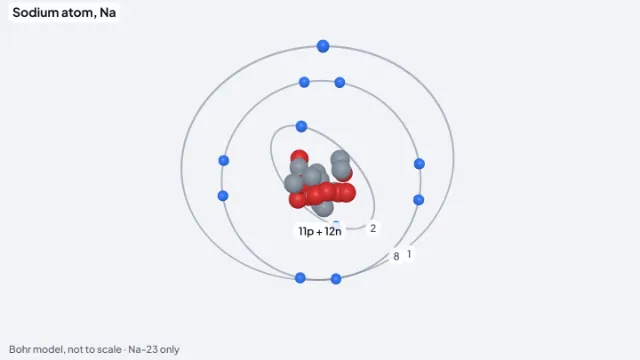
Every alkali metal atom has one electron in its outer shell: lithium 2,1, sodium 2,8,1, potassium 2,8,8,1. When they react, that electron is lost and the atom becomes an ion with a 1+ charge (Li⁺, Na⁺, K⁺) and the full-shell arrangement of a noble gas. One outer electron in all of them means one kind of chemistry, so their reactions have the same products and differ mainly in how fast and how violently they happen.

How do lithium, sodium and potassium react with water?

Each one produces hydrogen gas and a metal hydroxide; the hydroxide dissolves, so the water becomes alkaline:

2 Li(s)+2 HX2O(l)→2 LiOH(aq)+HX2(g)\ce{2Li(s) + 2H2O(l) -> 2LiOH(aq) + H2(g)}

2 Na(s)+2 HX2O(l)→2 NaOH(aq)+HX2(g)\ce{2Na(s) + 2H2O(l) -> 2NaOH(aq) + H2(g)}

2 K(s)+2 HX2O(l)→2 KOH(aq)+HX2(g)\ce{2K(s) + 2H2O(l) -> 2KOH(aq) + H2(g)}

MetalWhat you see on water
LithiumFloats and fizzes steadily, slowly getting smaller. It does not melt.
SodiumFizzes quickly, melts into a shiny ball and skates around the surface.
PotassiumMelts at once, darts about and the hydrogen bursts into a lilac flame; it may crack and spit at the end.

Universal indicator added to the water turns purple as the hydroxide forms, showing a strongly alkaline solution. The fizzing is hydrogen, and sodium melts because the reaction gives out enough heat to pass its low melting point.

How do they react with oxygen and chlorine?

Oxygen: the freshly cut metals tarnish in air as a layer of oxide forms, faster for each step down the group. Heated in air or oxygen, they burn: lithium with a crimson flame, sodium with a yellow flame and potassium with a lilac flame. The products are white solid oxides with the formula M₂O.

4 Na(s)+OX2(g)→2 NaX2O(s)\ce{4Na(s) + O2(g) -> 2Na2O(s)}

Chlorine: a hot alkali metal lowered into chlorine gas burns brightly, giving a white solid chloride. These chlorides, such as sodium chloride, are ionic compounds made of M⁺ and Cl⁻ ions, and they dissolve in water to give colourless solutions.

2 K(s)+ClX2(g)→2 KCl(s)\ce{2K(s) + Cl2(g) -> 2KCl(s)}

The pattern is the same for every reaction: same type of product, more vigorous reaction lower down. Burning sodium and potassium in plenty of air also makes some other oxides, which GCSE does not cover; answers use M₂O.

Why does reactivity increase down Group 1?

  1. Each element down the group has one more shell of electrons.
  2. So the single outer electron is further from the nucleus, shielded by an extra layer of inner electrons.
  3. The positive nucleus therefore attracts it less strongly.
  4. Less energy is needed to remove it, so the atom loses its outer electron more easily and reacts faster.

A full answer has all four links. "Potassium is bigger" on its own scores little: say what the extra distance does to the attraction for the outer electron.

Worked example: predicting rubidium

Question: Rubidium is directly below potassium in Group 1. Predict how it reacts with water, and write a balanced equation.

  1. Same products: rubidium hydroxide and hydrogen, because it also has one outer electron.
  2. Faster: reactivity increases down the group, so it reacts even more violently than potassium. In practice the reaction is violent and the hydrogen ignites at once.
  3. Equation: follow the pattern for potassium.

2 Rb(s)+2 HX2O(l)→2 RbOH(aq)+HX2(g)\ce{2Rb(s) + 2H2O(l) -> 2RbOH(aq) + H2(g)}

  1. Physical property: melting points fall down the group, so rubidium should melt below 63 °C. The measured value is 39 °C.

Safety: how these reactions are shown

Reactions of Group 1 metals with water are teacher demonstrations. The metal is handled with tongs, never fingers, cut into pieces no bigger than a grain of rice, and added to a large trough of water behind a safety screen while everyone wears eye protection. Potassium is used only in very small pieces because the hydrogen ignites. Rubidium and caesium are never used in schools. The alkaline solutions formed can irritate skin and eyes.

See the single outer electron in 3D

With the 3D shell model open, step through lithium, sodium and potassium using The first 20 elements table, and watch the Group card stay at Group 1 while the Period card climbs from 2 to 4. The lone outer electron sits on a ring further out each time: that growing distance is the whole reason for the reactivity trend. Press Make ion to watch the outer electron leave and see the ion match helium, neon and then argon. The crimson, yellow and lilac colours of these metals also show up when their compounds are heated, which you can see in the flame tests simulation. How the ions then bond is covered in the guide to ion formation.
Common mistakes

  • Writing that Group 1 metals react with water to form an oxide. The products are a metal hydroxide (such as NaOH) and hydrogen.
  • Saying reactivity decreases down Group 1. It increases: potassium reacts more violently than sodium, which reacts more violently than lithium.
  • Explaining the trend with 'more electrons' or 'bigger atoms' alone. Link the extra shell to a weaker attraction between the nucleus and the outer electron.
  • Giving the ions a 2+ or 1− charge. Group 1 atoms lose one electron, so every ion is 1+, such as K⁺.
  • Forgetting the 2s when balancing. The water equation is 2Na + 2H₂O → 2NaOH + H₂, because hydrogen gas is H₂.
  • Predicting rubidium's melting point above potassium's. Melting points fall down Group 1, so it should be lower.

Exam practice

Exam-style questions

Original questions written in the style of GCSE AQA Chemistry. Try each one before you reveal the answer.

  1. 1.During a demonstration, a rice-grain-sized piece of sodium is placed on water that has had universal indicator added.

    1. (a)Give two observations the students would make.

      2 marks
      Show the answer

      Answer: Any two: fizzing / bubbles; the sodium floats; it melts into a ball; it moves around the surface; it shrinks until none is left; the indicator goes purple / blue.

      Marking points

      • First correct observation
      • Second correct observation
    2. (b)Complete the balanced symbol equation: 2Na(s) + 2H₂O(l) → ____ + H₂(g)

      1 mark
      Show the answer

      Answer: 2NaOH(aq)

      Marking points

      • 2NaOH(aq)
    3. (c)Explain why the universal indicator changes colour.

      2 marks
      Show the answer

      Answer: Sodium hydroxide forms and dissolves, making the solution alkaline, so the indicator turns purple.

      Marking points

      • Sodium hydroxide forms
      • The solution is alkaline (high pH)
  2. 2.This question is about the alkali metals lithium, sodium and potassium.

    1. (a)Explain why potassium is more reactive than sodium. Answer in terms of electrons.

      3 marks
      Show the answer

      Answer: A potassium atom has an extra shell, which places its outer electron further out from the nucleus (and more shielded). The attraction between the nucleus and the outer electron is weaker, so potassium loses its outer electron more easily.

      Marking points

      • Potassium has more shells / its outer electron is further out
      • Weaker attraction to the nucleus
      • So the outer electron is lost more easily
    2. (b)Write a balanced equation for the reaction of lithium with chlorine.

      2 marks
      Show the answer

      Answer: 2Li(s) + Cl₂(g) → 2LiCl(s)

      Marking points

      • Correct formulae: Li, Cl₂ and LiCl
      • Balanced with 2Li and 2LiCl
    3. (c)Sodium is cut with a knife. Describe and explain what happens to the freshly cut surface.

      2 marks
      Show the answer

      Answer: It is shiny at first but quickly goes dull, because sodium reacts with oxygen in the air to form a layer of sodium oxide.

      Marking points

      • Shiny surface goes dull / tarnishes quickly
      • Reacts with oxygen (in air) to form an oxide
  3. 3.Caesium is near the bottom of Group 1. Its reaction with water is not carried out in schools.

    1. (a)Predict the products of the reaction of caesium with water.

      2 marks
      Show the answer

      Answer: Caesium hydroxide and hydrogen.

      Marking points

      • Caesium hydroxide
      • Hydrogen
    2. (b)Suggest why the reaction is not carried out in schools.

      1 mark
      Show the answer

      Answer: Reactivity increases down the group, so caesium reacts with water so violently that it is dangerous / explosive.

      Marking points

      • It would be far too violent / explosive, because reactivity increases down the group
    3. (c)Give the formula of the ion that caesium forms. Caesium's symbol is Cs.

      1 mark
      Show the answer

      Answer: Cs⁺

      Marking points

      • Cs⁺

Quiz

Quick check

6 questions

  1. 1.What are the products when potassium reacts with water?
  2. 2.Why do the Group 1 elements have similar chemical reactions?
  3. 3.Which metal reacts most vigorously with water?
  4. 4.Sodium burns in chlorine gas. Which formula is correct for the product?
  5. 5.Why is lithium stored under oil?
  6. 6.Why does reactivity increase going down Group 1?

Related articles

Next step

Now see it move

Open the full electron shells in 3d (atoms and ions up to calcium) simulation for every preset, graphs and the teacher tools, then test yourself.

Electron shells in 3D simulation: a 3D Bohr model of the first 20 elements3D