Skip to content

Cambridge IGCSE Chemistry (0620) · Atoms, elements and compounds

Electronic configuration

2.2.52.2.6

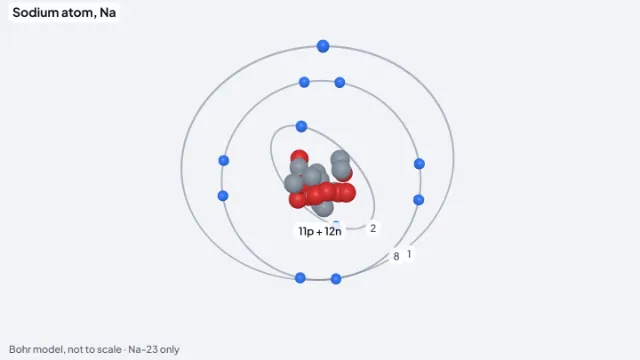
Core. An electronic configuration lists the electrons in each shell from the nucleus outwards, such as 2,8,3 for aluminium. Shells fill inside first: 2, then 8, then 8. Occupied shells give the period; outer electrons give the group for Groups I to VII; Group VIII has a full outer shell.

Loading simulation…

Symbols match your course. Open the full electron shells in 3d (atoms and ions up to calcium) simulation for more presets and teacher tools.

Which syllabus statements does this cover?

What is an electronic configuration?

An atom's electronic configuration lists how many electrons sit in each shell, starting from the shell nearest the nucleus, with commas between the shells. Aluminium, proton number 13, is 2,8,3: two electrons in the first shell, eight in the second, three in the third.

Three rules are enough for proton numbers 1 to 20:

  1. In a neutral atom, electrons equal protons, so the proton number tells you how many electrons to place.
  2. The shells fill from the inside out, because the innermost shell has the lowest energy.
  3. The first shell holds 2 electrons; the second holds 8; the third takes 8 before the fourth begins at potassium.

How do the configurations change across a period?

Moving one place to the right adds one proton and one electron. In Period 3, every element has a full first and second shell and is filling the third:

GroupIIIIIIIVVVIVIIVIII
Period 3 elementNaMgAlSiPSClAr
Configuration2,8,12,8,22,8,32,8,42,8,52,8,62,8,72,8,8
Outer electrons12345678 (full)

Period 2 follows the same pattern with only two shells (lithium 2,1 up to neon 2,8). Period 4 starts with potassium, 2,8,8,1, and calcium, 2,8,8,2.

How does the configuration give the group and the period?

  • Period number = number of occupied shells. Sulfur, 2,8,6, uses three shells: Period 3.
  • Group number = number of outer-shell electrons, for Groups I to VII. Sulfur has six: Group VI.
  • Group VIII: the outer shell is already full. For neon and argon that means 8 electrons; for helium it means 2, because the first shell is full with 2.

The full outer shell explains why the noble gases are so unreactive, and the shared number of outer electrons explains why the members of a group react alike. Hydrogen, 1, has one electron but is not an alkali metal; the Cambridge Periodic Table places it on its own above the groups.

How do you write the configuration of an ion?

The syllabus asks for ions as well as atoms. Start from the atom, then remove electrons for a positive ion or add them for a negative ion. The proton number never changes.

IonProtonsElectronsConfigurationSame as
Li⁺322Helium
Mg²⁺12102,8Neon
Al³⁺13102,8Neon
N³⁻7102,8Neon
S²⁻16182,8,8Argon
Ca²⁺20182,8,8Argon

Metal atoms lose their outer electrons; non-metal atoms gain enough to fill their outer shell. Either way the ion ends up with a noble gas configuration. See how these ions bond next.

Worked example: an ion from its symbol

Question: Give the electronic configuration of the chloride ion, Cl⁻. Chlorine has proton number 17.

  1. A chlorine atom has 17 electrons: 2,8,7.
  2. The ion carries a 1− charge, so it has one extra electron: 18 electrons.
  3. Configuration: 2,8,8, the same as argon.
  4. Check the charge: 17 protons and 18 electrons give 17 − 18 = −1.

And in reverse: a particle has 11 protons and the configuration 2,8. It has 10 electrons, one fewer than its protons, so it is the sodium ion, Na⁺.

Try it in the 3D model

Using the 3D shell model, tap the elements of Period 3 in the mini table one at a time and watch the third ring fill, while the Period card stays at 3 and the Group card counts up. Then tap down a column (try Li, then Na, then K) to see the period change while the group stays put. Press Make ion on magnesium, nitrogen and calcium and check each configuration against the table above. The model is a simplified Bohr picture: real electrons do not follow circular paths, and nothing is drawn to scale.
Common mistakes

  • Writing the configuration of an ion as if it were the atom. Remove electrons for a positive ion and add them for a negative ion: Mg²⁺ is 2,8, not 2,8,2.
  • Changing the number of protons when an ion forms. Only electrons are lost or gained; the proton number stays the same.
  • Putting 9 electrons in the third shell for potassium. Potassium is 2,8,8,1: the fourth shell starts after the third holds 8.
  • Saying the group number equals the number of shells. Shells give the period; outer electrons give the group.
  • Putting helium in Group II on the strength of its 2 electrons. Two is a full first shell, which makes helium a Group VIII noble gas.
  • Listing the shells from the outside in, so that sodium becomes 1,8,2. Always start from the shell nearest the nucleus.

Exam practice

Exam-style questions

Original questions written in the style of Cambridge IGCSE Chemistry. Try each one before you reveal the answer.

  1. 1.This question is about the elements with proton numbers 9 to 13.

    1. (a)Give the electronic configuration of an atom of fluorine (proton number 9).

      1 mark
      Show the answer

      Answer: 2,7

      Marking points

      • 2,7
    2. (b)Give the electronic configuration of the aluminium ion, Al³⁺ (proton number 13).

      1 mark
      Show the answer

      Answer: 2,8 (13 − 3 = 10 electrons).

      Marking points

      • 2,8
    3. (c)Name the noble gas with the same electronic configuration as Al³⁺.

      1 mark
      Show the answer

      Answer: Neon.

      Marking points

      • Neon
  2. 2.Element Q has the electronic configuration 2,8,6.

    1. (a)State the group and the period of the Periodic Table that Q is in. Explain how you decided.

      3 marks
      Show the answer

      Answer: Group VI, because it has 6 electrons in its outer shell. Period 3, because it has three occupied shells.

      Marking points

      • Group VI
      • Period 3
      • Outer electrons give the group; occupied shells give the period
    2. (b)Q forms an ion with a 2− charge. Give the electronic configuration of this ion.

      1 mark
      Show the answer

      Answer: 2,8,8

      Marking points

      • 2,8,8
  3. 3.Argon is a Group VIII noble gas. Its proton number is 18.

    1. (a)Give the electronic configuration of an argon atom.

      1 mark
      Show the answer

      Answer: 2,8,8

      Marking points

      • 2,8,8
    2. (b)State what is special about the outer shell of every Group VIII noble gas, and how this affects their reactivity.

      2 marks
      Show the answer

      Answer: The outer shell is full. So the noble gases do not easily gain, lose or share electrons, and they are very unreactive.

      Marking points

      • Full outer shell
      • So they are (very) unreactive
    3. (c)Give the symbols of two ions, formed from elements with proton numbers 1 to 20, that have the same configuration as argon.

      2 marks
      Show the answer

      Answer: Any two of: K⁺, Ca²⁺, Cl⁻, S²⁻ (P³⁻ also accepted).

      Marking points

      • One correct ion from K⁺, Ca²⁺, Cl⁻, S²⁻
      • A second correct ion

Quiz

Quick check

6 questions

  1. 1.What is the electronic configuration of silicon, proton number 14?
  2. 2.Which group and period hold an atom arranged 2,8,8,1?
  3. 3.Which particle has the configuration 2,8?
  4. 4.How many electrons does a magnesium ion, Mg²⁺, have? (Proton number 12)
  5. 5.Which statement about the Group VIII noble gases is correct?
  6. 6.Elements X and Y are in the same group. Which must be the same for X and Y?

Related articles

Next step

Now see it move

Open the full electron shells in 3d (atoms and ions up to calcium) simulation for every preset, graphs and the teacher tools, then test yourself.

Electron shells in 3D simulation: a 3D Bohr model of the first 20 elements3D