Skip to content

Cambridge IGCSE Chemistry (0620) · Atoms, elements and compounds

Simple molecules and covalent bonds

2.5.12.5.22.5.32.5.42.5.5

Core. Sharing one pair of electrons forms a covalent bond and gives each atom a noble gas configuration. Simple molecular compounds melt and boil at low temperatures and conduct poorly. Supplement: melting overcomes only weak intermolecular forces; O₂, N₂ and CO₂ have multiple bonds.

Loading simulation…

Symbols match your course. Open the full covalent molecules in 3d (ball-and-stick, space-filling and shared pairs) simulation for more presets and teacher tools.

What does syllabus 2.5 cover?

What are simple molecules?

A simple molecule is a small, separate particle made of a fixed number of non-metal atoms held together by covalent bonds. Water, H₂O, is one: every molecule has exactly one oxygen atom and two hydrogen atoms, and each molecule is a unit of its own. The syllabus describes compounds built from them as simple molecular compounds; some other courses say "small molecules".

  • A fixed number of atoms. The formula tells you exactly what is in one molecule: NH₃ always has 4 atoms and CH₄ always has 5. In a giant covalent structure such as SiO₂ the formula is only a ratio.
  • Elements as well as compounds. Hydrogen, chlorine, oxygen and nitrogen exist as molecules of two atoms (H₂, Cl₂, O₂, N₂). The noble gases are single atoms that do not bond, so they are not covalent molecules.
  • Strong inside, weak between. The covalent bonds within each molecule are strong, but the forces from one molecule to the next are weak. That is why so many simple molecular substances are already gases or liquids at 25 °C, and why those that are solids, such as iodine, melt at low temperatures.

What is a covalent bond? (Core)

Two atoms joined by a covalent bond hold one pair of electrons in common. Each atom usually supplies one electron of the pair. Sharing lets both atoms reach a noble gas electronic configuration: 2 outer electrons for hydrogen, like helium, and 8 for the other atoms in the syllabus list. Covalent bonds form between non-metal atoms.

The number of bonds an atom forms is the number of electrons it needs: one for H and Cl, two for O, three for N and four for C.

How do you draw the Core molecules? (Core)

Draw overlapping circles for the outer shells. Each shared pair goes in an overlap as one dot and one cross; any unshared pairs (lone pairs) go on the rest of the circle.

MoleculeBonding pairsLone pairsCheck
H₂1noneeach H has 2
Cl₂13 on each Cleach Cl has 8
HCl13 on ClH 2, Cl 8
H₂O22 on OO has 8
NH₃31 on NN has 8
CH₄4noneC has 8

How do you draw the Supplement molecules? (Supplement)

These need multiple bonds or several central atoms.

  • O₂: with 6 outer electrons apiece, each oxygen is 2 short of an octet, so the two atoms share two pairs (O=O). Each O keeps two lone pairs.
  • N₂: each N needs 3 more, so they share three pairs: a triple bond, N≡N, with one lone pair on each N.
  • CO₂: carbon shares two pairs with each oxygen, O=C=O. Carbon has 8 outer electrons and no lone pairs; each O has two lone pairs.
  • C₂H₄ (ethene): the two carbons share two pairs (C=C), and each carbon shares one pair with each of two hydrogens.
  • CH₃OH (methanol): carbon makes four single bonds (three to H, one to O); the oxygen bonds to carbon and to one hydrogen and keeps two lone pairs.

A good habit for any diagram: count each atom's electrons, including every shared pair it touches. Hydrogen should have 2 and everything else 8.

Worked example: carbon dioxide (Supplement)

Question: Draw a dot-and-cross diagram for carbon dioxide and state the number of shared electrons.

  1. Carbon (2,4) has 4 outer electrons and needs 4 more. Each oxygen (2,6) has 6 and needs 2 more.
  2. Carbon shares 2 pairs with each oxygen, so each C–O link is a double bond: O=C=O.
  3. Carbon's circle now holds 4 pairs = 8 electrons. Each oxygen holds 2 shared pairs plus 2 lone pairs = 8 electrons.
  4. Shared electrons: 2 double bonds × 4 electrons = 8, which is 4 shared pairs.

Why do simple molecular compounds melt low and not conduct?

Property (Core: describe)Explanation (Supplement)
Low melting and boiling pointsOnly the weak intermolecular forces between molecules are overcome; the strong covalent bonds inside each molecule do not break
Poor electrical conductivityThe molecules carry no overall charge and there are no ions or free electrons to move

When water boils, steam is still H₂O: no O–H bonds have broken. Pulling the molecules apart takes little energy, which is why so many simple molecular substances are fluids (gases or liquids) at 25 °C. Contrast these with giant covalent structures, where every atom is bonded into one network.

Check your diagrams in 3D

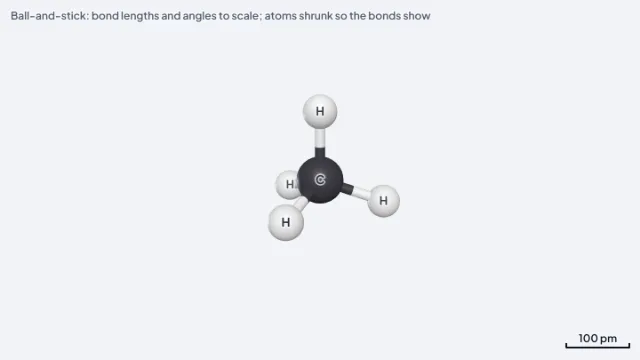
This molecule simulation contains all eleven molecules named in syllabus 2.5. Choose a Core molecule such as NH₃, press Pairs 3D and inspect the overlaps between shells, then press Pairs 2D for the flat exam version. For the Supplement list, step through O₂, N₂ and CO₂ and watch the Shared pairs card. Compare their boiling points: water has the highest of the eleven, and even that is only 100 °C.
Common mistakes

  • Saying the covalent bonds break when a simple molecular substance melts or boils. Only the weak intermolecular forces are overcome; the molecules stay whole.
  • Drawing the shared pair as two dots from the same atom. In a normal covalent bond each atom gives one electron, so show one dot and one cross.
  • Leaving out lone pairs, so that oxygen in water appears to have only 4 outer electrons. Every atom apart from hydrogen should finish with 8.
  • (Supplement) Drawing a single bond in O₂ or N₂. Oxygen shares two pairs (a double bond) and nitrogen shares three (a triple bond).
  • (Supplement) Giving carbon a lone pair in CO₂. Carbon uses all four outer electrons in two double bonds.
  • Saying simple molecular compounds conduct when dissolved, like ionic compounds. Their molecules have no overall charge, so they conduct poorly.

Exam practice

Exam-style questions

Original questions written in the style of Cambridge IGCSE Chemistry. Try each one before you reveal the answer.

  1. 1.Ammonia, NH₃, and methane, CH₄, are simple molecular compounds.

    1. (a)What is a covalent bond?

      1 mark
      Show the answer

      Answer: Two atoms holding one electron pair in common.

      Marking points

      • Two atoms sharing one electron pair
    2. (b)Using a dot-and-cross diagram, show the outer-shell electrons in one ammonia molecule.

      2 marks
      Show the answer

      Answer: Nitrogen in the centre sharing one pair (one dot and one cross) with each of three hydrogen atoms, and one lone pair on the nitrogen.

      Marking points

      • Three shared pairs, one between N and each H
      • One lone pair on N (8 electrons round N in total)
    3. (c)Describe two physical properties of methane that are typical of simple molecular compounds.

      2 marks
      Show the answer

      Answer: It has a low melting point and boiling point (it is a gas at room temperature). It does not conduct electricity.

      Marking points

      • Low melting / boiling point
      • Poor (no) electrical conductivity
  2. 2.Ethene, C₂H₄, and nitrogen, N₂, both contain multiple covalent bonds.

    1. (a)(Supplement) Draw a dot-and-cross diagram for nitrogen, N₂. Show outer-shell electrons only.

      2 marks
      Show the answer

      Answer: Three shared pairs between the two N atoms (each pair one dot and one cross), and one lone pair on each N atom.

      Marking points

      • Three shared pairs between the N atoms
      • One lone pair on each N
    2. (b)(Supplement) State the number of electrons shared between the two carbon atoms in ethene.

      1 mark
      Show the answer

      Answer: 4 (two shared pairs: a double bond).

      Marking points

      • 4
  3. 3.Chlorine, Cl₂, boils at −34 °C.

    1. (a)(Supplement) Explain, in terms of structure and bonding, why chlorine has a low boiling point.

      2 marks
      Show the answer

      Answer: Chlorine is made of simple molecules held together by weak intermolecular forces. Little energy is needed to overcome these forces; the strong Cl–Cl covalent bonds do not break.

      Marking points

      • Weak intermolecular forces (between the molecules)
      • Little energy needed to overcome them (covalent bonds not broken)
    2. (b)(Supplement) Explain why liquid chlorine is a poor conductor of electricity.

      2 marks
      Show the answer

      Answer: Each Cl₂ molecule is uncharged overall, and the liquid contains no ions or delocalised electrons that could carry charge.

      Marking points

      • Molecules are uncharged / no ions
      • No mobile charged particles (no free electrons)

Quiz

Quick check

6 questions

  1. 1.Why do the atoms in a hydrogen chloride molecule share a pair of electrons?
  2. 2.How many lone pairs are on the oxygen atom in a water molecule?
  3. 3.(Supplement) A carbon dioxide molecule contains how many shared pairs of electrons?
  4. 4.(Supplement) What is overcome when methanol, CH₃OH, boils?
  5. 5.Which compound is made of simple molecules with only single covalent bonds?
  6. 6.Which property is typical of a simple molecular compound?

Related articles

Next step

Now see it move

Open the full covalent molecules in 3d (ball-and-stick, space-filling and shared pairs) simulation for every preset, graphs and the teacher tools, then test yourself.

Covalent molecules in 3D simulation: eleven simple covalent molecules, from H₂ to methanol3D