New on Labverse
Interactive chemistry simulations
Chemistry is new here, and growing. We are starting with the ideas that are hardest to picture on a flat page: electrons in shells, the shapes of molecules, giant lattices and particles colliding. Turn each model in 3D, change one thing at a time and watch what happens.
- Simulations
- 12
- Simulations in 3D
- 9
- Chemistry topics
- 6
- Courses mapped
- 3
In short
Can you see atoms and molecules in 3D for free?
Yes. The chemistry simulations on Labverse are free, run in the browser on a phone or computer, and need no download or sign-up. Drag to turn an atom, a molecule or a crystal lattice, or use the arrow keys, then change one setting at a time to see how electron shells, bonds or collision rates respond.
Chemistry courses
Every topic of your syllabus, in its own order and wording, with the simulations that show it.
- United KingdomGCSE Chemistry — AQA (8462)Separate chemistry, with the chemistry of Combined Science: Trilogy (8464) included. Foundation and higher tier.85 topics
- InternationalCambridge IGCSE Chemistry (0620)Core and supplement content for the 2026–2028 syllabus, taught in schools around the world.69 topics
- PakistanPunjab Board Class 9 ChemistryNew syllabus (National Curriculum 2023), English medium, chapter by chapter.60 topics
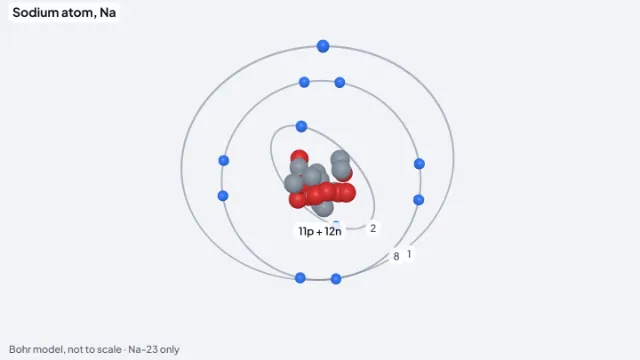
Atomic structure and the periodic table
Protons, neutrons, electron shells and why the table is arranged as it is.
Bonding, structure and properties
Ionic, covalent and metallic bonding, and the structures they build.
 3D
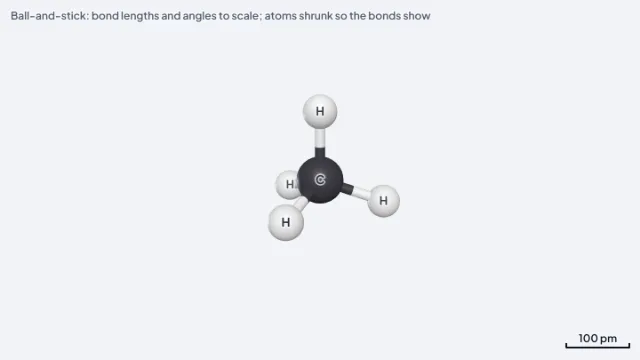
Covalent molecules in 3D (ball-and-stick, space-filling and shared pairs)
Turn 11 covalent molecules in 3D: ball-and-stick, space-filling and shared-pair views, dot-and-cross diagrams, lone pairs and bond angles.Predict: A nitrogen molecule, N₂, is two nitrogen atoms joined by covalent bonding. Each nitrogen atom starts with 5 electrons in its outer shell. How many pairs of electrons do the two atoms share?Try it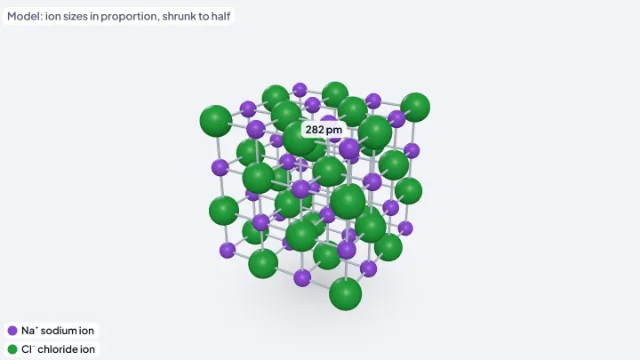 3D
Giant structures in 3D (sodium chloride, diamond, graphite and metals)
Turn sodium chloride, diamond, graphite, magnesium and silicon dioxide in 3D. Count neighbours, melt the salt, slide the layers and see what conducts.Predict: In solid sodium chloride, how many chloride ions are the nearest neighbours of each sodium ion?Try it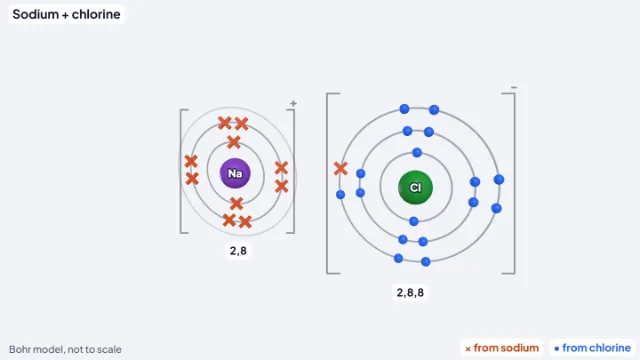 3D
Ionic bonding in 3D (electron transfer and the ions formed)
Watch metal atoms hand electrons to non-metal atoms in 3D, see the ions form with their charges, then draw the dot-and-cross diagram and the formula.Predict: Magnesium (2,8,2) reacts with oxygen (2,6) to make magnesium oxide. What charge does the magnesium ion carry?Try it
Rates of reaction
Collision theory and the factors that speed reactions up.
 3D
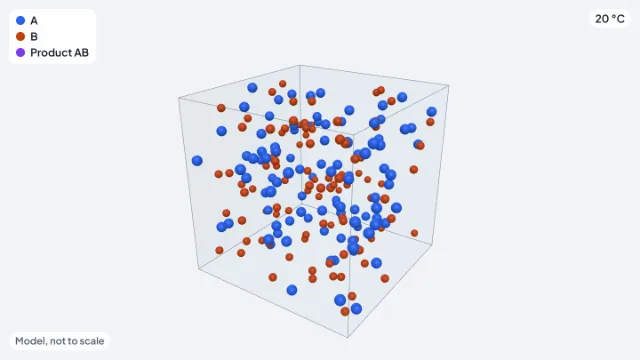
Collision theory in 3D (temperature, concentration, surface area and catalysts)
Watch particles collide in a 3D vessel. Change temperature, concentration, surface area and a catalyst, and see why only some collisions react.Predict: A vessel holds 100 particles of A and 60 of B at 20 °C. Play runs it for 4 seconds, then runs the same mixture again with the B doubled to 120 particles in the same volume. In the second run, how many A–B collisions happen each second?Try it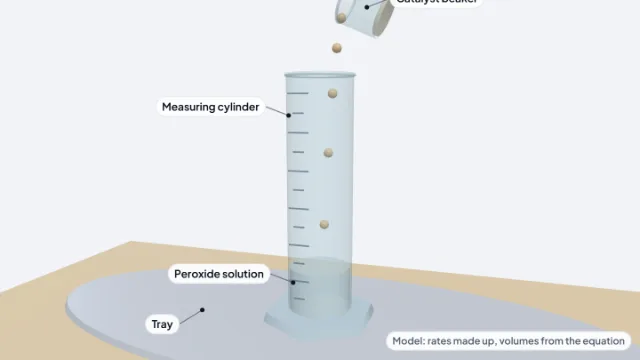 3DWow science
Elephant toothpaste in 3D (a catalyst decomposing hydrogen peroxide into a foam tower)
Why does elephant toothpaste foam so fast? Add a catalyst to hydrogen peroxide in 3D, zoom in on the molecules and graph the oxygen made over time.Predict: Potassium iodide is added as the catalyst and the hydrogen peroxide breaks down into water and oxygen. When the foam has stopped, how much of the catalyst is left?Try it
Chemical changes
Acids, alkalis, the reactivity series and electrolysis.
 3D
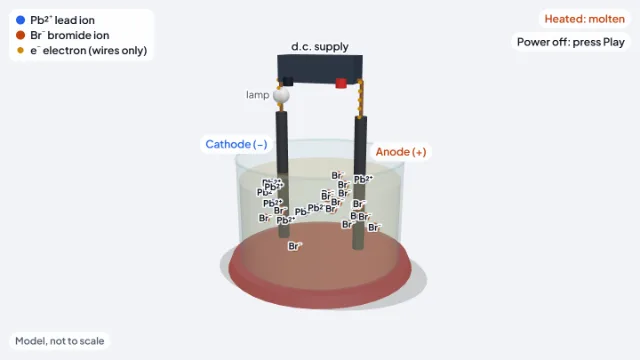
Electrolysis in 3D (molten and aqueous compounds, products at each electrode)
Switch on a 3D electrolysis cell and watch ions drift to the electrodes. Compare molten and aqueous compounds and predict the product at each electrode.Predict: Concentrated sodium chloride solution is electrolysed with graphite electrodes. What forms at the cathode (the negative electrode)?Try it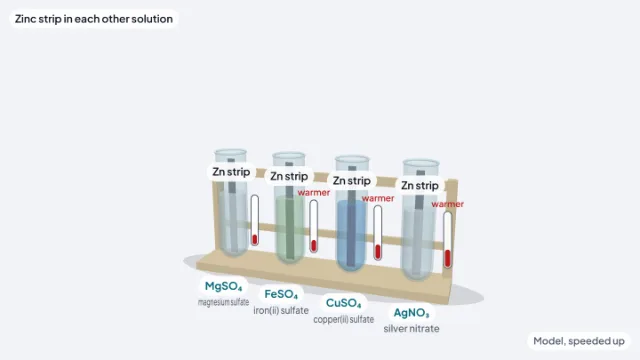 3D
Reactivity series and displacement in 3D (metals in salt solutions)
Lower metal strips into salt solutions in 3D, watch coatings form and colours change, then fill a results grid and deduce the reactivity series.Predict: A clean strip of copper is lowered into zinc sulfate solution. What happens?Try it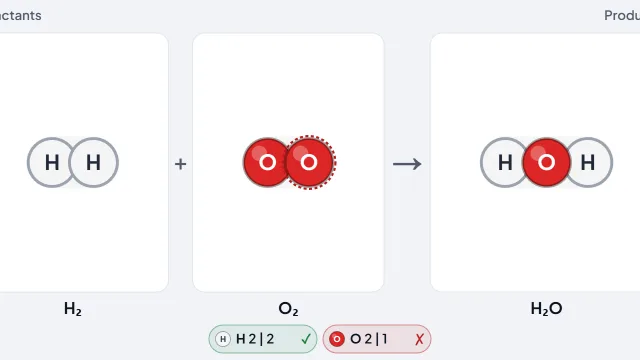
Balancing chemical equations (atom counts and state symbols)
Balance chemical equations with − and + buttons while a live atom counter shows every atom conserved. Add state symbols and check the masses.Predict: Methane burns in oxygen: CH₄ + O₂ → CO₂ + H₂O. When the equation is balanced with the smallest whole numbers, what number goes in front of O₂?Try it
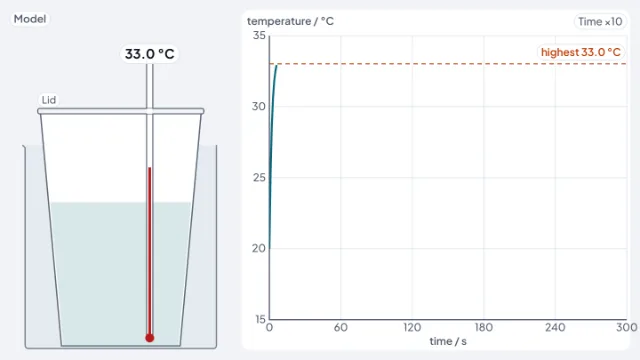
Energy changes
Exothermic and endothermic reactions and energy profiles.
Chemical analysis
Pure substances, chromatography and tests for ions and gases.
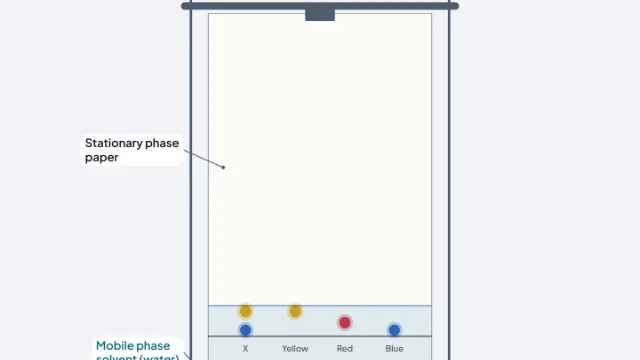
Paper chromatography (solvent front, spots and Rf values)
Run a virtual chromatogram: watch the solvent rise, measure each spot from the start line and calculate Rf values to identify dyes and test purity.Predict: A green food colouring, X, is spotted on a pencil line beside three reference dyes (yellow, red and blue) and the paper is stood in water. Which of the reference dyes does X contain?Try it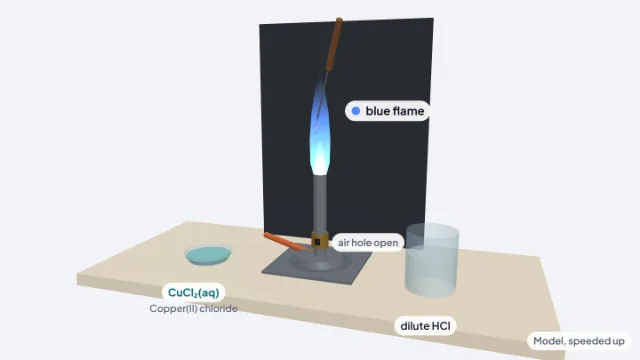 3D
Flame tests in 3D (identifying metal ions by flame colour)
Dip a nichrome loop, hold it in a 3D Bunsen flame and read the colour: lithium, sodium, potassium, calcium, barium and copper ions, plus mystery samples.Predict: A clean loop is dipped in potassium chloride solution and held in a blue Bunsen flame. What colour does the flame turn?Try it
Next step
Find your course
Pick your chemistry syllabus to see every topic in order, with the 3D simulations that show it.