Chemistry topic
Chemical analysis
Chemists identify what is in a mixture. Run a paper chromatogram, measure how far each spot travels, work out Rf values and decide whether a sample is pure.
In short
How do you calculate an Rf value in chromatography?
Divide the distance moved by the substance by the distance moved by the solvent, both measured from the start line: Rf = distance moved by substance ÷ distance moved by solvent. Rf is always less than 1, and a substance has the same Rf in the same solvent, so matching Rf values help identify what is in a mixture.
Simulations
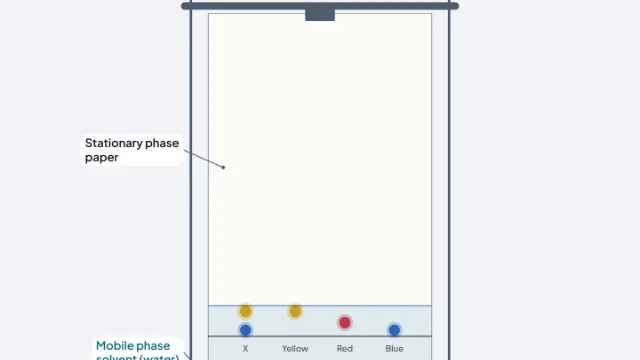
Paper chromatography (solvent front, spots and Rf values)
Run a virtual chromatogram: watch the solvent rise, measure each spot from the start line and calculate Rf values to identify dyes and test purity.Predict: A green food colouring, X, is spotted on a pencil line beside three reference dyes (yellow, red and blue) and the paper is stood in water. Which of the reference dyes does X contain?Try it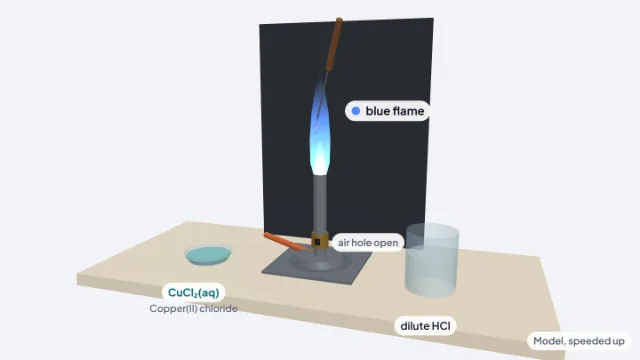 3D
Flame tests in 3D (identifying metal ions by flame colour)
Dip a nichrome loop, hold it in a 3D Bunsen flame and read the colour: lithium, sodium, potassium, calcium, barium and copper ions, plus mystery samples.Predict: A clean loop is dipped in potassium chloride solution and held in a blue Bunsen flame. What colour does the flame turn?Try it
Virtual practicals
Do the practicals from your course in the browser: follow the method and record what you measure or observe.
- AQA RP 6
Paper chromatography and Rf values
Separate food colourings by paper chromatography, measure each spot and the solvent front, calculate Rf values and identify the dyes in an unknown mixture.
Start the labRequired byAQAIGCSE - AQA RP 7
Identifying ions in unknown compounds
Identify the ions in an unknown salt with flame tests, sodium hydroxide, acid and limewater, silver nitrate and barium chloride. Separate chemistry only.
Start the labRequired byAQAIGCSE
Next step
Keep exploring
Every chemistry simulation, the 3D models and the chemistry courses.