Chemistry topic
Atomic structure and the periodic table
An element’s place in the periodic table comes from its atoms. Build atoms shell by shell in 3D, see how the outer electrons decide the group and the number of shells decides the period, and watch atoms gain or lose electrons to become ions.
In short
How are electrons arranged in shells?
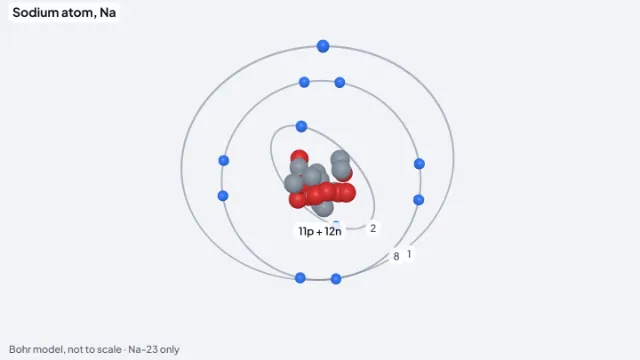
Electrons fill shells from the nucleus outwards. For the first 20 elements the first shell holds up to 2 electrons and the next two hold up to 8 each, so sodium, with 11 electrons, is 2,8,1. The number of outer-shell electrons gives the group and the number of occupied shells gives the period, which is why sodium sits in Group 1, Period 3.
Simulations
Articles
10 min read
Covalent Bonding and Dot-and-Cross Diagrams: Water, Ammonia, Methane, CO₂, O₂ and N₂ Step by Step
A step-by-step method for drawing dot-and-cross diagrams of covalent molecules, with a table of shared pairs and lone pairs for eleven molecules, worked examples for water, carbon dioxide and nitrogen, double and triple bonds, and the checks that catch most mistakes.
Read article
11 min read
Electron Configuration of the First 20 Elements: The 2,8,8 Rule, Groups and Periods
A fast method for writing the electron configuration (electronic structure) of the first 20 elements, a complete table from hydrogen to calcium, how to read the group and period from it, how to draw shell diagrams, and why potassium starts a fourth shell.
Read article
11 min read
How Atoms Form Ions: Charges From the Group, Ion Electron Configurations and Formulae
Learn why metal atoms lose electrons and non-metal atoms gain them, how to predict an ion's charge from the periodic table, how to write the electron configuration of an ion, why carbon and the noble gases form no simple ions, and how to write ionic formulae, with worked examples.
Read article
7 min read
Sleep and Memory: Why Sleep Makes Revision Stick, Plus Focus and the Pomodoro Technique
What sleep does for memory before and after you study, the experiments from 1924 to a 2019 study of teenagers, how much sleep 13 to 18 year olds need, an evening-and-morning revision routine for physics and chemistry, and an honest look at the Pomodoro technique.
Read article
7 min read
The Memory Palace (Method of Loci) for Science Revision: How to Use It
How the memory palace works, where the legend of Simonides comes from, and what brain scans of memory champions showed. Then three worked palaces for science lists: the electromagnetic spectrum, the reactivity series and the first 20 elements, with the method's honest limits.
Read article
Next step
Keep exploring
Every chemistry simulation, the 3D models and the chemistry courses.