Physics7 min read
Sleep and Memory: Why Sleep Makes Revision Stick, Plus Focus and the Pomodoro Technique
What sleep does for memory before and after you study, the experiments from 1924 to a 2019 study of teenagers, how much sleep 13 to 18 year olds need, an evening-and-morning revision routine for physics and chemistry, and an honest look at the Pomodoro technique.
Published
On this page
- What does sleep do for memory?
- Does losing sleep affect teenagers' revision?
- How much sleep do teenagers need?
- How can you use sleep in your revision?
- Does the Pomodoro technique work?
- Common mistakes
- Is it better to revise at night or in the morning?
- Can a nap help memory?
- Is 6 hours of sleep enough during exams?
- How long should a revision session be?
In short
Sleep helps you remember what you revise in two ways: while you sleep, the brain strengthens and sorts the memories you made that day, and a good night's sleep gets you ready to take in new material the next day. Sleep experts recommend 8 to 10 hours a night for 13 to 18 year olds, so staying up late to revise more can cost you more memory than it gains.
One of the first experiments on this was run in 1924. John Jenkins and Karl Dallenbach at Cornell University had two students learn lists of nonsense syllables, then tested them 1, 2, 4 or 8 hours later (American Journal of Psychology). Sometimes the students spent the gap going about their day. Sometimes they went to sleep. After a night's sleep they remembered far more than after the same number of hours awake.
They thought sleep just shielded memories from a busy day. Later research found the sleeping brain also works on them.
What does sleep do for memory?
After learning, sleep consolidates. New memories start out fragile. During sleep, and especially during deep sleep, the brain seems to replay the day's new memories and link them to what you already know. Matthew Walker and Robert Stickgold reviewed the evidence in Neuron in 2004, and Björn Rasch and Jan Born did so in more detail in Physiological Reviews in 2013. Both reviews conclude that sleep after learning helps memory, though scientists still debate exactly how it works.
Before learning, sleep prepares. A tired brain takes in less. In a 2007 study by Seung-Schik Yoo, Matthew Walker and colleagues (Nature Neuroscience), young adults who had stayed awake all night remembered fewer of the pictures they then studied than those who had slept. Brain scans showed that the hippocampus, a key area for forming new memories, was less active in the sleep-deprived group while they studied.
Does losing sleep affect teenagers' revision?
Yes. A 2019 study in the Journal of Adolescent Health tested this with a pattern many students know. James Cousins, Kian Wong and Michael Chee in Singapore gave 29 students aged 15 to 18 only 5 hours in bed a night for five nights, like a busy school week. A comparison group of 30 had 9 hours a night.
After the fourth short night, both groups learned facts about arthropods, the animal group that includes insects, spiders and crabs. The short sleepers forgot more at every test: 30 minutes later, 3 days later and 6 weeks later. The authors report 26% more forgetting at the first test, rising to 65% at 6 weeks.
The cost of short nights did not wear off. It was largest at the latest test, the kind that matters for exams.
How much sleep do teenagers need?
| Source | Advice for teenagers |
|---|---|
| American Academy of Sleep Medicine (2016 consensus statement) | 8 to 10 hours in every 24 hours, regularly, for ages 13 to 18 |
| Evelina London Children's Hospital (NHS) sleep advice for teenagers | Most need 9 to 9.5 hours; under 7 hours on most nights is probably not enough |
The NHS advice also points out that during puberty most teenagers' body clocks shift later, so feeling awake at midnight is normal. That makes a regular bedtime more important, not less. This is general guidance, not medical advice. If you often struggle to sleep, talk to a parent, a school nurse or your doctor.
How can you use sleep in your revision?
Test yourself in the evening, then again in the morning
Learn or revise a topic in the evening and finish with a short self-test. After a night's sleep, test yourself on it again before you look at your notes. For example:
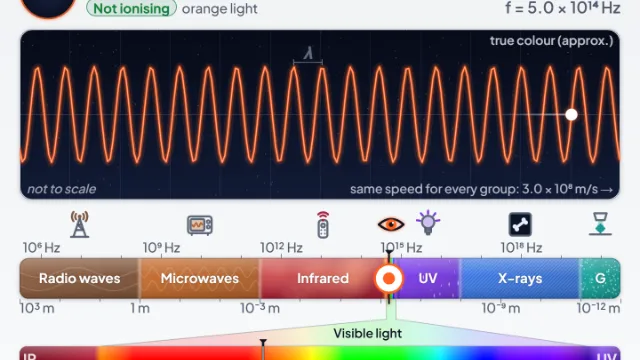
- Evening: write the electromagnetic spectrum from radio to gamma, with one use of each wave, then check it against the electromagnetic spectrum simulation.
- Morning: write it again from memory, with no checking first.
- Fix: anything you missed in the morning gets retested in your next session.
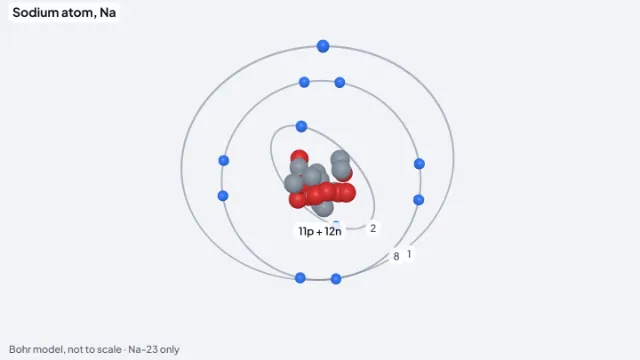
The same works in chemistry. Draw the electron arrangements of the first 20 elements at night, check them in the atomic shells simulation, and redraw them over breakfast. The morning test is retrieval practice, and the overnight gap gives sleep a chance to do its work.
Spread revision over many nights
Each night of sleep is another chance for consolidation. Five short sessions over five days give you five nights; one long session the night before gives you one, or none if you stay up. The spaced repetition guide shows how to plan those gaps.
Protect the night before an exam
The night before a paper, a short look over your mistakes list is fine. A new topic at 2 a.m. is not: you learn it with a tired brain and cut the sleep that would have kept what you already knew.
Keep the basics
The NHS advice for teenagers suggests:
- putting your phone away at least an hour before bed, and keeping screens out of the bedroom at night;
- cutting down on caffeinated and sugary drinks, especially after lunch;
- keeping naps to 20 minutes or less, and not after 5 p.m.;
- avoiding long weekend lie-ins, getting up by about 9 or 10 a.m.
Does the Pomodoro technique work?
The Pomodoro technique was invented by Francesco Cirillo, an Italian student, in the late 1980s. He timed his study with a kitchen timer shaped like a tomato, which is pomodoro in Italian. The usual version is 25 minutes of focused work, a short break of about 5 minutes, and a longer break after four rounds.
It is very popular, but there is little direct research on it. One of the few tests was published in the British Journal of Educational Psychology in 2023. Felicitas Biwer and colleagues followed 87 Dutch university students through a day of self-study. Some took breaks on a fixed timer, either 6 minutes after every 24 minutes or 3 minutes after every 12. Others chose their own breaks.
The students who chose their own breaks studied in longer stretches, but they reported more tiredness and distraction and less concentration and motivation. The groups got through about the same amount of work. That is one study, of university students, on one day, so it is a hint, not proof.
The honest verdict is that Pomodoro is a useful way to start and to take regular breaks, but it does not make you remember more by itself. What you do in each 25 minutes matters far more. Spend it answering questions or recalling from memory, not rereading.
Common mistakes
- Swapping sleep for revision time. The 2019 study shows short nights cut what you keep, even weeks later.
- Revising in bed with a phone. Screens and notifications can keep you awake. Revise at a desk and keep the bed for sleep.
- Treating the timer as the work. Four Pomodoros of rereading are still rereading.
Is it better to revise at night or in the morning?
Either can work. Revising in the evening and testing yourself the next morning makes good use of the night in between. Avoid learning new material late into the night if it cuts your sleep.
Can a nap help memory?
It can. In a Singapore study of young adults, an hour's nap in the middle of a day of learning still helped memory a week later compared with taking a break, while an extra hour of cramming helped only in the short term (Cousins and colleagues, Sleep, 2019). But the NHS advice for teenagers is to keep any nap to 20 minutes or less and before 5 p.m., so it does not spoil your night's sleep.
Is 6 hours of sleep enough during exams?
For most teenagers, no. The recommendation for 13 to 18 year olds is 8 to 10 hours, and the NHS advice says under 7 hours most nights is probably not enough.
How long should a revision session be?
There is no single right length. Many students do well with 25 to 50 minutes and a short break, filled with self-testing. All our revision guides are on the study skills page, starting with the science of revising.