Skip to content

GCSE Chemistry — AQA (8462) · Atomic structure and the periodic table

Electronic structure

4.1.1.7

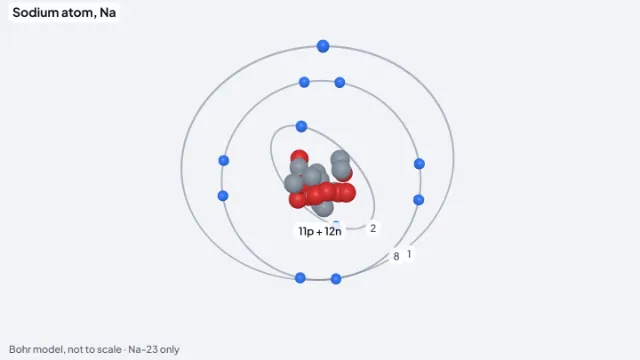
Electrons fill the lowest available energy level first: at most 2 in the first shell, then 8 in the second and, up to calcium, 8 in the third. So sodium is 2,8,1. Count occupied shells for the period and outer electrons for the group.

Loading simulation…

Symbols match your course. Open the full electron shells in 3d (atoms and ions up to calcium) simulation for more presets and teacher tools.

Where this sits in AQA chemistry

How do electrons fill the shells?

Electrons occupy the lowest energy level available, which is the shell nearest the nucleus. Only when that shell is full does the next one start. For the twenty elements AQA expects you to know:

Shell (energy level)Most electrons it takes up to calciumFirst element to use it
1st (lowest energy)2Hydrogen
2nd8Lithium
3rd8Sodium
4th2 (calcium is the last one you need)Potassium

A neutral atom's electron count matches its proton count, which is its atomic number. So the recipe is short: find the atomic number on the periodic table, then pour that many electrons in, 2 first, then up to 8, then up to 8 again.

What are the electronic structures of the first 20 elements?

ElementAtomic numberElectronic structure
H11
He22
Li32,1
Be42,2
B52,3
C62,4
N72,5
O82,6
F92,7
Ne102,8
Na112,8,1
Mg122,8,2
Al132,8,3
Si142,8,4
P152,8,5
S162,8,6
Cl172,8,7
Ar182,8,8
K192,8,8,1
Ca202,8,8,2

Commas separate the shells, listed from the nucleus outwards. Keep the commas: run together as 281, sodium's structure looks like a single number.

How do you draw the diagram version?

Draw a small circle or dot for the nucleus, labelled with the symbol, and one ring for each occupied shell. Put the electrons on the rings as dots or crosses, keeping the count for each ring equal to the matching number. Spacing the outer electrons in pairs makes them easy to count. Aluminium, 2,8,3, needs three rings: 2 electrons on the inner ring, 8 on the middle and 3 on the outer. Examiners check the count on each ring, not how neatly it is drawn.

Two facts come straight off the electronic structure:

  • The number of occupied shells tells you the period. Chlorine, 2,8,7, has electrons in three shells, which places it in Period 3.
  • The number of outer electrons tells you the group for Groups 1 to 7. Chlorine has 7, so it is in Group 7.

Group 0 is different. Its elements have a full outer shell: 8 for neon and argon, but only 2 for helium, because helium's single shell is full with 2. A full outer shell is why the noble gases hardly react. Elements in one group share the same number of outer electrons, which is why they react in similar ways; how ions form shows how that number fixes the charge on an ion.

Worked example: from atomic number to group and period

Question: Calcium has atomic number 20. Give its electronic structure and use it to find calcium's group and period.

  1. A neutral calcium atom has 20 electrons.
  2. First shell: 2 (18 left). Second shell: 8 (10 left). Third shell: 8 (2 left). Fourth shell: 2.
  3. Electronic structure: 2,8,8,2.
  4. Four occupied shells, so Period 4. Two outer electrons, so Group 2.

Working backwards: an element is 2,8,5. Adding up gives 15 electrons, so the atomic number is 15: phosphorus, in Group 5 and Period 3.

Why does the third shell stop at 8?

Strictly, the third shell has room for up to 18 electrons. After argon, though, the fourth shell is lower in energy than the rest of the third, so potassium and calcium put their last electrons there. The rest of the third shell fills from scandium onwards, which is why AQA stops at calcium. You will not be asked about this, but it explains why the "2, 8, 8" pattern is not a rule for every element.

Try it in the 3D simulation

Using the 3D atom builder, step through the atomic numbers with the slider or the arrow buttons. Watch which number in the Electron arrangement card grows, and notice a new ring appear at lithium, sodium and potassium. Turn on the flat-shells option and press Front to see the atom the way you draw it in an exam, then compare the Group and Period cards with your own prediction from the numbers. The model is not to scale: a real nucleus is far smaller than the one drawn. Shells are a model too: real electrons do not travel round fixed circular paths, and each ring stands for an energy level.
Common mistakes

  • Putting 8 electrons in the first shell. The first shell is full with 2, so lithium is 2,1, not 3.
  • Writing potassium as 2,8,9. For the elements AQA uses, the third shell takes 8 and the fourth shell then starts, so potassium is 2,8,8,1.
  • Counting the electronic structure from the outside in. List the shells from the nucleus outwards, so the last number is always the outer shell.
  • Using the mass number for the number of electrons. A neutral atom has as many electrons as protons, so use the atomic number.
  • Saying helium belongs in Group 2 because it has 2 outer electrons. Its only shell is full, so it is a noble gas in Group 0.
  • Drawing the right number of rings but the wrong number of electrons on one of them. Check each ring against its number in the electronic structure.

Exam practice

Exam-style questions

Original questions written in the style of GCSE AQA Chemistry. Try each one before you reveal the answer.

  1. 1.Magnesium has atomic number 12 and sulfur has atomic number 16.

    1. (a)Give the electronic structure of a magnesium atom.

      1 mark
      Show the answer

      Answer: 2,8,2

      Marking points

      • 2,8,2
    2. (b)Draw a diagram to show the electronic structure of a sulfur atom.

      2 marks
      Show the answer

      Answer: A nucleus with three shells around it: 2 electrons on the first shell, 8 on the second and 6 on the third.

      Marking points

      • Three shells drawn around a nucleus
      • 2, 8 and 6 electrons on the first, second and third shells
    3. (c)Explain, using their electronic structures, why magnesium and sulfur are in the same period.

      2 marks
      Show the answer

      Answer: Both atoms have electrons in three shells (energy levels). Period number equals the count of occupied shells, so both sit in Period 3.

      Marking points

      • Both have three occupied shells / energy levels
      • Period number = count of occupied shells (Period 3)
  2. 2.An atom of element X has the electronic structure 2,8,7.

    1. (a)Give the atomic number of element X.

      1 mark
      Show the answer

      Answer: 17 (2 + 8 + 7 electrons, and a neutral atom has as many protons as electrons).

      Marking points

      • 17
    2. (b)State the group of the periodic table that element X is in. Say how you can tell.

      2 marks
      Show the answer

      Answer: Group 7, because an atom of X has 7 electrons in its outer shell.

      Marking points

      • Group 7
      • It has 7 electrons in its outer shell
    3. (c)Element Y is in the same group as X, one period below it. How many outer-shell electrons does an atom of Y have?

      1 mark
      Show the answer

      Answer: 7. Elements in the same group have the same number of outer electrons.

      Marking points

      • 7
  3. 3.A student writes: 'The electronic structure of a potassium atom is 2,8,9, because the third shell can hold more than 8 electrons.' Potassium has atomic number 19.

    1. (a)Give the correct electronic structure of a potassium atom.

      1 mark
      Show the answer

      Answer: 2,8,8,1

      Marking points

      • 2,8,8,1
    2. (b)Use the correct electronic structure to give the group and the period of potassium.

      2 marks
      Show the answer

      Answer: Group 1, because it has one outer electron. Period 4, because it has four occupied shells.

      Marking points

      • Group 1 (one electron in the outer shell)
      • Period 4 (four occupied shells)
    3. (c)Explain why argon, 2,8,8, is very unreactive.

      2 marks
      Show the answer

      Answer: Argon's outer shell is full (8 electrons). So it has no tendency to lose, gain or share electrons, and it hardly reacts.

      Marking points

      • Its outer shell is full / it has a stable arrangement of 8 outer electrons
      • So it does not easily lose, gain or share electrons

Quiz

Quick check

6 questions

  1. 1.What is the electronic structure of a nitrogen atom (atomic number 7)?
  2. 2.Which electronic structure belongs to an element in Group 2?
  3. 3.An element has the electronic structure 2,8,8,2. How many occupied shells does it have, and which period is it in?
  4. 4.Why are the electrons in a sodium atom arranged 2,8,1 rather than 1,8,2?
  5. 5.Which element has the same number of outer electrons as oxygen, 2,6?
  6. 6.Helium has the electronic structure 2. Why is it placed in Group 0?

Related articles

Next step

Now see it move

Open the full electron shells in 3d (atoms and ions up to calcium) simulation for every preset, graphs and the teacher tools, then test yourself.

Electron shells in 3D simulation: a 3D Bohr model of the first 20 elements3D