Where this sits in AQA chemistry
How is the modern periodic table arranged?
Elements are lined up in order of atomic number (proton number), starting with hydrogen at 1. The table is then cut into rows so that elements with similar properties land in the same column:
- A group is a column. Elements in a group react in similar ways.
- A period is a row. Moving along a period, the properties change step by step.
It is called periodic because similar properties keep coming back at regular intervals as the atomic number rises. Lithium (3), sodium (11) and potassium (19) are all soft, reactive metals, and each starts a new row.
Why do elements in a group behave alike?
Chemical reactions involve the outer electrons, and every element in one group carries an identical count of outer-shell electrons. That is the link between position and atomic structure:
| Atomic number | Electronic structure | Outer electrons, so group | Occupied shells, so period |
|---|---|---|---|
| 9 (fluorine) | 2,7 | 7, Group 7 | 2, Period 2 |
| 12 (magnesium) | 2,8,2 | 2, Group 2 | 3, Period 3 |
| 17 (chlorine) | 2,8,7 | 7, Group 7 | 3, Period 3 |
| 19 (potassium) | 2,8,8,1 | 1, Group 1 | 4, Period 4 |
Fluorine and chlorine share a column because both have 7 outer electrons, and that is why both form 1− ions and react in similar ways. So the chain of reasoning runs: atomic number → number of electrons → electronic structure → group and period. The filling rules are on the electronic structure page. Group 0 is the exception to "outer electrons = group number": its elements have full outer shells.
How can you predict reactions from the table?
Because a group shares its chemistry, you can predict how an element you have never met will behave from its neighbours:
- Rubidium sits below potassium in Group 1. Potassium reacts with water to give potassium hydroxide and hydrogen, so rubidium should give rubidium hydroxide and hydrogen, and, as reactivity rises down Group 1, it should react even more violently.
- Astatine sits below iodine in Group 7. Reactivity falls down that group, so astatine should be the least reactive halogen and, following the colour trend, a dark solid.
These predictions come from trends, not from memorising every element, which is exactly what the exam rewards. The details are on the Group 1 and Group 7 pages.
How was the periodic table developed?
In the early and middle 1800s, nobody knew about protons, neutrons or electrons, so chemists sorted the elements by atomic weight (the old name for relative atomic mass). Those first attempts had two problems:
- They were incomplete. Many elements had not yet been discovered, so a list with no spaces pushed elements into the wrong places.
- Strict weight order put some elements in the wrong group, next to elements whose chemistry was nothing like theirs.
Dmitri Mendeleev (1869) solved both problems with two bold choices:
- He left gaps where he believed an undiscovered element belonged, so that the known elements could sit in groups with similar properties.
- He swapped the order of a few pairs when their properties demanded it. Tellurium has a higher atomic weight than iodine, yet he put tellurium first, so that iodine could sit with chlorine and bromine, which it resembles.
Why did Mendeleev's predictions matter?
Mendeleev used the gaps to forecast the properties of the missing elements. For the gap below silicon he predicted an element with an atomic weight of about 72 and a density of about 5.5 g/cm³. When germanium was discovered in 1886, its atomic weight was 72.6 and its density 5.3 g/cm³. Gallium (1875) and scandium (1879) also fitted gaps he had left. A theory that makes predictions which are later confirmed by experiment gains a lot of support, and this is the key "how science works" point here.
The noble gases, found in the 1890s, were not in his table at all, yet they slotted in neatly as a whole new group: further evidence that the arrangement was sound.
Why was atomic weight order sometimes wrong?
Isotopes explain it. Relative atomic mass is an average that depends on the mix of isotopes, while position depends on the number of protons. Two pairs show this:
| Pair | Atomic numbers | Relative atomic masses | Why the masses are "out of order" |
|---|---|---|---|
| Argon, then potassium | 18, then 19 | 40, then 39 | Nearly all argon atoms are argon-40, while most potassium atoms are potassium-39 |
| Tellurium, then iodine | 52, then 53 | 127.6, then 126.9 | Tellurium has a large share of heavy isotopes; iodine has only iodine-127 |
Ordering by atomic number puts every element in the right group without any swaps, which is why the modern table uses it. To see how protons and isotopes were discovered, read the development of the atomic model.
Worked example: from atomic number to a prediction
Question: Element Q has atomic number 15. Which group and period is it in, and which element in Period 2 should it most resemble?
- 15 electrons fill as 2, then 8, then 5: 2,8,5.
- Three occupied shells, so Period 3. Five outer electrons, so Group 5.
- The Period 2 element in Group 5 has 2,5: nitrogen (atomic number 7). Q (phosphorus) should share some of nitrogen's chemistry, for example both are non-metals.
Explore the table in 3D
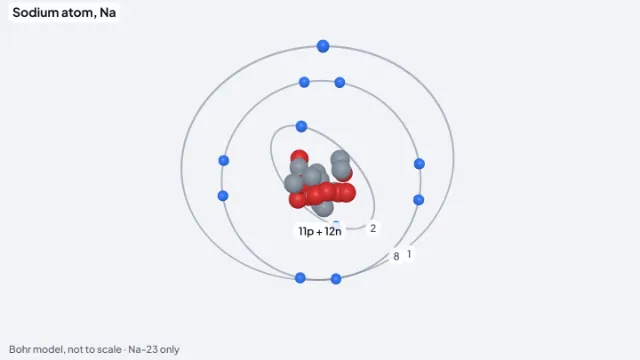
The 3D electron shells simulation includes The first 20 elements table: tap any element to build its atom, and the group (column) and period (row) are shaded. Compare the Group and Period cards with the Electron arrangement card, and read the rule in Shells and the periodic table. Use the Quick picks or step through with the Atomic number slider, and watch a new shell appear each time a new period starts at lithium, sodium and potassium. A longer walk through the first 20 arrangements is in this step-by-step guide.