Where this sits in AQA chemistry
Which elements are in Group 0?
Six naturally occurring elements make up the right-hand column, the noble gases, from helium at the top down through neon, argon, krypton and xenon to radon. All six are colourless gases at room temperature, and all of them exist as single atoms. Compare that with oxygen, nitrogen and chlorine, which go around in pairs (O₂, N₂, Cl₂).
Why are the noble gases unreactive?
Look at their electronic structures:
| Element | Shells used | Arrangement | Is the outer shell full? |
|---|---|---|---|
| Helium | 1 | 2 | Yes: 2 is the most the first shell takes |
| Neon | 2 | 2,8 | Yes: the second shell has its 8 |
| Argon | 3 | 2,8,8 | Yes: 8 in the third shell is stable |
Every noble gas atom has a full outer shell. That is a stable arrangement, so the atoms are not driven to give away, take in or share electrons. Since reactions are all about electrons being lost, gained or shared, the noble gases hardly react at all, and they do not even bond to each other to make molecules.
Helium is the exception to the "eight outer electrons" rule. It has only one shell, and that shell is full with 2. It still belongs in Group 0 because a full outer shell, not the number 8, is what the group has in common.
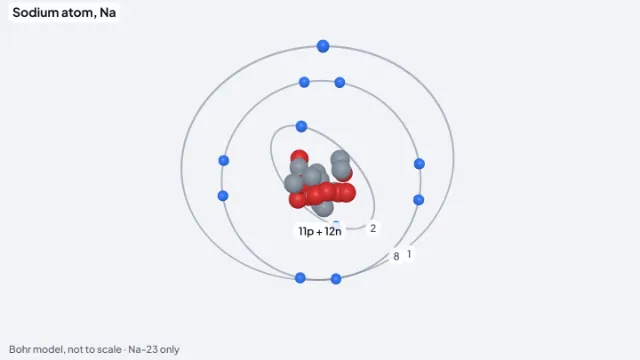
This group is also the target the other elements aim at. When sodium loses an electron, Na⁺ is left with 2,8, the same arrangement as neon; when chlorine gains one, Cl⁻ has 2,8,8, the same as argon. The ionic bonding page builds on this.
Beyond the specification: a few compounds of xenon have been made, for example with fluorine, under special conditions. GCSE answers treat the noble gases as unreactive.
How do boiling points change down Group 0?
| Noble gas | Relative atomic mass | Boiling point / °C |
|---|---|---|
| Helium | 4 | −269 |
| Neon | 20 | −246 |
| Argon | 40 | −186 |
| Krypton | 84 | −153 |
| Xenon | 131 | −108 |
| Radon | 222 | −62 |
The pattern: boiling point increases as relative atomic mass increases, which means going down the group. Helium boils only about 4 degrees above absolute zero. Radon boils over 200 degrees higher, at −62 °C, though it is still a gas at room temperature.
Why? Boiling separates the atoms from each other, so it only has to overcome the weak forces between atoms. Bigger, heavier atoms with more electrons attract each other more strongly, so more energy is needed to pull them apart. No bonds inside the substance are broken, because there are none.
Worked example: predicting from a trend
Question: A data book gives the boiling points of argon (−186 °C) and xenon (−108 °C) but leaves out krypton, which is between them in the group. Estimate krypton's boiling point.
- Krypton is between argon and xenon, so its boiling point should lie between −186 °C and −108 °C.
- The midpoint is (−186 + −108) ÷ 2 = −147 °C.
- A sensible estimate is about −150 °C. The measured value is −153 °C, so the estimate is close.
Exam mark schemes accept a range for estimates like this, as long as the value fits the trend. An answer outside the two neighbours, or one that makes krypton boil lower than argon, would lose the mark.
What are the noble gases used for?
Their lack of reactivity makes them useful, though the specification does not ask you to learn the uses:
- Helium fills balloons and airships. It is much less dense than air and, unlike hydrogen, it does not burn.
- Argon surrounds the hot filament in old-style light bulbs and shields metal during welding: it stops the hot metal reacting with oxygen.
- Neon glows red-orange when electricity passes through it, which gave neon signs their name.
See the full shells in 3D
In the 3D electron shells simulation, pick helium, neon and argon from The first 20 elements. The Group card reads Group 0 with a note about the full outer shell. Press Make ion for any of them: instead of an ion, the simulation explains that a full outer shell means the atom forms no simple ion. Now pick sodium and chlorine and press Make ion again; the Ion panel names the noble gas whose arrangement each ion now matches. More on shells is in the electronic structure notes, and the rest of the table is on the periodic table page.