Chemistry11 min read
How Atoms Form Ions: Charges From the Group, Ion Electron Configurations and Formulae
Learn why metal atoms lose electrons and non-metal atoms gain them, how to predict an ion's charge from the periodic table, how to write the electron configuration of an ion, why carbon and the noble gases form no simple ions, and how to write ionic formulae, with worked examples.
Published
On this page
- Why do atoms lose or gain electrons?
- How does the group number predict an ion's charge?
- How do you write the electron configuration of an ion?
- Why don't the noble gases form ions?
- Why don't carbon and silicon form simple ions?
- What about hydrogen and the transition metals?
- How do ions combine to make a formula?
- What does an ionic dot-and-cross diagram show?
- Common mistakes
- Quick answers
- Key points
In short
An ion is an atom (or group of atoms) that carries an electric charge because it has lost or gained electrons. Metal atoms lose their outer electrons and become positive ions. Non-metal atoms gain electrons and become negative ions. In both cases the atom ends up with a full outer shell, the same electron configuration as a noble gas.
The charge comes straight from the group. Sodium, in Group 1, loses one electron to form Na⁺. Magnesium, in Group 2, loses two to form Mg²⁺. Oxygen, in Group 6, gains two to form O²⁻, and chlorine, in Group 7, gains one to form Cl⁻. Because the nucleus stays exactly as it was, an ion's charge is always its protons minus its electrons.
Why do atoms lose or gain electrons?
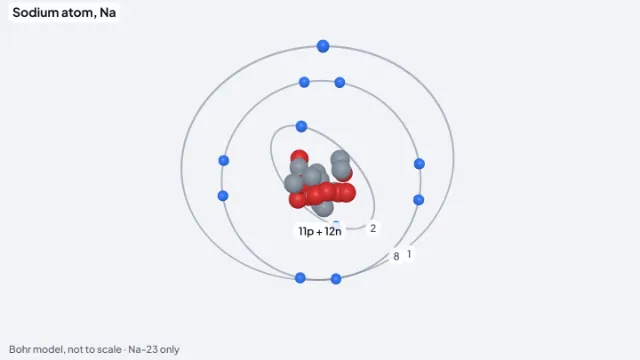
Atoms with a complete outer shell, like neon and argon, are very stable: they hardly react at all. Other atoms can reach that same stable arrangement in one of two ways when they react with a different element. They can share electrons (covalent bonding), or they can hand electrons over completely (ionic bonding).
Whether an atom gives electrons away or takes them in depends on which route is shorter:
- Sodium, 2,8,1, is one electron past a full shell. Losing that single electron is far easier than finding seven more, so sodium loses it and is left with the full shell underneath: 2,8.
- Chlorine, 2,8,7, is one electron short of a full shell. Gaining one electron completes it: 2,8,8.
When sodium burns in chlorine, both happen at once. Each sodium atom passes its outer electron to a chlorine atom. Nothing is created or lost: the electron simply moves. The new positive and negative ions then attract each other strongly, and that attraction is the ionic bond. The Punjab book also calls it an electrovalent bond.
If you need a reminder of how to write configurations like 2,8,1, start with electron configuration of the first 20 elements.
How does the group number predict an ion's charge?
For the main groups, the group number tells you how many outer electrons an atom has, and so how many it must lose or gain.
| Group (AQA / 1 to 18) | Outer electrons | What the atom does | Ion charge | Examples |
|---|---|---|---|---|
| 1 / 1 | 1 | gives up 1 | 1+ | K⁺, Na⁺, Li⁺ |
| 2 / 2 | 2 | gives up 2 | 2+ | Mg²⁺, Ca²⁺ |
| 3 / 13 | 3 | gives up 3 | 3+ | Al³⁺ |
| 4 / 14 | 4 | usually shares instead | no simple ion for C or Si | none |
| 5 / 15 | 5 | gains 3 | 3− | N³⁻ (nitride) |
| 6 / 16 | 6 | gains 2 | 2− | O²⁻ (oxide), S²⁻ (sulfide) |
| 7 / 17 | 7 | gains 1 | 1− | F⁻, Cl⁻, Br⁻, I⁻ |
| 0 / 18 | full shell | neither | none | none |
Cambridge numbers the same columns with Roman numerals, I to VIII.
A quick way to remember it: metals on the left lose a number of electrons equal to their group, and non-metals on the right gain (8 − group number). So Group 6 gains 8 − 6 = 2.
Negative ions made from a single non-metal atom take the ending -ide: chloride, oxide, sulfide, nitride. Positive metal ions keep the metal's name: a sodium ion is still called sodium.
Worked example 1: a magnesium ion
Magnesium has atomic number 12. Work out its ion's charge and electron configuration.
Atom: 12 electrons, arranged as 2,8,2
Group: 2 outer electrons, so Group 2, a metal
Change: it loses its 2 outer electrons, leaving 10
Charge: 12 protons − 10 electrons = +2
Answer: Mg²⁺. Its configuration, [2,8]²⁺, matches neon's
How do you write the electron configuration of an ion?
Start from the atom, then remove or add electrons in the outer shell only:
- Write the configuration of the neutral atom.
- For a metal, take away its outer electrons. The shell beneath becomes the new outer shell.
- For a non-metal, add electrons to the outer shell until it holds 8.
- Put square brackets round the numbers and write the charge outside, at the top right.
| Ion | Electron configuration | Matches the noble gas | Electrons |
|---|---|---|---|
| N³⁻ | [2,8]³⁻ | neon | 10 (7 protons) |
| O²⁻ | [2,8]²⁻ | neon | 10 (8 protons) |
| F⁻ | [2,8]⁻ | neon | 10 (9 protons) |
| Na⁺ | [2,8]⁺ | neon | 10 (11 protons) |
| Mg²⁺ | [2,8]²⁺ | neon | 10 (12 protons) |
| Al³⁺ | [2,8]³⁺ | neon | 10 (13 protons) |
| S²⁻ | [2,8,8]²⁻ | argon | 18 (16 protons) |
| Cl⁻ | [2,8,8]⁻ | argon | 18 (17 protons) |
| K⁺ | [2,8,8]⁺ | argon | 18 (19 protons) |
| Ca²⁺ | [2,8,8]²⁺ | argon | 18 (20 protons) |
| Li⁺ | [2]⁺ | helium | 2 (3 protons) |
Read down the last column: six quite different ions each hold exactly 10 electrons, just like neon. What tells them apart is the nucleus. Al³⁺ has 13 protons pulling on its 10 electrons, so it is small. N³⁻ has only 7, so its electrons spread out and it is much larger.
Worked example 2: a sulfide ion
Sulfur has atomic number 16. Give the formula and configuration of its ion, and count its particles.
Atom: 16 electrons, arranged as 2,8,6
Change: a non-metal in Group 6 gains 2 electrons, filling its third shell to 8
Electrons: 16 + 2 = 18
Charge: 16 protons − 18 electrons = −2
Answer: S²⁻, written [2,8,8]²⁻, which matches argon's arrangement. It still has 16 protons, because gaining electrons does not touch the nucleus.
The electron shells in 3D simulation lets you watch this happen. Pick an element and press Make ion: sodium's lone outer electron drifts away, while chlorine pulls one in. Read the charge and the ion's configuration from the cards, then try magnesium, oxygen and aluminium.
Why don't the noble gases form ions?
The noble gases already have full outer shells, so there is nothing for them to gain by losing or gaining electrons:
- Losing an electron would mean pulling it out of a complete shell, where it is held very tightly. In each period, the noble gas is the element whose outermost electron takes the most energy to remove.
- Gaining an electron would mean starting a brand-new shell further out, where the extra electron is barely attracted at all.
So neon, argon and the others stay as single, uncharged atoms. In special lab conditions, xenon can be made to combine with fluorine, but that chemistry is well beyond GCSE, and no noble gas forms a simple ion in the reactions you study.
Why don't carbon and silicon form simple ions?
Carbon (2,4) and silicon (2,8,4) sit exactly halfway to a full shell. Losing four electrons or gaining four would each take a very large amount of energy, so these atoms share electrons instead and form covalent bonds. That is why diamond and silicon dioxide are covalent, not ionic. Further down the same group, tin and lead are metals and do form positive ions, such as Pb²⁺.
To see how sharing works, read covalent bonding and dot-and-cross diagrams.
What about hydrogen and the transition metals?
Hydrogen has one electron. Losing it leaves just a proton, the hydrogen ion H⁺, which matters a great deal in acids. With very reactive metals, hydrogen can instead gain an electron to form the hydride ion, H⁻, which has the same configuration as helium. The Punjab book mentions both.
Transition metals such as iron and copper often form more than one ion, for example Fe²⁺ and Fe³⁺. Their charge cannot be read from a group number, so the name shows it in Roman numerals: iron(II) for Fe²⁺ and iron(III) for Fe³⁺. Cambridge uses these names throughout.
How do ions combine to make a formula?
An ionic compound has no overall charge, so the positive and negative charges must cancel. Pick the smallest whole numbers of each ion that make the total zero.
Worked example 3: aluminium oxide
Aluminium oxide is the hard, white coating that protects aluminium window frames. Write its formula.
Ions: aluminium is in Group 3, so Al³⁺. Oxygen is in Group 6, so O²⁻
Balance the charges: the smallest number both 3 and 2 go into is 6
Positive side: 2 × (+3) = +6, so 2 aluminium ions
Negative side: 3 × (−2) = −6, so 3 oxide ions
Answer: Al₂O₃
Check: +6 − 6 = 0
Worked example 4: magnesium nitride
Magnesium burns in air with a dazzling white flame and makes a little magnesium nitride alongside the oxide. Write its formula.
Ions: Mg²⁺ and N³⁻
Balance: 3 × (+2) = +6 and 2 × (−3) = −6
Answer: Mg₃N₂
What does an ionic dot-and-cross diagram show?
A dot-and-cross diagram shows where every outer electron ends up. Draw the metal's electrons as crosses and the non-metal's as dots (or the other way round), so the moved electrons stand out.
For sodium chloride, draw the sodium ion inside square brackets marked +, either showing no outer electrons or showing the complete second shell as 8 crosses. Draw the chloride ion with 8 electrons in its outer shell, 7 dots and 1 cross, in square brackets marked −. The single cross on the chloride is the electron that came from sodium.
For calcium chloride, CaCl₂, a calcium atom hands its two outer electrons to two different chlorine atoms, one each. You draw one [Ca]²⁺ and two separate [Cl]⁻ ions, each chloride holding one cross. For magnesium oxide, MgO, both of magnesium's outer electrons go to a single oxygen atom, which ends with 6 dots and 2 crosses.
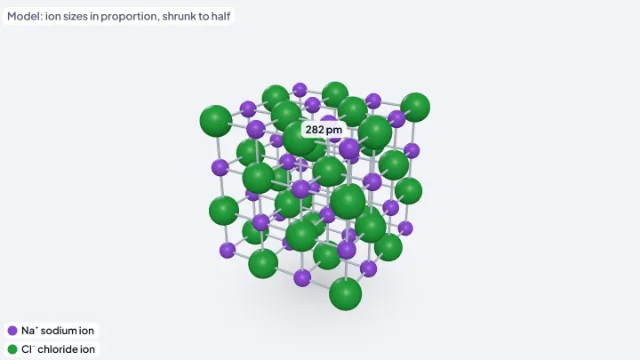
The diagram only shows one set of ions. In a real crystal, millions of ions pack together in a giant ionic lattice. You can rotate one in the giant structures in 3D simulation, where each sodium ion sits among 6 chloride ions.
Common mistakes
- Changing the protons. Making an ion moves electrons only. A chloride ion still has 17 protons.
- Getting the sign backwards. Losing negative electrons leaves a positive ion. Gaining them makes a negative one.
- Writing the atom's configuration for the ion. Na⁺ is [2,8]⁺, not 2,8,1.
- Calling Cl⁻ "chlorine". As an ion it is chloride. Chlorine is the element, Cl₂.
- Giving carbon a 4+ or 4− ion. Carbon shares electrons and forms no simple ion at this level.
- Forgetting brackets and charges on dot-and-cross diagrams for ionic compounds.
- Writing MgCl. Mg²⁺ needs two Cl⁻ ions, so magnesium chloride is MgCl₂.
Quick answers
Do metals gain or lose electrons?
Metals lose electrons. Their atoms have only a few outer electrons, so giving them away is the easiest route to a full shell, and they become positive ions.
Why is a chloride ion bigger than a chlorine atom?
The ion has one more electron but the same 17 protons. The electrons repel each other a little more and the nucleus pulls on each one slightly less, so the outer shell spreads out.
Is an ion with 10 electrons always neon?
No. An ion is never a different element. Na⁺, Mg²⁺ and O²⁻ all have 10 electrons, the same arrangement as neon, but their numbers of protons are 11, 12 and 8, so they are still sodium, magnesium and oxygen.
Key points
- Ions form when atoms lose or gain electrons. Metals form positive ions and non-metals form negative ions.
- Charge = protons − electrons, and only the electrons ever change.
- Groups 1, 2 and 3 give 1+, 2+ and 3+ ions. Groups 5, 6 and 7 give 3−, 2− and 1− ions.
- Simple ions of the first 20 elements have the electron configuration of a noble gas, such as [2,8]⁺ for sodium.
- Noble gases, carbon and silicon form no simple ions.
- In an ionic formula, the charges add up to zero: Al₂O₃, MgCl₂, Mg₃N₂.