Chemistry9 min read
Ionic, Covalent and Metallic Bonding Compared: Structures, Melting Points and Conductivity
Compare the three types of bonding and the four structures they make (giant ionic, simple molecular, giant covalent and metallic), with a comparison table, real melting points, a worked example that identifies an unknown solid, and the mistakes that cost marks.
Published
On this page
- Which elements form ionic, covalent and metallic bonds?
- How do ionic, covalent and metallic bonds differ?
- What structures do the three types of bonding make?
- Why do some substances have high melting points and others low?
- When does each type of substance conduct electricity?
- Why are metals malleable while ionic crystals shatter?
- Common mistakes
- Quick answers
- Key points
In short
There are three types of strong chemical bond, and the elements involved tell you which one forms. Ionic bonding happens between a metal and a non-metal: electrons move from the metal to the non-metal, and the oppositely charged ions attract. Covalent bonding happens between non-metals: atoms share pairs of electrons. Metallic bonding holds a metal together: positive metal ions sit in a sea of delocalised electrons that they all attract.
Those bonds build four kinds of structure, and the structure decides the properties. Giant ionic lattices and giant covalent networks have very high melting points. Simple molecular substances melt and boil at low temperatures. Metals conduct electricity as solids, ionic compounds only when melted or dissolved, and most covalent substances not at all.
Which elements form ionic, covalent and metallic bonds?
A quick look at the periodic table usually answers this:
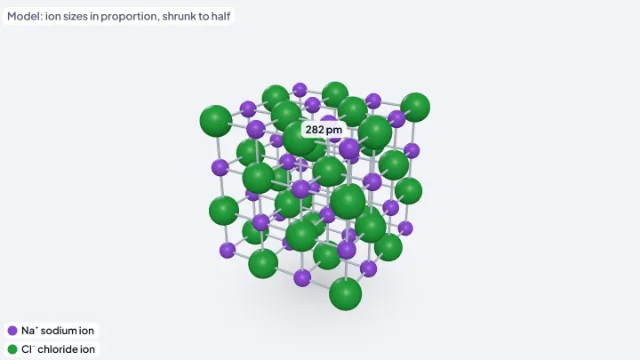
- Metal + non-metal → ionic. Sodium chloride, NaCl; magnesium oxide, MgO; calcium chloride, CaCl₂.
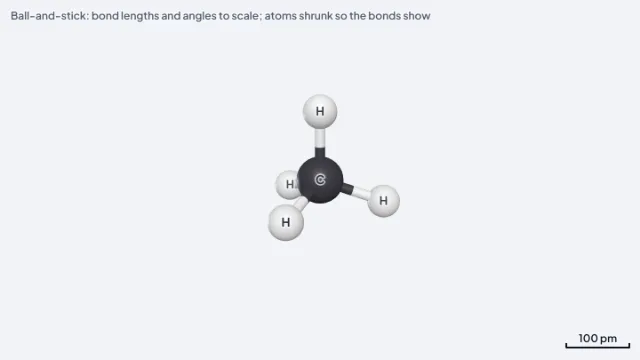
- Non-metal + non-metal → covalent. Water, H₂O; carbon dioxide, CO₂; methane, CH₄; and diamond, which is carbon bonded to carbon.
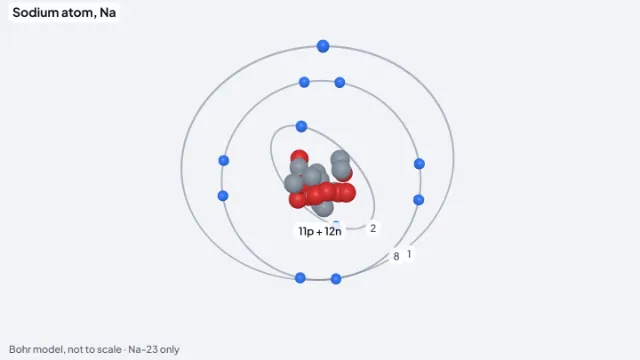
- Metal on its own (or mixed with other metals) → metallic. Copper, iron, aluminium and alloys such as brass.
In every case the atoms end up more stable than they started, usually with full outer shells. Ion charges and ionic formulae have their own guide, and shared pairs are drawn step by step in our dot-and-cross walkthrough.
How do ionic, covalent and metallic bonds differ?
Each bond is an electrostatic attraction, but between different particles:
- Ionic bond: attraction between positive and negative ions. It acts in all directions, so each ion attracts every oppositely charged neighbour around it.
- Covalent bond: attraction of two nuclei for a shared pair of electrons between them. It acts along a fixed line between two particular atoms.
- Metallic bond: attraction between positive metal ions and delocalised electrons. The electrons belong to no particular atom, so the bonding is spread through the whole metal.
All three are strong. The big differences in properties come from the structure each one builds, and from whether there are weak forces anywhere in that structure.
What structures do the three types of bonding make?
| Property | Giant ionic | Simple molecular | Giant covalent | Metallic |
|---|---|---|---|---|
| Elements | metal + non-metal | non-metals | non-metals (C, Si) | metals |
| Particles | positive and negative ions | small molecules | atoms | positive ions and delocalised electrons |
| What must be overcome to melt it | strong attraction between ions | weak forces between molecules | strong covalent bonds | strong metallic bonds |
| Melting point | high | low | very high | usually high |
| Conducts as a solid? | no | no | no (graphite is the exception) | yes |
| Conducts when molten? | yes | no | no | yes |
| Conducts dissolved in water? | yes, if it dissolves | usually no | does not dissolve | does not dissolve (some react) |
| Examples | NaCl, MgO, CaCl₂ | H₂O, CO₂, CH₄, Cl₂ | diamond, graphite, SiO₂ | Cu, Fe, Al, Mg |
AQA also lists polymers as covalent substances with very large molecules. Their intermolecular forces are stronger than those in small molecules, so they are solids at room temperature.
Why do some substances have high melting points and others low?
Melting means letting the particles move past each other. How much energy that takes depends on what holds the particles in place.
- In a giant ionic lattice, each ion is held by the pull of all the oppositely charged ions surrounding it. Melting means overcoming a huge number of strong attractions, so the temperature must be high.
- In a giant covalent structure, melting means breaking covalent bonds, millions of them. The melting points are very high, though not always the highest: magnesium oxide, an ionic compound with doubly charged ions, melts higher than silicon dioxide.
- In a metal, the ions must be moved against the pull of the electron sea. Most metals melt at high temperatures, though there is a wide spread.
- In a simple molecular substance, the covalent bonds inside each molecule never break when it melts or boils. Only the weak forces between molecules are overcome, so little energy is needed.
| Substance | Structure | Melting point (°C) |
|---|---|---|
| Methane, CH₄ | simple molecular | −182 |
| Chlorine, Cl₂ | simple molecular | −101 |
| Water, H₂O | simple molecular | 0 |
| Sodium, Na | metallic | 98 |
| Aluminium, Al | metallic | 660 |
| Sodium chloride, NaCl | giant ionic | 801 |
| Copper, Cu | metallic | 1085 |
| Iron, Fe | metallic | 1538 |
| Silicon dioxide, SiO₂ | giant covalent | about 1700 |
| Magnesium oxide, MgO | giant ionic | about 2850 |
Two details are worth knowing. Magnesium oxide melts far higher than sodium chloride because its ions carry double charges, Mg²⁺ and O²⁻, so they attract each other much more strongly than Na⁺ and Cl⁻. And among simple molecules, bigger molecules have stronger forces between them: in Group 7, fluorine and chlorine are gases, bromine is a liquid and iodine is a solid at room temperature.
Water melts and boils far higher than its tiny size suggests. Its molecules attract each other through hydrogen bonds, an unusually strong type of intermolecular force that the Punjab book covers in its bonding chapter.
When does each type of substance conduct electricity?
To conduct, a substance must contain charged particles that are free to move. Ask two questions: are there charged particles, and are they free to move?
- Ionic compounds: the ions are charged, but in the solid each one is locked in the lattice and can only vibrate. Melting it, or making a solution of it, lets those ions drift through the liquid, and that moving charge is a current. This is why molten and dissolved salts can be electrolysed.
- Metals: the delocalised electrons already move freely through the solid, so metals conduct as solids and as liquids.
- Simple molecular substances: the molecules have no overall charge and no electrons are free, so they do not conduct in any state.
- Giant covalent substances: usually no free electrons and no ions, so no conduction. Graphite is the exception: one electron from each atom is delocalised. See diamond vs graphite.
The giant structures in 3D simulation lets you test this. Apply a p.d. to solid sodium chloride and nothing drifts; press Molten and the ions start to move, positive one way and negative the other. Switch to Metal and the electrons drift while the ions stay put. Compare these with the separate molecules in the covalent molecules in 3D simulation, where nothing charged is free at all.
Why are metals malleable while ionic crystals shatter?
In a pure metal the ions sit in neat layers. Push hard and the layers slide over each other, but the electron sea moves with them, so the bonding is never broken. The metal bends and stays in one piece: it is malleable (can be hammered into shape) and ductile (can be drawn into wires).
An ionic crystal behaves very differently. Hit it hard enough to shift one layer by a single ion, and positive ions suddenly line up beside positive ions, and negative beside negative. They repel, and the crystal splits apart. So ionic solids are hard but brittle.
Mixing in atoms of a different size (another metal, or carbon in steel) turns a pure metal into an alloy. The odd-sized atoms distort the layers and make it harder for them to slide, so alloys such as steel and brass are harder than the pure metals they contain.
Worked example: identify the structure from data
A student tests four solids. Decide the type of structure for each.
| Solid | Melting point (°C) | Conducts as solid? | Conducts when molten? |
|---|---|---|---|
| A | 1420 | no | yes |
| B | −95 | no | no |
| C | above 3000 | no | no |
| D | 650 | yes | yes |
A: high melting point and conducts only when molten, so its charged particles are fixed in the solid and freed by melting. Giant ionic.
B: melts far below room temperature and never conducts, so only weak forces hold its particles together and there is nothing charged to move. Simple molecular.
C: extremely high melting point and no conduction at all, so strong covalent bonds run through the whole structure. Giant covalent.
D: conducts as a solid and as a liquid, so it has delocalised electrons. Metallic.
The order of checks that works every time: conducts as a solid? Then metal (or graphite). If not, conducts when molten? Then ionic. If not, look at the melting point: low means simple molecular, very high means giant covalent.
Common mistakes
- "Ionic compounds conduct when solid." The ions are present but fixed. They conduct only when molten or in solution.
- "Boiling water breaks the O–H bonds." Steam is still H₂O. Boiling overcomes the forces between molecules.
- Writing about "molecules of sodium chloride". Salt has no molecules: NaCl just records a 1 : 1 ratio of ions in the lattice.
- Crediting the metal ions with the current. They stay in place and vibrate; it is the delocalised electrons that carry the charge.
- Calling every covalent substance low-melting. Diamond and silicon dioxide are covalent and melt at very high temperatures.
- Explaining graphite's conductivity with ions. It contains no ions; its delocalised electrons carry the charge.
- Using "intermolecular forces" for ionic or metallic substances. Only molecular substances have separate molecules.
Quick answers
Which type of bonding is the strongest?
There is no single answer: the strength depends on the particular substance. As a rough guide, giant covalent and giant ionic structures with highly charged ions, such as diamond and magnesium oxide, have the highest melting points.
Why do ionic compounds dissolve in water but many covalent ones don't?
Water molecules are slightly charged at each end, so they can surround and pull away individual ions. Many simple molecular substances have no charges for water to grip. There are exceptions on both sides: calcium carbonate is ionic but insoluble, and sugar is covalent but very soluble.
Is graphite metallic?
No. Graphite is a giant covalent structure. It shares one feature with metals, delocalised electrons, which is why it conducts.
Key points
- Ionic bonding: metal + non-metal, electron transfer, attraction between oppositely charged ions.
- Covalent bonding: non-metals sharing pairs of electrons.
- Metallic bonding: positive ions attracted to a sea of delocalised electrons.
- Giant structures (ionic, covalent and metallic) have high melting points; simple molecules have low ones.
- Metals conduct as solids; ionic compounds only when molten or dissolved; simple molecules not at all; graphite is the covalent exception.
- Metal layers slide without breaking bonds, so metals bend. Ionic crystals shatter.