Skip to content

Cambridge IGCSE Chemistry (0620) · Atoms, elements and compounds

Giant covalent structures

2.6.12.6.22.6.32.6.4

Core. In diamond each carbon bonds to four others in a rigid network, so it is very hard and used in cutting tools. In graphite each carbon bonds to three, forming layers that slide (a lubricant), with delocalised electrons that conduct (electrodes). Supplement: SiO₂ is a network like diamond.

Loading simulation…

Symbols match your course. Open the full giant structures in 3d (sodium chloride, diamond, graphite and metals) simulation for more presets and teacher tools.

Syllabus 2.6: who needs what?

What is a giant covalent structure?

In a giant covalent structure (also called a macromolecular structure), covalent bonds link every atom to its neighbours in a network that continues throughout the solid. There are no separate molecules: one crystal is, in effect, one enormous molecule. Because every atom is held by strong covalent bonds, these substances have very high melting points. Compare that with the separate molecules described on simple molecules and covalent bonds.

Is diamond a giant covalent structure? (Core)

Yes. Diamond is a giant covalent structure: each carbon atom is joined by strong covalent bonds to four others, and that network runs through the whole crystal with no separate molecules. It is one of the three giant covalent structures in syllabus 2.6, with graphite (also Core) and silicon(IV) oxide (Supplement).

Each other type of structure can be ruled out:

  • Not simple molecular. A molecule has a fixed number of atoms, but a diamond has no such limit. A 1-carat stone (0.2 g) holds about 1 × 10²² carbon atoms, all bonded into one network, which is why its formula is written simply as C.
  • Not ionic. Every atom is carbon, so no electrons are transferred and there are no ions. The electrons are shared in pairs.
  • Not metallic. There are no delocalised electrons, so diamond does not conduct electricity.

Cambridge papers sometimes list the properties of unknown solids and expect you to name the structure of each. Use this pattern: a very high melting point together with no conductivity as a solid or liquid and insolubility in water points to a giant covalent structure. A high melting point with conduction only when molten or dissolved points to an ionic compound; a low melting point points to simple molecules; conduction as a solid points to a metal (or to graphite).

What is the structure of diamond? (Core)

Diamond is pure carbon. Each carbon atom forms single covalent bonds to four other carbon atoms, arranged as a tetrahedron around it. The same pattern repeats in every direction, making a rigid three-dimensional network.

  • Very hard: scratching it means breaking strong covalent bonds, and the bonds hold every atom firmly in three dimensions.
  • Use, cutting tools: diamond-tipped saws and drill bits cut stone, glass and metal because the diamond is harder than anything they cut.
  • No electrical conductivity: all four outer electrons of each carbon are used in bonds, so none are free to move.

What is the structure of graphite? (Core)

Graphite is carbon too, yet each of its atoms is covalently bonded to just three neighbours, making flat layers of hexagonal rings. The layers are stacked on top of one another and held together only by weak forces.

  • Use, lubricant: the layers slide over each other easily, so powdered graphite reduces friction, for example in locks and on machinery that would get too hot for oil.
  • Use, electrode: each carbon has one outer electron not used in bonding. These delocalised electrons move along the layers, so graphite conducts electricity. It is also cheap and unreactive, which makes it a good material for electrodes in electrolysis.
  • High melting point: although the layers slide, melting graphite would mean breaking the strong covalent bonds within them. (Strictly, at normal pressure graphite does not melt at all: it turns straight to a gas above about 3600 °C.)
DiamondGraphite
Bonds per carbon atom43
ArrangementTetrahedral, 3D networkHexagonal layers
HardnessVery hardSoft, slippery
Conducts electricity?NoYes
Syllabus useCutting toolsLubricant, electrode

What is the structure of silicon(IV) oxide? (Supplement)

Silicon(IV) oxide, SiO₂, is found as quartz and is the main compound in sand. Each silicon atom forms covalent bonds to four oxygen atoms, arranged tetrahedrally, and each oxygen atom bonds to two silicon atoms. The network continues in three dimensions, so there are no SiO₂ molecules; the formula gives the 1 : 2 ratio of atoms.

Why are diamond and silicon(IV) oxide so similar? (Supplement)

Both are giant covalent structures in which every atom is held in a rigid 3D tetrahedral network of strong covalent bonds, and neither has any delocalised electrons. So both:

  • are very hard
  • have very high melting points (silicon(IV) oxide melts at about 1700 °C)
  • do not conduct electricity, as solids or otherwise
  • are insoluble in water

Worked example: explaining a use (Core)

Question: Explain, in terms of structure, why graphite is used as a lubricant.

  1. Graphite is made of layers of carbon atoms.
  2. Within a layer, each carbon is covalently bonded to three others.
  3. Nothing but weak forces acts between neighbouring layers, so one layer slips easily over the next.
  4. That sliding makes graphite slippery, so it reduces friction between moving parts.

Compare the carbon structures in 3D

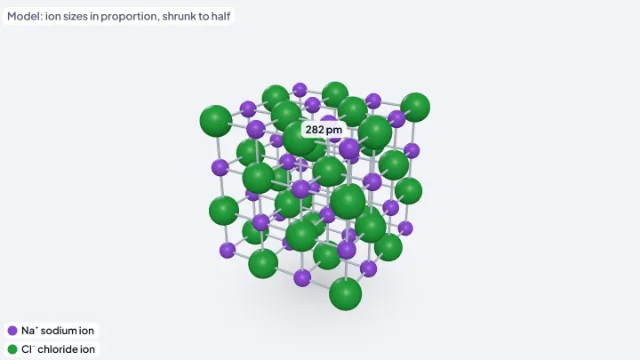
Open the 3D structures model, select Diamond, then tap Highlight to count the four bonds round one atom; switch to Graphite and the count is three. Press Apply p.d. on each, then Slide layers on graphite. On the Cambridge setting the fifth structure is labelled Silicon(IV) oxide: highlight a silicon atom to find its four oxygens, and read the Ratio and formula card. Metals, which also conduct with delocalised electrons, are on metallic bonding.
Common mistakes

  • Blaming graphite's softness on weak covalent bonds. Each layer is held together strongly; the weakness lies between layers.
  • Saying diamond conducts because it is a form of carbon like graphite. All of diamond's outer electrons are in bonds, so none are delocalised.
  • Explaining graphite's use as an electrode by its softness. It is used because its delocalised electrons let it conduct.
  • Describing diamond's structure as layers. Diamond is a 3D tetrahedral network; graphite is the layered form.
  • (Supplement) Writing that silicon(IV) oxide is made of SiO₂ molecules. It is a giant structure; the formula is only the ratio of atoms.
  • (Supplement) Saying each oxygen in silicon(IV) oxide bonds to four silicon atoms. Each silicon bonds to four oxygens, and each oxygen to two silicons.

Exam practice

Exam-style questions

Original questions written in the style of Cambridge IGCSE Chemistry. Try each one before you reveal the answer.

  1. 1.Diamond and graphite are both forms of carbon with giant covalent structures.

    1. (a)Describe the structure of diamond.

      2 marks
      Show the answer

      Answer: Each carbon atom is covalently bonded to four other carbon atoms, arranged tetrahedrally, in a giant three-dimensional network.

      Marking points

      • Each C bonded to four other C atoms (tetrahedral)
      • Giant 3D network / lattice
    2. (b)Explain why diamond is used in cutting tools.

      2 marks
      Show the answer

      Answer: Diamond is very hard, because every atom is held in place by strong covalent bonds in all directions, which must be broken to scratch it.

      Marking points

      • Diamond is very hard
      • Many strong covalent bonds in a rigid 3D network
    3. (c)Explain why graphite conducts electricity.

      2 marks
      Show the answer

      Answer: Each carbon atom forms only three bonds, so one outer electron per atom is delocalised. These electrons can move along the layers.

      Marking points

      • Each C uses only three electrons in bonding / one electron per atom delocalised
      • Delocalised electrons can move (along the layers)
  2. 2.Graphite is used as a lubricant in machinery that becomes too hot for oil.

    1. (a)Describe the structure of graphite.

      2 marks
      Show the answer

      Answer: Layers of hexagonal rings of carbon atoms, each carbon bonded covalently to three others, with weak forces between the layers.

      Marking points

      • Layers of hexagonal rings; each C bonded to three others
      • Weak forces between the layers
    2. (b)Use the structure to explain why graphite is a good lubricant.

      1 mark
      Show the answer

      Answer: The layers can slide over each other easily.

      Marking points

      • Layers slide over each other
    3. (c)Suggest why graphite still works as a lubricant at high temperatures.

      2 marks
      Show the answer

      Answer: Its melting point is very high: melting would need the strong covalent bonds inside each layer to break, so it stays solid when hot.

      Marking points

      • Very high melting point / stays solid
      • Strong covalent bonds within layers must break to melt it
  3. 3.Silicon(IV) oxide, SiO₂, is the main compound in sand.

    1. (a)(Supplement) Describe the structure of silicon(IV) oxide.

      3 marks
      Show the answer

      Answer: A giant covalent structure. Each silicon atom is covalently bonded to four oxygen atoms, and each oxygen atom is bonded to two silicon atoms, in a 3D network.

      Marking points

      • Giant covalent structure / 3D network
      • Each Si bonded to four O atoms
      • Each O bonded to two Si atoms
    2. (b)(Supplement) Give two properties that silicon(IV) oxide shares with diamond, and explain why they are similar.

      3 marks
      Show the answer

      Answer: Both are very hard and have very high melting points (and neither conducts). Both are giant covalent structures: strong covalent bonds lock each atom into a rigid 3D tetrahedral network.

      Marking points

      • One shared property (very hard / very high melting point / does not conduct)
      • A second shared property
      • Both giant covalent with strong bonds in a 3D (tetrahedral) network
  4. 4.Here are some properties of three solids. Solid P melts at 801 °C and conducts electricity only when molten. Solid Q does not melt below 3500 °C, does not conduct electricity and does not dissolve in water. Solid R melts at 114 °C and does not conduct electricity as a solid or as a liquid.

    1. (a)Which solid, P, Q or R, has a giant covalent structure? Give two reasons for your choice.

      3 marks
      Show the answer

      Answer: Q. It has a very high melting point, and it does not conduct electricity (and is insoluble in water).

      Marking points

      • Q
      • Very high melting point
      • Does not conduct electricity / insoluble in water
    2. (b)Solid Q is diamond. Explain why diamond is described as a giant covalent structure and not as a simple molecular substance.

      2 marks
      Show the answer

      Answer: Each carbon atom is covalently bonded to four other carbon atoms in a network that continues throughout the crystal. There are no discrete molecules, so the number of atoms is not fixed.

      Marking points

      • Each carbon bonded to four others in a continuous 3D network
      • No separate molecules / no fixed number of atoms

Quiz

Quick check

5 questions

  1. 1.How many carbon atoms is each carbon atom bonded to in graphite?
  2. 2.Which is a use of graphite named in the Cambridge syllabus?
  3. 3.Why does diamond not conduct electricity?
  4. 4.(Supplement) In silicon(IV) oxide, how many oxygen atoms is each silicon atom bonded to?
  5. 5.(Supplement) Which property does silicon(IV) oxide share with diamond?

Related articles

Next step

Now see it move

Open the full giant structures in 3d (sodium chloride, diamond, graphite and metals) simulation for every preset, graphs and the teacher tools, then test yourself.

Giant structures in 3D simulation: the sodium chloride lattice, diamond, graphite, a metal and silicon dioxide3D