Skip to content

GCSE Chemistry — AQA (8462) · Bonding, structure and the properties of matter

Properties of ionic compounds and small molecules

4.2.2.34.2.2.4

Ionic compounds have high melting points because many strong attractions between ions must be overcome; they conduct only when molten or dissolved, when their ions can move. Small molecules melt and boil easily because only weak intermolecular forces are overcome, and they never conduct.

Loading simulation…

Symbols match your course. Open the full covalent molecules in 3d (ball-and-stick, space-filling and shared pairs) simulation for more presets and teacher tools.

Where this sits in AQA chemistry

Why do ionic compounds have high melting points?

An ionic compound is a regular giant lattice. Every ion is held by strong electrostatic attraction to the oppositely charged ions around it, in all directions. To melt the solid, the ions must be given enough energy to break free of these many strong attractions, so a large amount of energy is needed. Sodium chloride melts at 801 °C; magnesium oxide, with 2+ and 2− ions, melts at about 2850 °C.

When do ionic compounds conduct electricity?

Ionic compounds conduct electricity only when they are molten or dissolved in water. As solids they do not conduct, even though they are full of charged ions. For a current to flow, something charged has to travel through the substance, and the ions can only travel once the lattice has broken up.

State of sodium chlorideAre there ions?Can they move?Conducts?
SolidYesNo: fixed in the lattice, they only vibrateNo
Molten (above 801 °C)YesYesYes
Dissolved in waterYesYesYes

In a solid, every ion is held in place by the strong attractions around it, so it can vibrate but cannot travel towards an electrode. Melting gives the ions enough energy to move past one another; dissolving separates them and surrounds each one with water molecules. Either way, positive ions can drift towards the negative electrode and negative ions towards the positive electrode, and that flow of ions is the current.

So the charge is carried by ions, not electrons, which is the opposite of a metal: a metal conducts as a solid because its delocalised electrons move. Moving ions is also why the compound is split up at the electrodes, the process of electrolysis of molten compounds and solutions. An ionic compound that barely dissolves in water, such as magnesium oxide, can only conduct once it is melted, at about 2850 °C.

Why do small molecules melt and boil at low temperatures?

A substance made of small molecules, such as water, methane or chlorine, has two kinds of force in it:

  • covalent bonds inside each molecule, which are strong
  • intermolecular forces between neighbouring molecules, which are weak

Melting and boiling separate molecules from one another. Just the weak intermolecular forces need overcoming; every covalent bond survives, so steam consists of intact H₂O molecules. Little energy is needed, so the melting and boiling points are low and many of these substances are gases or liquids at room temperature.

Why do bigger molecules boil at higher temperatures?

Intermolecular forces get stronger as molecules get larger. More energy is then needed to pull the molecules apart, so boiling points rise with molecular size. The halogens show this neatly:

HalogenFormulaBoiling pointState at 20 °C
FluorineF₂−188 °CGas
ChlorineCl₂−34 °CGas
BromineBr₂59 °CLiquid
IodineI₂184 °CSolid

The same trend runs through the alkanes in crude oil, which is why fractional distillation can separate them.

Why does iodine have a low melting point?

Iodine is made of small I₂ molecules, and melting it only overcomes the weak intermolecular forces between them. The strong covalent bond inside each I₂ molecule does not break, so little energy is needed and iodine melts at 114 °C, far below the 801 °C of sodium chloride.

"Low" here means low compared with ionic compounds and giant structures. Of the four halogens in the table above, iodine actually has the highest melting point and is the only solid at room temperature. Its molecules are the largest of the four, so the forces between them are the strongest, but they are still weak forces between molecules, not bonds within a lattice. You can see how weakly the molecules are held if you warm a few iodine crystals gently in a fume cupboard: purple iodine vapour forms even before the solid melts.

In an exam, write "weak intermolecular forces between iodine molecules" or "weak forces between molecules". Writing "iodine has weak bonds" or "the covalent bonds break" loses the mark, because the I–I bond is strong and stays intact.

Why don't small molecules conduct electricity?

Each molecule has no overall electric charge, and none of its electrons are free to move away from it. With no charged particles able to flow, there is no current, whether the substance is solid, liquid or gas.

Worked example: predicting the state

Question: Methanol, CH₃OH, melts at −98 °C and boils at 65 °C. Sodium chloride melts at 801 °C. Give the state of each at 25 °C and at 100 °C, and explain the difference in melting points.

  1. Methanol at 25 °C: above its melting point but below its boiling point, so liquid. At 100 °C: above its boiling point, so gas.
  2. Sodium chloride at both temperatures: below 801 °C, so solid.
  3. Explanation: melting methanol only overcomes weak intermolecular forces between small molecules. Melting sodium chloride overcomes strong electrostatic forces between ions throughout a giant lattice, which needs far more energy.

Compare boiling points in the simulation

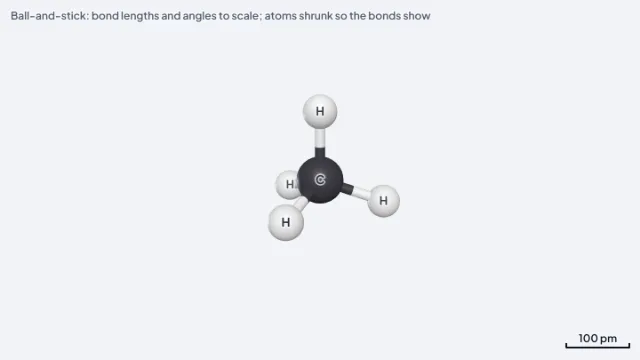
The molecule simulation lists real boiling points for its molecules. Compare methane, ammonia and water, which are similar in size: water boils far higher, because its intermolecular forces are unusually strong (the type of force is beyond AQA). Switch to Space-fill to see that the molecules themselves stay whole. Then open sodium chloride in the giant structures simulation and press Molten with a p.d. applied to watch the freed ions drift. The bonds behind these ideas are spec points 4.2.1.2 to 4.2.1.4.
Common mistakes

  • Saying covalent bonds break when water boils. The H₂O molecules leave the liquid whole; only the intermolecular forces are overcome.
  • Explaining that solid sodium chloride does not conduct because it has no ions. It has ions, but they are fixed in the lattice and cannot move.
  • Saying molten ionic compounds conduct because electrons move. The moving charged particles are the ions.
  • Writing that small molecules have weak bonds. The covalent bonds are strong; it is the forces between molecules that are weak.
  • Saying intermolecular forces get weaker as molecules get bigger. They get stronger, so larger molecules have higher boiling points.
  • Thinking a substance made of small molecules conducts when dissolved, just as salt does. Molecules have no overall charge, so there is nothing charged to carry a current.

Exam practice

Exam-style questions

Original questions written in the style of GCSE AQA Chemistry. Try each one before you reveal the answer.

  1. 1.Magnesium oxide is an ionic compound. It melts at about 2850 °C.

    1. (a)Give the reason magnesium oxide melts at such a high temperature.

      3 marks
      Show the answer

      Answer: Magnesium oxide is a giant ionic lattice. There are strong electrostatic forces of attraction between the oppositely charged Mg²⁺ and O²⁻ ions, acting in all directions. A large amount of energy is needed to overcome these many strong forces.

      Marking points

      • Giant lattice of ions
      • Strong electrostatic attraction between oppositely charged ions
      • Large amount of energy needed to overcome the many strong forces
    2. (b)Magnesium oxide conducts electricity when molten but not when solid. Explain why.

      2 marks
      Show the answer

      Answer: Solid MgO has its ions locked in the lattice. Once molten, the ions can move about and carry charge.

      Marking points

      • Ions locked in place in the solid
      • Mobile ions carry charge in the melt
  2. 2.The table gives data for three substances made of small molecules. Ammonia NH₃: melting point −78 °C, boiling point −33 °C. Bromine Br₂: melting point −7 °C, boiling point 59 °C. Iodine I₂: melting point 114 °C, boiling point 184 °C.

    1. (a)State whether each substance is a solid, a liquid or a gas at 25 °C.

      2 marks
      Show the answer

      Answer: Ammonia: gas. Bromine: liquid. Iodine: solid.

      Marking points

      • Ammonia gas and bromine liquid
      • Iodine solid
    2. (b)Explain why iodine has a higher boiling point than bromine.

      2 marks
      Show the answer

      Answer: Iodine molecules are larger than bromine molecules. The intermolecular forces between larger molecules are stronger, so more energy is needed to separate them.

      Marking points

      • Iodine molecules are larger
      • Stronger intermolecular forces, so more energy needed to overcome them
    3. (c)Sodium chloride melts at 801 °C. Explain why iodine has a much lower melting point than sodium chloride.

      4 marks
      Show the answer

      Answer: Iodine is made of small I₂ molecules. Melting iodine only overcomes the weak intermolecular forces between the molecules; the covalent bonds inside them do not break, so little energy is needed. Sodium chloride is a giant ionic lattice with strong electrostatic attractions between oppositely charged ions in all directions, and breaking these down takes far more energy.

      Marking points

      • Iodine: small molecules with weak intermolecular forces between them
      • Covalent bonds in I₂ are not broken on melting / little energy needed
      • Sodium chloride: giant lattice with strong electrostatic attraction between oppositely charged ions
      • Far more energy required to melt sodium chloride
    4. (d)Explain why liquid bromine does not conduct electricity.

      2 marks
      Show the answer

      Answer: Bromine is made of molecules with no overall electric charge, and there are no free electrons or ions to carry charge.

      Marking points

      • Molecules have no overall charge
      • No charged particles free to move
  3. 3.A student says: 'When methane boils, the C–H bonds in the molecules break.'

    1. (a)What is wrong with the student's statement? Explain.

      2 marks
      Show the answer

      Answer: Boiling only separates the methane molecules from each other by overcoming the weak intermolecular forces. The strong C–H covalent bonds are not broken, so the gas consists of whole CH₄ molecules.

      Marking points

      • Only the intermolecular forces (between molecules) are overcome
      • Covalent bonds are strong and stay intact (gas is still CH₄ molecules)
    2. (b)Methane boils at −161 °C. Explain why so little energy is needed to boil it.

      2 marks
      Show the answer

      Answer: Methane molecules are small, so the intermolecular forces between them are very weak. Only a small amount of energy is needed to overcome them.

      Marking points

      • Weak intermolecular forces (small molecules)
      • Little energy needed to overcome them

Quiz

Quick check

5 questions

  1. 1.Melting sodium chloride requires overcoming what?
  2. 2.Which statement about solid potassium chloride is correct?
  3. 3.Which substance is most likely to be made of small molecules?
  4. 4.Why does chlorine, Cl₂, have a lower boiling point than bromine, Br₂?
  5. 5.Why do substances made of small molecules not conduct electricity?

Related articles

Next step

Now see it move

Open the full covalent molecules in 3d (ball-and-stick, space-filling and shared pairs) simulation for every preset, graphs and the teacher tools, then test yourself.

Covalent molecules in 3D simulation: eleven simple covalent molecules, from H₂ to methanol3D