Skip to content

Cambridge IGCSE Chemistry (0620) · Atoms, elements and compounds

Metallic bonding

2.7.12.7.2Supplement

Supplement only. In a metal, positive ions sit in a giant lattice, attracted to a sea of delocalised electrons. Those electrons can move, so metals conduct; layers of ions can slide without the bonding breaking, so metals are malleable and ductile.

Loading simulation…

Symbols match your course. Open the full giant structures in 3d (sodium chloride, diamond, graphite and metals) simulation for more presets and teacher tools.

Who needs this topic?

What is a metallic bond? (Supplement)

A solid metal is a giant metallic lattice. The atoms are packed closely in a regular arrangement, and each one releases its outer-shell electrons. Those electrons no longer belong to any single atom: they are delocalised, spread through the whole lattice as a "sea" of electrons. What remains at each lattice site is a positive ion.

The metallic bond is the electrostatic attraction between the positive ions and the sea of delocalised electrons. Every ion attracts the electrons around it, and the electrons are attracted to every ion near them, so the attraction holds the whole lattice together.

In magnesium, for example, each atom releases both of its outer electrons, leaving Mg²⁺. In sodium, each atom gives one and becomes Na⁺.

How is a metallic lattice different from an ionic lattice?

Giant metallic latticeGiant ionic lattice
Positive particlesMetal cationsMetal cations
Negative particlesDelocalised electrons, free to moveAnions, fixed in place
Conducts as a solid?YesNo
Under a strong forceBends or stretchesShatters (brittle)

Why do metals conduct electricity? (Supplement)

The delocalised electrons can move throughout the lattice. When a potential difference is applied across a metal, they drift towards the positive end, and this flow of electrons is the electric current. The ions stay in their lattice positions. Because the mobile electrons are present in the solid, metals conduct both as solids and when molten.

Why are metals malleable and ductile? (Supplement)

Malleable means the metal can be hammered or pressed into shape; ductile means it can be drawn out into a wire.

The positive ions are arranged in layers. When a force is applied, one layer can slide over the next. The sea of delocalised electrons moves with the ions, so after the layers have moved, every ion is still surrounded by electrons and still attracted to them. The slide leaves the metallic bonding intact, and the metal deforms rather than snapping.

Compare an ionic crystal: if its layers shift, ions of the same charge end up side by side, repel, and the crystal splits. That is why salt crystals shatter while copper bends.

Worked example: a full explanation (Supplement)

Question: Copper is used for electrical wires. Explain, in terms of structure and bonding, two properties of copper that make it suitable.

  1. Structure and bonding: copper is a giant lattice of positive copper ions in a sea of delocalised electrons, held together by electrostatic attraction between the ions and the electrons.
  2. Good electrical conductivity: the delocalised electrons are free to move through the lattice, so they can carry a current along the wire.
  3. Ductility: the layers of ions can slide over each other without the metallic bonding breaking, so copper can be drawn into thin wires.

A full answer names the particles, the attraction between them and then links each property to the model.

How does this fit with other metal topics?

Alloys are harder than pure metals because atoms of a different size disrupt the layers so they slide less easily (syllabus 9.3). Graphite, from syllabus 2.6, is the one non-metal at IGCSE that also conducts using delocalised electrons. The ionic lattice, which behaves so differently, is part of syllabus 2.4.

Try it in the simulation

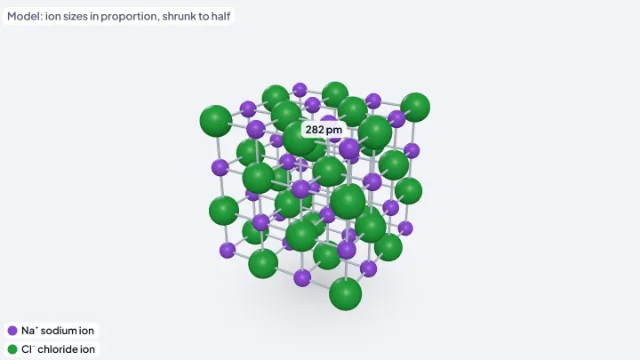
Pick Metal in the 3D lattice explorer: the block shows magnesium ions with their delocalised electrons. Press Highlight to read how many electrons each atom releases. Press Apply p.d. and watch the electrons, still moving randomly, gain a slow drift in one direction while the ions stay put. Then press Slide layers and see that the lattice holds together as the layers move.
Common mistakes

  • (Supplement) Leaving the attraction out of the definition. Name both partners: the bond is an electrostatic pull between lattice ions and the electron sea.
  • (Supplement) Saying the metal ions carry the current. They stay at their lattice sites; the delocalised electrons do the moving.
  • (Supplement) Describing the lattice as made of atoms and electrons. The atoms have released their outer electrons, so the lattice is made of positive ions.
  • (Supplement) Explaining malleability by saying the bonds are weak. Metallic bonding is strong; the layers can slide because the electron sea moves with them and the attraction is kept.
  • (Supplement) Confusing malleable and ductile. Malleable: it can be hammered into shape. Ductile: it can be pulled out into wires.
  • (Supplement) Saying metals have negative ions. The only negative particles are the delocalised electrons.

Exam practice

Exam-style questions

Original questions written in the style of Cambridge IGCSE Chemistry. Try each one before you reveal the answer.

  1. 1.Aluminium is a metal used for overhead power cables.

    1. (a)(Supplement) Describe metallic bonding.

      3 marks
      Show the answer

      Answer: Metal atoms give up their outer electrons, which become delocalised, so the lattice consists of positive ions in a mobile sea of electrons. Electrostatic attraction between the ions and that sea holds the lattice together.

      Marking points

      • Lattice of positive ions
      • Sea of delocalised electrons
      • Ions and delocalised electrons attract electrostatically
    2. (b)(Supplement) Explain why aluminium conducts electricity.

      2 marks
      Show the answer

      Answer: Its delocalised electrons can move throughout the metal and carry charge, forming a current.

      Marking points

      • Delocalised electrons
      • Free to move (through the structure) and carry charge
  2. 2.Gold is very malleable: it can be beaten into leaf less than a millionth of a metre thick.

    1. (a)(Supplement) Define the word malleable.

      1 mark
      Show the answer

      Answer: It can be hammered or pressed into different shapes without breaking.

      Marking points

      • Can be hammered / beaten into shape (without breaking)
    2. (b)(Supplement) Account for the malleability of metals using their structure and bonding.

      3 marks
      Show the answer

      Answer: The positive ions sit in layers. Under a force, the layers slide over each other. The delocalised electrons move with them, so the attraction between ions and electrons is not lost and the metal does not break.

      Marking points

      • Ions in layers
      • Layers slide over each other
      • Metallic bonding / attraction to delocalised electrons is maintained
  3. 3.Solid sodium conducts electricity, but solid sodium chloride does not. Both contain sodium ions.

    1. (a)(Supplement) Explain this difference.

      3 marks
      Show the answer

      Answer: In sodium metal there are delocalised electrons that can move through the lattice and carry charge. In solid sodium chloride all the electrons are held by the ions, and the ions are fixed in the lattice, so no charged particles can move.

      Marking points

      • Sodium has delocalised electrons
      • That can move and carry charge
      • In solid sodium chloride the ions are fixed and there are no mobile electrons
    2. (b)(Supplement) Give the charge on the ions in the sodium metal lattice.

      1 mark
      Show the answer

      Answer: 1+ (each sodium atom releases one outer electron).

      Marking points

      • 1+

Quiz

Quick check

5 questions

  1. 1.(Supplement) What is metallic bonding?
  2. 2.(Supplement) Which particles carry the current in a copper wire?
  3. 3.(Supplement) What does ductile mean?
  4. 4.(Supplement) Why can the layers in a metal slide without the metal breaking?
  5. 5.(Supplement) How many delocalised electrons does each magnesium atom release in the metal lattice?

Related articles

Next step

Now see it move

Open the full giant structures in 3d (sodium chloride, diamond, graphite and metals) simulation for every preset, graphs and the teacher tools, then test yourself.

Giant structures in 3D simulation: the sodium chloride lattice, diamond, graphite, a metal and silicon dioxide3D