Which syllabus statements does this cover?
How are elements written?
Every element has a symbol of one or two letters, with only the first letter a capital: Co is cobalt, but CO is carbon monoxide. How the element is written depends on its structure:
- Metals and noble gases are written as the symbol alone: Na, Fe, Cu, He, Ar.
- Seven non-metals exist as diatomic molecules and are always written with a 2: H₂, N₂, O₂, F₂, Cl₂, Br₂, I₂.
- Carbon and sulfur are written as C and S in equations.
Writing O instead of O₂, or Cl instead of Cl₂, is one of the commonest reasons for losing an equation mark.
What is a molecular formula?
The molecular formula of a compound tells you how many atoms of each element are in one molecule. Ethane is C₂H₆: each molecule contains 2 carbon atoms and 6 hydrogen atoms. The small subscript number belongs to the symbol just before it, and a missing number means one: CO₂ has one carbon and two oxygens.
Working out a formula from a model (Core 3)
When you are shown a ball-and-stick model or a diagram, count each kind of atom and write the counts as subscripts. A model with one nitrogen atom joined to three hydrogen atoms is NH₃, ammonia. A model of methanol shows 1 carbon, 4 hydrogen and 1 oxygen atom, giving CH₄O, which is usually written CH₃OH to show the OH group.
What is an empirical formula? (Supplement)
The empirical formula is the simplest whole-number ratio of the atoms (or ions) of each element in a compound. Divide the numbers in the molecular formula by their highest common factor:
| Compound | Molecular formula | Divide by | Empirical formula |
|---|---|---|---|
| Ethane | C₂H₆ | 2 | CH₃ |
| Glucose | C₆H₁₂O₆ | 6 | CH₂O |
| Hydrogen peroxide | H₂O₂ | 2 | HO |
| Water | H₂O | 1 | H₂O (already simplest) |
For ionic compounds, which are giant lattices, the formula is always written as the simplest ratio of ions, so it is an empirical formula. Calculating empirical formulae from masses belongs to the mole topic.
How do you work out the formula of an ionic compound? (Supplement)
The positive and negative charges must cancel out. Choose the smallest numbers of each ion that give a total charge of zero.
| Positive ions | Negative ions |
|---|---|
| Na⁺, K⁺, Ag⁺, NH₄⁺ | Cl⁻, Br⁻, OH⁻, NO₃⁻ |
| Mg²⁺, Ca²⁺, Cu²⁺, Zn²⁺, Fe²⁺ | O²⁻, SO₄²⁻, CO₃²⁻ |
| Al³⁺, Fe³⁺ | N³⁻ |
Worked example: aluminium sulfate.
- Ions: Al³⁺ and SO₄²⁻.
- The lowest common multiple of 3 and 2 is 6, so you need 6+ and 6−: two Al³⁺ (2 × 3+) and three SO₄²⁻ (3 × 2−).
- A group of atoms that appears more than once goes in brackets: Al₂(SO₄)₃.
The same method gives Ca(OH)₂, (NH₄)₂CO₃ and Fe₂O₃. From a diagram of a lattice, simply count the ratio of the two ions instead.
How do you write and balance an equation?
Start with a word equation, then replace each name with the correct formula, then balance:
- Write the correct formulae. From this point on, never change a formula to make it balance.
- Tally the atoms of every element, reactants first, then products.
- Balance by putting numbers in front of formulae, one element at a time. Leave lone elements such as O₂ until last.
- Recount, and add state symbols: (s) solid, (l) liquid, (g) gas, (aq) dissolved in water.
Worked example: aluminium burns in oxygen to form aluminium oxide, Al₂O₃.
- Unbalanced: Al + O₂ → Al₂O₃. Oxygen is 2 on the left and 3 on the right.
- The lowest common multiple of 2 and 3 is 6: 3O₂ → 2Al₂O₃ gives 6 oxygen atoms each side.
- Now there are 4 Al on the right, so put 4 in front of Al:
Counting again gives Al 4 = 4 and O 6 = 6, so it is balanced.
What is an ionic equation? (Supplement)
An ionic equation shows only the particles that actually change. Ions that are present in solution before and after, unchanged, are spectator ions and are left out. Split every aqueous ionic compound into its ions, cross out what appears on both sides, and keep the rest. Solids, liquids, gases and covalent molecules stay as formulae.
For hydrochloric acid neutralising sodium hydroxide, Na⁺ and Cl⁻ cancel, leaving:
For silver nitrate solution added to sodium chloride solution, a white precipitate forms, and the nitrate and sodium ions are spectators:
An ionic equation must balance in charge as well as atoms: both sides of the first one total zero.
Practise in the simulation
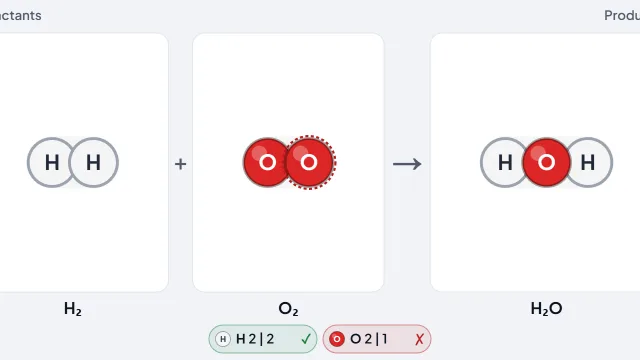
The equation balancer lets you practise step 3 with pictures of the atoms. Pick a level under Equation (Simple, Medium or Harder), then use the − and + buttons for the Numbers in front of each formula. The Atom counter tracks every element on both sides, and red rings mark atoms with no partner yet. Press Check when you think it balances, or Hint to be told which element is off. Once it is balanced, read the State symbols panel and the Mass is conserved table, which adds up the relative formula masses on each side. Try aluminium and oxygen to repeat the worked example above.
For the reactions behind many of these equations, see the reactivity series and halogen displacement. Where the charges on ions come from is explained under how ions form.