Skip to content

GCSE Chemistry — AQA (8462) · Quantitative chemistry

Conservation of mass and balanced equations

4.3.1.1

No atoms are made or destroyed in a reaction, so the products weigh the same as the reactants. That is why a symbol equation must have the same number of each kind of atom on both sides. Balance it by changing the big numbers in front of formulas, never the small subscripts.

Loading simulation…

Symbols match your course. Open the full balancing chemical equations (atom counts and state symbols) simulation for more presets and teacher tools.

Where this sits in AQA chemistry

What is the law of conservation of mass?

In a chemical reaction no atoms are created and none are destroyed. The atoms in the reactants are only rearranged into new substances. Because every atom that goes in also comes out, the total mass of the products equals the total mass of the reactants.

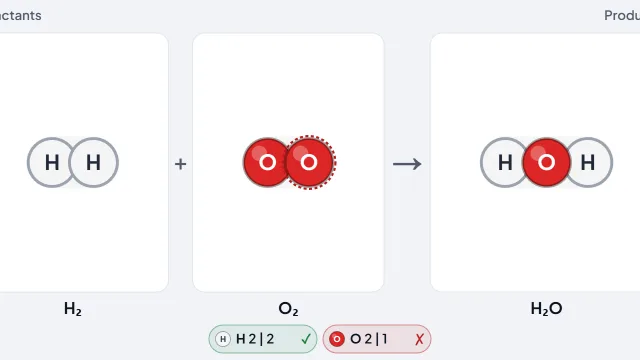
Take hydrogen burning in oxygen. Two hydrogen molecules and one oxygen molecule rearrange into two water molecules:

2 HX2(g)+OX2(g)→2 HX2O(l)\ce{2H2(g) + O2(g) -> 2H2O(l)}

Count the atoms: 4 hydrogen and 2 oxygen on the left; 4 hydrogen and 2 oxygen on the right. Same atoms, new partners, same mass.

How do you read the numbers in an equation?

There are two kinds of number, and they do different jobs.

  • A subscript (the small number written low down) belongs to the formula. It counts the atoms of the element just before it inside one particle. In H₂O there are 2 hydrogen atoms and 1 oxygen atom. After a bracket, it multiplies everything inside: Ca(OH)₂ has 1 calcium, 2 oxygen and 2 hydrogen atoms.
  • A multiplier (the full-size number in front) tells you how many of those particles there are. It multiplies every atom in the formula. 3H₂SO₄ means three molecules, so 6 hydrogen, 3 sulfur and 12 oxygen atoms.
WrittenParticlesAtoms of each element
2O₂2 oxygen moleculesO: 4
2Al₂O₃2 formula units of aluminium oxideAl: 4, O: 6
3Mg(NO₃)₂3 formula units of magnesium nitrateMg: 3, N: 6, O: 18

When balancing, you may change only the multipliers. Changing a subscript changes the substance itself. Add one oxygen to the water formula and you have written hydrogen peroxide (H₂O₂), a bleach, instead.

How do you balance an equation?

  1. Write the correct formula for every reactant and product. From now on, leave the formulas alone.
  2. List each element and count its atoms on both sides.
  3. Pick an element that is out of balance, ideally one that appears in just one formula on each side, and put a multiplier in front of a formula to fix it.
  4. Recount everything, because one change can upset another element.
  5. Save elements that appear on their own, such as O₂ or H₂, for last.
  6. Check the multipliers are the smallest whole numbers that work. A multiplier of 1 is never written.

Worked example: aluminium burning in oxygen

Unbalanced: Al + O₂ → Al₂O₃

  1. Oxygen first, since it is the awkward one: 2 on the left, 3 on the right. Both 2 and 3 go into 6, so aim for 6 oxygen atoms per side with 3O₂ and 2Al₂O₃. That gives 6 oxygen atoms on each side.
  2. Aluminium next: 2Al₂O₃ contains 4 aluminium atoms, so put 4 in front of Al.
  3. Recount: left, 4 Al and 6 O; right, 4 Al and 6 O. Balanced.

4 Al(s)+3 OX2(g)→2 AlX2OX3(s)\ce{4Al(s) + 3O2(g) -> 2Al2O3(s)}

Check the mass with the relative atomic masses from the AQA periodic table (Al = 27, O = 16):

  • Reactants: 4 × 27 = 108, and 3 × (2 × 16) = 96. Total = 204.
  • Products: 2 × (2 × 27 + 3 × 16) = 2 × 102 = 204.

The totals match, exactly as the law says they must. In grams, 108 g of aluminium reacts with 96 g of oxygen to make 204 g of aluminium oxide.

A harder one: burning propane

Unbalanced: C₃H₈ + O₂ → CO₂ + H₂O

  1. Carbon: 3 on the left, so 3CO₂.
  2. Hydrogen: 8 on the left, so 4H₂O (4 × 2 = 8).
  3. Oxygen on the right is now 3 × 2 + 4 × 1 = 10 atoms, so the left needs 5O₂.

CX3HX8(g)+5 OX2(g)→3 COX2(g)+4 HX2O(l)\ce{C3H8(g) + 5O2(g) -> 3CO2(g) + 4H2O(l)}

Leaving oxygen until the end worked because O₂ contains no other element, so changing its multiplier disturbed nothing else.

Can you show conservation of mass in the lab?

Yes, if nothing can get in or out. Pour copper(II) sulfate solution and sodium hydroxide solution into separate containers, weigh both together on a balance, then mix them and weigh again. A blue precipitate of copper(II) hydroxide forms, yet the reading does not change, because every atom stays inside the containers:

CuSOX4(aq)+2 NaOH(aq)→Cu(OH)X2(s)+NaX2SOX4(aq)\ce{CuSO4(aq) + 2NaOH(aq) -> Cu(OH)2(s) + Na2SO4(aq)}

Wear eye protection: sodium hydroxide solution damages eyes and skin. If instead a gas leaves an open flask, the balance reading falls, and if a gas from the air joins a solid, it rises. The atoms are still conserved in both cases; they have simply moved into or out of what is being weighed. State symbols such as (aq) and (s) are explained in states of matter and state symbols.

Practise in the simulation

The balancing equations simulation has Simple, Medium and Harder equations. Raise or lower each multiplier with the − and + buttons under the picture (the Numbers in front of each formula controls) while the Atom counter keeps score; atoms with no partner on the other side are ringed in red. Press Check when you think every element matches; Hint names an element that is still out of balance. Once an equation balances, the Mass is conserved panel totals the relative formula masses for reactants and products, and the two numbers agree. Try the propane and aluminium equations from this page, then press Next equation for more.
Common mistakes

  • Altering a small number inside a formula, for example writing O instead of O₂. That makes a different substance; only the numbers in front may change.
  • Forgetting that a multiplier applies to every atom in the formula. 2H₂O contains 4 hydrogen atoms and 2 oxygen atoms.
  • Missing the effect of brackets. In Mg(NO₃)₂ the 2 doubles everything inside the bracket: 2 nitrogen and 6 oxygen atoms.
  • Stopping at numbers that balance but can be divided further, such as 4Na + 2Cl₂ → 4NaCl. Use the smallest whole numbers: 2Na + Cl₂ → 2NaCl.
  • Saying mass is lost when a gas escapes from an open flask. The atoms still exist; they have left the flask, so the balance no longer weighs them.
  • Writing a 1 in front of a formula. A formula with no number in front already means one particle.

Exam practice

Exam-style questions

Original questions written in the style of GCSE AQA Chemistry. Try each one before you reveal the answer.

  1. 1.A student mixes copper(II) sulfate solution with sodium hydroxide solution in a flask on a balance. A blue solid forms. The reading before mixing is 152.40 g.

    1. (a)Predict the reading on the balance after the reaction. Explain your answer.

      2 marks
      Show the answer

      Answer: 152.40 g. No atoms are made or lost and nothing escapes from the flask, so the total mass stays the same.

      Marking points

      • 152.40 g (no change)
      • Atoms are not created or destroyed / mass is conserved and no gas escapes
    2. (b)Balance the equation: CuSO₄ + NaOH → Cu(OH)₂ + Na₂SO₄

      1 mark
      Show the answer

      Answer: CuSO₄ + 2NaOH → Cu(OH)₂ + Na₂SO₄

      Marking points

      • 2 in front of NaOH (all other multipliers 1)
    3. (c)Give the number of oxygen atoms shown on the left-hand side of the balanced equation.

      1 mark
      Show the answer

      Answer: 6 (4 in CuSO₄ and 1 in each of the 2 NaOH).

      Marking points

      • 6
  2. 2.Iron reacts with oxygen to form iron(III) oxide. Unbalanced: Fe + O₂ → Fe₂O₃

    1. (a)Balance the equation.

      1 mark
      Show the answer

      Answer: 4Fe + 3O₂ → 2Fe₂O₃

      Marking points

      • 4Fe + 3O₂ → 2Fe₂O₃
    2. (b)A student balances the equation as 2Fe + O₃ → Fe₂O₃. Explain what is wrong with this.

      2 marks
      Show the answer

      Answer: The student has changed the formula of oxygen from O₂ to O₃. Formulas cannot be changed when balancing, because O₃ is a different substance; only the numbers in front can be changed.

      Marking points

      • Changed the formula / subscript of oxygen (O₂ to O₃)
      • Only the numbers in front of formulas may be changed (O₃ is a different substance)
    3. (c)How many atoms in total are shown in 2Fe₂O₃?

      1 mark
      Show the answer

      Answer: 10 (4 iron and 6 oxygen).

      Marking points

      • 10
  3. 3.Magnesium burns in oxygen: 2Mg + O₂ → 2MgO. In one experiment, 4.8 g of magnesium reacts completely with 3.2 g of oxygen. Relative atomic masses: Mg = 24, O = 16.

    1. (a)Calculate the mass of magnesium oxide formed.

      1 mark
      Show the answer

      Answer: 4.8 + 3.2 = 8.0 g

      Marking points

      • 8.0 g
    2. (b)Show that the total relative formula masses on each side of the equation are equal.

      2 marks
      Show the answer

      Answer: Left: 2 × 24 + 2 × 16 = 48 + 32 = 80. Right: 2 × (24 + 16) = 2 × 40 = 80.

      Marking points

      • Reactants total 80 (48 + 32)
      • Products total 80 (2 × 40)
    3. (c)When magnesium is burned in an open crucible, the mass of the crucible and its contents goes up. Explain why.

      2 marks
      Show the answer

      Answer: Oxygen from the air combines with the magnesium. The oxygen atoms were not being weighed at the start, but they are part of the magnesium oxide at the end.

      Marking points

      • Oxygen from the air reacts / is added
      • Its mass was not included at the start but is in the product

Quiz

Quick check

6 questions

  1. 1.What does the law of conservation of mass state?
  2. 2.How many hydrogen atoms are shown in 2Ca(OH)₂?
  3. 3.Which is the correctly balanced equation for hydrogen reacting with chlorine?
  4. 4.What number should go in front of O₂ to balance CH₄ + __O₂ → CO₂ + 2H₂O?
  5. 5.Why must you not change the small numbers inside formulas when balancing?
  6. 6.In a sealed flask, 12.0 g of reactants react completely. What is the total mass of the products?

Next step

Now see it move

Open the full balancing chemical equations (atom counts and state symbols) simulation for every preset, graphs and the teacher tools, then test yourself.

Balancing chemical equations simulation: pick an equation, change only the numbers in front of each formula