Where this sits in AQA chemistry
What happens when metals react with oxygen?
Most metals combine with oxygen to make a metal oxide. Magnesium ribbon burns with a dazzling white flame and leaves a white powder; copper heated in air turns black on the surface.
Because the metal gains oxygen, these are oxidation reactions. The reverse, losing oxygen, is reduction. When hot copper(II) oxide is reacted with hydrogen, the copper oxide loses its oxygen (it is reduced) and the hydrogen gains it (it is oxidised):
Oxidation and reduction always happen together: whatever loses oxygen hands it to something else.
What is the reactivity series?
Put metals in a queue from the fiercest reacting to the most sluggish and you have the reactivity series. Here are AQA's eight, with the non-metals carbon and hydrogen slotted in for comparison:
| Position | Element | With cold water | With dilute acid |
|---|---|---|---|
| Most reactive | Potassium | Very vigorous: melts, the hydrogen ignites with a lilac flame | Explosive: never tried in school |
| Sodium | Vigorous: melts into a ball and fizzes about | Dangerous: never tried in school | |
| Lithium | Steady fizzing | Too violent to try in school | |
| Calcium | Fizzes steadily; the water goes cloudy | Vigorous fizzing | |
| Magnesium | Hardly anything: a few bubbles after a long time | Rapid fizzing; the tube gets warm | |
| Carbon | Non-metal | Shown for comparison | |
| Zinc | No visible reaction | Steady bubbling | |
| Iron | No visible reaction (rusting takes days) | Slow bubbling | |
| Hydrogen | Non-metal | Shown for comparison | |
| Least reactive | Copper | No reaction | No reaction |
Metals that react with water give a metal hydroxide and hydrogen. Metals that react with a dilute acid give a salt and hydrogen:
Hydrogen's place is a useful marker: metals above it give hydrogen with dilute acids, and copper, below it, does not. Carbon's place matters for extracting metals: carbon can take oxygen away from the oxides of metals below it, such as zinc and iron.
Why are some metals more reactive than others?
When a metal reacts, its atoms lose electrons and form positive ions: potassium becomes K⁺, magnesium becomes Mg²⁺. The reactivity of a metal measures how readily it does this. Potassium gives up its outer electron so easily that it reacts violently with cold water; copper holds on to its electrons so well that it does not react with water or dilute acids at all. So the reactivity series is really a ranking of how easily each metal forms its positive ion.
What is a displacement reaction?
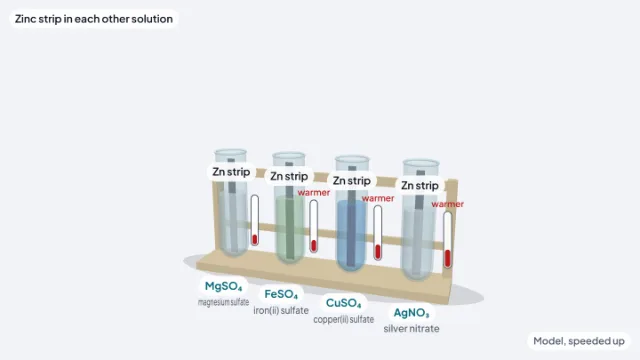
A more reactive metal displaces a less reactive metal from its compound. Put a strip of zinc into blue copper(II) sulfate solution and the zinc atoms give their electrons to the copper ions. Zinc goes into solution as Zn²⁺ and copper metal builds up on the strip as a red-brown layer, while the blue colour fades:
Swap them round, copper in zinc sulfate solution, and nothing happens: copper sits lower in the series than zinc. The mixture also warms up slightly in a displacement: these reactions give out energy.
Worked example: deducing an order from results
Question: Strips of three unknown metals, labelled J, K and L, were each dipped into the nitrate solutions of the other two. A tick marks the tubes where a coating appeared. Put the metals in order of reactivity.
| Metal strip | J nitrate | K nitrate | L nitrate |
|---|---|---|---|
| J | — | ✓ | ✓ |
| K | ✗ | — | ✓ |
| L | ✗ | ✗ | — |
- Count the ticks in each row. J displaces both others (2), K displaces one (1), L displaces none (0).
- More ticks means more reactive, because a metal can only displace metals below it.
- Order: J, then K, then L (most to least reactive).
- Check for consistency: every pair agrees. For example, J displaces K, and K does not displace J.
The same logic works with acid: the faster the bubbles, the higher the metal. Keep the acid's concentration and volume, the temperature, and the size of each piece of metal the same, so that the comparison is fair.
Safety in reactivity experiments
Use small pieces of metal and dilute acid, and wear eye protection. Hydrogen is flammable, so keep flames away from the tubes. Potassium, sodium and lithium are never added to acid, and their reactions with water are teacher demonstrations behind a screen. Copper(II) sulfate solution is harmful if swallowed and irritates eyes; wash hands afterwards.
Run the displacement tests on screen
The reactivity and displacement simulation has three ways to test. One metal, every solution puts a strip of your chosen metal into each of the other four solutions: one row of the Results grid. Every metal, one solution fills in a column, and One metal, one solution lets you test a single tube. Press Add the metal, read the coatings and colour changes in In the tubes, then check the Order from your results card. Fill the whole grid records every test at once, and the Equations panel gives the word, symbol and ionic equations for each reaction you have seen. Silver appears as an extra metal beyond the AQA list. For how metals form ions, see metals and non-metals, and the Group 1 reactions with water are on the alkali metals page.