GCSE AQA Chemistry · 4.4 · Chapter 5 of 11
Chemical changes
12 topics4 of 12 topic guides ready2 simulations
Metal oxides and the reactivity series
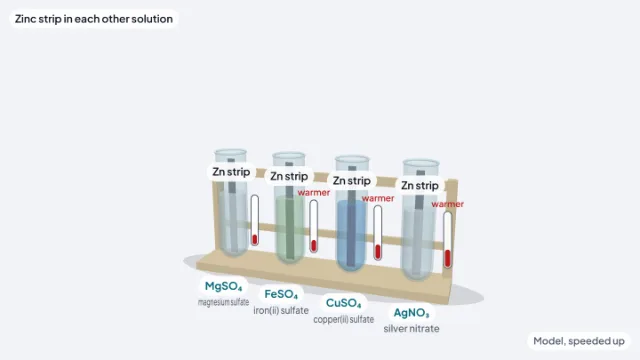
Topic guide4.4.1.14.4.1.2Metals gain oxygen to form oxides; order metals by their reactions with water and acid; displacement.
Extracting metals by reduction
Topic guide coming soon4.4.1.3Unreactive metals occur native; metals below carbon are extracted by heating oxides with carbon.
Oxidation and reduction in terms of electrons
Topic guide coming soon4.4.1.4Higher tierOxidation is loss and reduction is gain of electrons; ionic equations for displacement.
Reactions of acids with metals
Topic guide coming soon4.4.2.1Acids and reactive metals give a salt and hydrogen; explained as redox at HT.
Neutralisation and making soluble salts
Topic guide coming soon4.4.2.24.4.2.3Acids with alkalis, bases and carbonates; naming salts; making a pure dry salt from an insoluble base.
The pH scale and neutralisation
Topic guide coming soon4.4.2.4H+ in acids and OH- in alkalis; pH 0 to 14 by indicator or probe; H+ + OH- gives water.
Titrations
Topic guide coming soon4.4.2.5Separate chemistry onlyMeasuring the volumes of strong acid and alkali that react exactly; concentration calculations at HT.
Strong and weak acids
Topic guide coming soon4.4.2.6Higher tierFull against partial ionisation, dilute against concentrated, and a tenfold H+ change per pH unit.
Electrolysis and molten ionic compounds
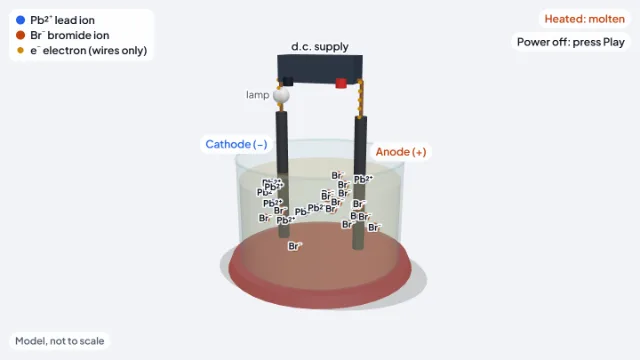
Topic guide4.4.3.14.4.3.2Ions move to electrodes when an ionic compound is molten or dissolved; molten binary compounds give metal and non-metal.
Using electrolysis to extract metals
Topic guide coming soon4.4.3.3Reactive metals such as aluminium are extracted by electrolysis of a molten mixture with cryolite; carbon anodes burn away.
Electrolysis of aqueous solutions
Topic guide4.4.3.4Water's ions compete: hydrogen forms unless the metal is less reactive; oxygen forms unless a halide is present.
Half equations at electrodes
Topic guide4.4.3.5Higher tierReduction at the cathode and oxidation at the anode written as balanced half equations.
Next step
Start with Metal oxides and the reactivity series
The first topic guide in this chapter, with its simulation, worked examples and exam-style questions.