Skip to content

GCSE Chemistry — AQA (8462) · Chemical changes

Electrolysis and molten ionic compounds

4.4.3.14.4.3.2

Electrolysis splits an ionic compound into elements with a direct current, once it is melted or dissolved so its ions can move. Cations travel to the negative cathode, anions to the positive anode. In a molten binary compound the metal appears at the cathode and the non-metal at the anode.

Loading simulation…

Symbols match your course. Open the full electrolysis in 3d (molten and aqueous compounds, products at each electrode) simulation for more presets and teacher tools.

Where this sits in AQA chemistry

What is electrolysis?

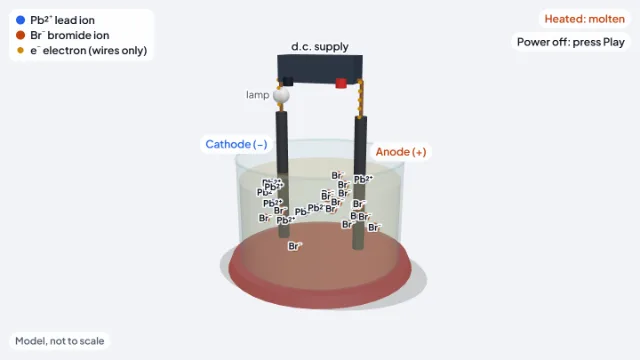
Electrolysis is the splitting up of an ionic compound by passing a direct current through it while it is molten or dissolved. The liquid that conducts is called the electrolyte. Two rods, the electrodes, dip into it and connect to the d.c. supply:

  • the cathode is the negative electrode, so it attracts the positive ions (metal ions and H⁺);
  • the anode is the positive electrode, so it attracts the negative ions (non-metal ions such as Br⁻ and Cl⁻).

When an ion reaches the electrode of opposite charge it is discharged: it gains or loses electrons and turns into an uncharged element. The compound is broken down into the elements it was made from.

Why must an ionic compound be molten?

An ionic solid is a giant lattice in which every ion is held in place by strong electrostatic attraction to its neighbours. The ions can vibrate but cannot drift anywhere, so a solid ionic compound does not conduct. Melting breaks up the regular arrangement: the ions are now free to move through the liquid, which can carry a current. Dissolving in water frees the ions too, which is covered on electrolysis of aqueous solutions. The link between the lattice and conductivity is explained on properties of ionic compounds.

A neat classroom check: wire a lamp into the circuit. With solid lead(II) bromide in the crucible the lamp stays off; once the solid has melted the lamp comes on and the products begin to appear.

How is the current carried?

Charge moves in two different ways in the same circuit:

  1. In the wires and electrodes, electrons flow, pushed round by the power supply.
  2. In the electrolyte, no electrons travel through the liquid. Instead the ions themselves drift towards the electrodes, and their movement is the current.
  3. At the surfaces of the electrodes the two meet: positive ions pick up electrons from the cathode, and negative ions hand electrons over to the anode.

What forms at each electrode in a molten compound?

A binary compound contains just two elements, so the melt holds only two kinds of ion. The rule is short:

the metal forms at the cathode and the non-metal forms at the anode.

Molten compoundIons in the meltAt the cathode (−)At the anode (+)
Lead(II) bromide, PbBr₂Pb²⁺, Br⁻Lead: silvery liquid that sinks to the bottomBromine: red-brown vapour
Zinc chloride, ZnCl₂Zn²⁺, Cl⁻ZincChlorine: pale green gas
Sodium chloride, NaClNa⁺, Cl⁻SodiumChlorine
Potassium iodide, KIK⁺, I⁻PotassiumIodine
Calcium oxide, CaOCa²⁺, O²⁻CalciumOxygen

The name of the compound gives the answer away. The first word is the metal, and the "-ide" ending tells you the non-metal: bromide gives bromine, oxide gives oxygen. The electrodes are usually graphite or platinum. These are inert, meaning they carry the current without reacting themselves.

Half equations for a melt (HT)

Metal ions arriving at the cathode gain electrons: this is reduction. Non-metal ions arriving at the anode lose electrons: this is oxidation. For lead(II) bromide:

PbX2++2 eX−→Pb\ce{Pb^2+ + 2e- -> Pb}

2 BrX−→BrX2+2 eX−\ce{2Br- -> Br2 + 2e-}

Bromine exists as Br₂ molecules, so two bromide ions are needed for each molecule, and two electrons are released. For every lead atom made at the cathode, one bromine molecule is made at the anode, because both steps involve two electrons. Writing and balancing these is covered step by step on half equations at electrodes.

Worked example: molten potassium iodide

Question: Molten potassium iodide is electrolysed with inert electrodes. Predict the product at each electrode and, for Higher tier, write both half equations.

  1. Ions present: potassium is in Group 1, so it forms K⁺. Iodine is in Group 7, so it forms I⁻. Nothing else is in the melt.
  2. Cathode (−): the positive K⁺ ions are attracted here and gain an electron each. Potassium metal forms.
  3. Anode (+): the negative I⁻ ions are attracted here and lose an electron each. Iodine forms, seen as a purple vapour above the very hot melt.
  4. (HT) Cathode: KX++eX−→K\ce{K+ + e- -> K} (reduction).
  5. (HT) Anode: 2 IX−→IX2+2 eX−\ce{2I- -> I2 + 2e-} (oxidation).
  6. Check the electrons: two electrons are released for each I₂, and the same two electrons make two potassium atoms. So the products form in the ratio 2K : 1I₂.

How is this done safely in the lab?

Molten lead(II) bromide gives off toxic bromine and contains toxic lead, so it is at most a teacher demonstration in a fume cupboard. For class practical work, the AQA specification names anhydrous zinc chloride as the safer choice. Even then, the crucible is very hot, chlorine is toxic, and the run should be short and well ventilated. Eye protection is essential.

Electrolysis of molten compounds is also how very reactive metals are produced on a large scale. Aluminium is made this way, from aluminium oxide dissolved in molten cryolite, which is a separate spec point (4.4.3.3).

Try it in the simulation

The 3D cell above opens on Molten lead(II) bromide. Press Play and read the Cathode (−) and Anode (+) cards as lead collects below one rod and bromine fumes rise from the other. Then switch the Molten button to Solid and play again: the ions stay put and the lamp stays dark. Finally choose Molten sodium chloride and predict both products before you press Play. The site's ionic bonding model shows how the ions were formed in the first place.
Common mistakes

  • Saying solid ionic compounds contain no ions. The solid is full of ions; they simply cannot leave their places in the lattice to reach the electrodes.
  • Getting the electrodes the wrong way round. In electrolysis the cathode is negative and attracts positive ions; the anode is positive and attracts negative ions.
  • Writing that electrons flow through the molten electrolyte. Electrons move only in the wires and electrodes; ions carry the charge in the liquid.
  • Giving the anode product as a single atom, such as Br. Halogens and oxygen form diatomic molecules, so the product is Br₂, Cl₂ or O₂.
  • Naming the anode product with its ion name, such as 'chloride gas'. The element formed is chlorine; chloride is the ion it came from.
  • (HT) Putting the electrons on the wrong side. Metal ions gain electrons at the cathode (electrons on the left); non-metal ions lose them at the anode (electrons on the right).

Exam practice

Exam-style questions

Original questions written in the style of GCSE AQA Chemistry. Try each one before you reveal the answer.

  1. 1.A student places solid zinc chloride in a crucible with two graphite electrodes connected to a d.c. supply and a lamp. The lamp does not light. The student heats the crucible until the zinc chloride melts, and the lamp lights.

    1. (a)Explain why the lamp lights only after the zinc chloride has melted.

      2 marks
      Show the answer

      Answer: In the solid, the zinc and chloride ions can only vibrate about fixed points in the lattice. Once melted, the ions can drift through the liquid and carry charge to the electrodes, so a current flows.

      Marking points

      • Ions cannot move / are held in fixed positions in the solid
      • Ions are free to move when molten, so charge flows
    2. (b)Name the product formed at each electrode.

      2 marks
      Show the answer

      Answer: Zinc at the negative electrode (cathode); chlorine at the positive electrode (anode).

      Marking points

      • Zinc at the cathode / negative electrode
      • Chlorine at the anode / positive electrode
    3. (c)(Higher tier) Write a half equation for the reaction at the negative electrode, and explain why it is described as reduction.

      3 marks
      Show the answer

      Answer: Zn²⁺ + 2e⁻ → Zn. Each zinc ion gains two electrons, and gaining electrons is reduction.

      Marking points

      • Zn²⁺ and 2e⁻ on the left
      • Zn on the right
      • Reduction because electrons are gained
  2. 2.Molten lead(II) bromide is electrolysed using inert electrodes in a fume cupboard.

    1. (a)Describe what is seen at the positive electrode.

      1 mark
      Show the answer

      Answer: Red-brown (brown) fumes or vapour of bromine.

      Marking points

      • Red-brown / brown vapour or gas (bromine)
    2. (b)Give the meaning of the term inert electrode.

      1 mark
      Show the answer

      Answer: An electrode that conducts but does not react or change during the electrolysis, such as graphite or platinum.

      Marking points

      • Does not react / is not changed in the electrolysis
    3. (c)Suggest why the electrolysis is carried out in a fume cupboard.

      2 marks
      Show the answer

      Answer: Bromine vapour is toxic, and lead compounds and lead vapour are toxic too, so the fumes must be removed and not breathed in.

      Marking points

      • Bromine (vapour) is toxic
      • So the fumes must not be inhaled / must be removed
  3. 3.Some molten binary ionic compounds are electrolysed with inert electrodes.

    1. (a)Predict the products at the cathode and at the anode for molten calcium bromide.

      2 marks
      Show the answer

      Answer: Calcium at the cathode; bromine at the anode.

      Marking points

      • Calcium at the cathode
      • Bromine at the anode
    2. (b)Molten lithium oxide is electrolysed. Explain which ions move towards the anode.

      2 marks
      Show the answer

      Answer: Oxide ions, O²⁻, move to the anode because they are negatively charged and the anode is the positive electrode.

      Marking points

      • Oxide ions / O²⁻
      • Negative ions are attracted to the positive anode
    3. (c)Explain how electric charge is carried through the molten compound and through the connecting wires.

      2 marks
      Show the answer

      Answer: In the molten compound, charge is carried by moving ions. In the wires, charge is carried by moving electrons.

      Marking points

      • Ions move in the molten electrolyte
      • Electrons move in the wires

Quiz

Quick check

6 questions

  1. 1.Molten magnesium chloride is electrolysed. What forms at the cathode?
  2. 2.Which of these is an electrolyte?
  3. 3.During the electrolysis of molten sodium chloride, which way do the chloride ions move?
  4. 4.Why are graphite electrodes used for electrolysing molten lead(II) bromide?
  5. 5.(HT) Which half equation shows the reaction at the anode when molten aluminium oxide is electrolysed?
  6. 6.A molten compound gives a metal at one electrode and a red-brown vapour at the other. Which compound could it be?

Next step

Now see it move

Open the full electrolysis in 3d (molten and aqueous compounds, products at each electrode) simulation for every preset, graphs and the teacher tools, then test yourself.

Electrolysis in 3D simulation: a 3D electrolysis cell with labelled ions3D