What syllabus 4.1 expects
What is electrolysis? (Core)
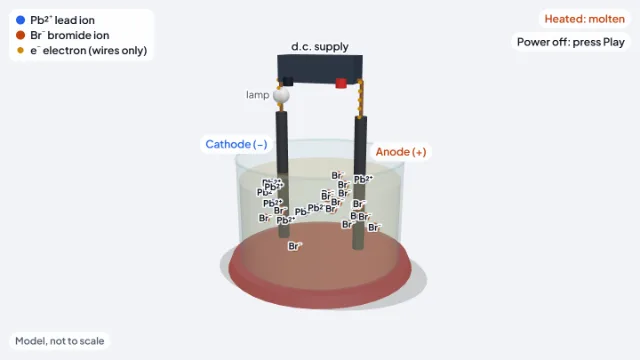
Electrolysis is the decomposition of an ionic compound, when it is molten or in aqueous solution, by passing an electric current through it. Three terms describe the cell:
- the electrolyte is the molten or aqueous substance being decomposed;
- the anode is the positive electrode;
- the cathode is the negative electrode.
Inert electrodes, made of platinum or carbon (graphite), conduct the current but do not react. Cambridge's general rule for where the products appear: metals or hydrogen are produced at the cathode, while non-metals apart from hydrogen are produced at the anode.
What do the three Core electrolytes produce? (Core)
| Electrolyte (inert electrodes) | Cathode product and observation | Anode product and observation |
|---|---|---|
| Molten lead(II) bromide | Lead: shiny grey liquid metal collecting at the bottom | Bromine: red-brown vapour |
| Concentrated aqueous sodium chloride | Hydrogen: colourless bubbles that give a squeaky pop with a lighted splint | Chlorine: pale yellow-green bubbles that bleach damp litmus paper |
| Dilute sulfuric acid | Hydrogen: colourless bubbles | Oxygen: colourless bubbles that relight a glowing splint |
Two details examiners like. With concentrated sodium chloride the solution around the cathode turns alkaline, because sodium hydroxide is left behind once hydrogen and chlorine have gone. With dilute sulfuric acid, you collect roughly double the volume of hydrogen compared with oxygen, because the reaction is really the decomposition of water.
How do you predict the products from a molten binary compound? (Core)
A binary compound is made of two elements. Once melted it contains only a metal ion and a non-metal ion, so the cathode collects the metal and the anode gives the non-metal. Molten potassium chloride gives potassium and chlorine; molten calcium iodide gives calcium and iodine; molten aluminium oxide gives aluminium and oxygen. No water is present, so hydrogen cannot be a product.
How is charge transferred during electrolysis? (Supplement)
Charge moves round the whole circuit, but not always in the same way:
- External circuit: electrons flow through the wires from the anode, round through the power supply, to the cathode.
- At the cathode: positive ions gain electrons from the electrode.
- In the electrolyte: ions move. Cations drift towards the cathode and anions drift towards the anode. No free electrons pass through the electrolyte.
- At the anode: negative ions give up electrons to the electrode, and these electrons enter the external circuit.
What happens with copper(II) sulfate solution? (Supplement)
| Carbon (graphite) electrodes | Copper electrodes | |
|---|---|---|
| Cathode | Pink-brown copper coats the electrode | Pink-brown copper coats the electrode; its mass increases |
| Anode | Bubbles of oxygen | No gas; the anode slowly dissolves and loses mass |
| Blue colour of the solution | Fades, as Cu²⁺ ions are removed | Stays the same, as each Cu²⁺ ion removed is replaced from the anode |
| Solution left | Becomes acidic (sulfuric acid builds up) | Copper(II) sulfate, unchanged in concentration |
The copper-electrode version is how impure copper is refined: the impure metal is the anode and a thin sheet of pure copper is the cathode.
How do you predict the products for a halide solution? (Supplement)
In an aqueous solution, water provides H⁺ and OH⁻ ions as well as the ions of the compound.
- Cathode: the product is hydrogen, unless the metal is below hydrogen in the reactivity series (such as copper or silver), in which case the metal forms.
- Anode, concentrated halide: the halogen forms, such as chlorine from concentrated sodium chloride.
- Anode, dilute halide: mainly oxygen forms, because hydroxide ions from water are discharged instead. The more the solution is diluted, the less chlorine and the more oxygen is produced.
Worked example. Predict the products for (a) concentrated aqueous copper(II) chloride and (b) very dilute aqueous sodium chloride, using inert electrodes.
- (a) Cathode: copper is below hydrogen, so copper is deposited.
- (a) Anode: the chloride solution is concentrated, so chlorine forms.
- (b) Cathode: sodium is above hydrogen, so hydrogen forms.
- (b) Anode: the chloride solution is dilute, so mainly oxygen forms.
Try it in the simulation
Open the 3D cell above, which starts with Molten lead(II) bromide, press Play, and compare the Cathode (−) and Anode (+) cards with the Core table. Choose Sodium chloride solution and switch Concentrated to Dilute to see the anode product change. For the Supplement, choose Copper(II) sulfate solution and run it twice, once with Graphite and once with Copper electrodes, watching the colour of the solution. The reactivity order behind the cathode rule can be tested in the reactivity series and displacement model.