Where this sits in AQA chemistry
Why is a solution different from a melt?
A melt contains just the two ions of the compound. A solution has a third ingredient: water. A very small fraction of water molecules split into hydrogen ions and hydroxide ions:
So in sodium chloride solution there are four kinds of ion: Na⁺ and H⁺ drift to the cathode, while Cl⁻ and OH⁻ drift to the anode. At each electrode only one of the two competing ions is discharged, and the two rules below tell you which.
What forms at the cathode?
At the negative electrode the choice is between the metal ion and H⁺. It depends on how reactive the metal is compared with hydrogen:
- When the metal sits above hydrogen in the reactivity series (potassium, sodium, calcium, magnesium and the like), hydrogen gas is produced and the metal ions stay in solution.
- When the metal sits below hydrogen (copper, silver, gold), the metal is deposited on the cathode.
A reactive metal holds on to its outer electrons only loosely, so its ion does not readily take electrons back. Hydrogen ions accept them more easily, which is why sodium is never deposited from sodium chloride solution.
What forms at the anode?
At the positive electrode the choice is between the negative ion of the compound and OH⁻:
- If the solution contains halide ions (chloride, bromide or iodide), the halogen is produced: chlorine, bromine or iodine.
- If not, for example with sulfate, nitrate or carbonate ions, oxygen is produced from the hydroxide ions, and the other negative ion stays in solution.
Which products does each solution give?
| Solution (inert electrodes) | Is the metal below hydrogen? | Is a halide present? | Cathode (−) | Anode (+) |
|---|---|---|---|---|
| Sodium chloride | No | Yes | Hydrogen | Chlorine |
| Potassium bromide | No | Yes | Hydrogen | Bromine |
| Copper(II) chloride | Yes | Yes | Copper | Chlorine |
| Copper(II) sulfate | Yes | No | Copper | Oxygen |
| Silver nitrate | Yes | No | Silver | Oxygen |
| Sodium sulfate | No | No | Hydrogen | Oxygen |
Answering the two questions in the middle columns, one for each electrode, is all the prediction needs. When both answers are "no", as with sodium sulfate, only water is broken down, so the solution becomes slowly more concentrated.
Worked example: sodium chloride solution
Question: A current is passed through concentrated sodium chloride solution using graphite electrodes. Name the products at each electrode and explain why the solution left behind is alkaline.
- Ions present: Na⁺ and Cl⁻ from the salt; H⁺ and OH⁻ from water.
- Cathode: sodium is more reactive than hydrogen, so H⁺ ions are discharged. Hydrogen gas forms.
- Anode: chloride is a halide, so Cl⁻ ions are discharged. Chlorine gas forms.
- What remains: H⁺ and Cl⁻ have been removed, leaving Na⁺ and OH⁻ ions in the solution. That is sodium hydroxide solution, which is alkaline.
This is why the electrolysis of brine is a major industry: one process makes hydrogen, chlorine and sodium hydroxide, all of which are useful.
Half equations for solutions (HT)
The first two are reductions at the cathode; the last two are oxidations at the anode. The oxygen equation is the hardest to balance, so it gets a full walk-through on half equations at electrodes.
How do you carry out required practical 3?
- Pour about 50 cm³ of the solution, for example copper(II) chloride, into a small beaker.
- Fit two carbon rods through a lid so they cannot touch each other, and connect them to the d.c. terminals of a low-voltage supply set to about 4 V.
- Before switching on, write a hypothesis: predict each product using the two rules above.
- Switch on, watch both electrodes and switch off again after no more than about 5 minutes.
- Identify the products: with forceps, hold blue litmus paper in the solution beside the anode to test for chlorine. If you want to test a gas at the cathode, collect it in an upturned test tube for the splint tests.
- Switch off, rinse the electrodes and repeat with the next solution, such as sodium chloride.
| Product | What you see | Test |
|---|---|---|
| Copper | Pink-brown coating on the cathode | None needed: the coating is visible |
| Hydrogen | Colourless bubbles | Squeaky pop with a lighted splint |
| Oxygen | Colourless bubbles | Relights a glowing splint |
| Chlorine | Pale green bubbles; sharp smell | Bleaches damp litmus paper white |
Chlorine is toxic, so keep the voltage low (about 4 V), the runs short (about 5 minutes) and the room well ventilated, and never sniff the gas.
Try it in the simulation
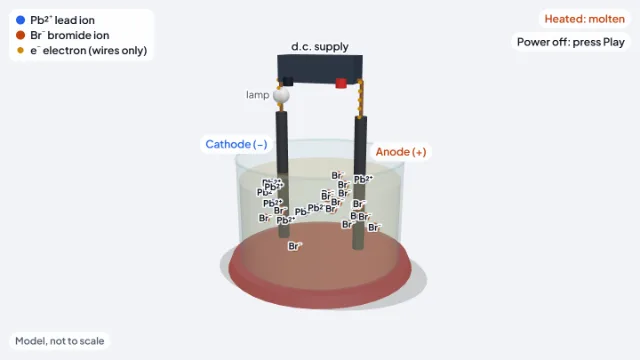
Pick Sodium chloride solution in the 3D cell above, then press Play. Watch the Na⁺ ions drift to the cathode and stay in solution while hydrogen bubbles off instead, and read the Ions present card. Then try Copper(II) sulfate solution and Potassium iodide solution, predicting both products before each run. The order of reactivity that decides the cathode product is the same one you can test by dropping metals into salt solutions in the reactivity series and displacement model. For the molten case with no water, see electrolysis of molten compounds.