Skip to content

Cambridge IGCSE Chemistry (0620) · Electrochemistry

Ionic half-equations at electrodes

4.1.11Supplement

Supplement. An ionic half-equation describes one electrode, electrons included. Reduction happens at the cathode, where ions gain electrons: Cu²⁺ + 2e⁻ → Cu. Oxidation happens at the anode, where electrons are lost: 2Cl⁻ → Cl₂ + 2e⁻. Atoms and total charge must balance on both sides.

Loading simulation…

Symbols match your course. Open the full electrolysis in 3d (molten and aqueous compounds, products at each electrode) simulation for more presets and teacher tools.

Who needs ionic half-equations?

What does an ionic half-equation show? (Supplement)

An electrolysis cell has two separate reactions, one at each electrode. An ionic half-equation shows just one of them, with the electrons written in as e⁻.

  • Cathode (negative): cations take electrons from the electrode. Gaining electrons is reduction, so e⁻ appears among the reactants.
  • Anode (positive): anions, or an anode made of a reactive metal, give electrons to the electrode. Losing electrons is oxidation, so e⁻ appears among the products.

Cambridge also defines oxidation and reduction by oxygen gain and loss, and by change of oxidation number, but at the electrodes the electron definition is the one to use.

How do you build a half-equation step by step? (Supplement)

Take the formation of chlorine at the anode.

  1. Reactant and product: Cl⁻ → Cl₂.
  2. Balance the atoms: chlorine molecules contain two atoms, so 2Cl⁻ → Cl₂.
  3. Balance the charge with electrons: the left totals 2−, the right totals 0. Two electrons must leave, so they go on the right.

2 ClX−→ClX2+2 eX−\ce{2Cl- -> Cl2 + 2e-}

  1. Check: both sides now total 2−, and the electrons are products, which fits oxidation at the anode.

The same steps work at the cathode, except that the electrons end up on the left. For a copper(II) ion, Cu²⁺ → Cu has 2+ on the left and 0 on the right, so two electrons are added to the left.

What are the half-equations for each Cambridge electrolyte? (Supplement)

ElectrolyteCathode: reductionAnode: oxidation
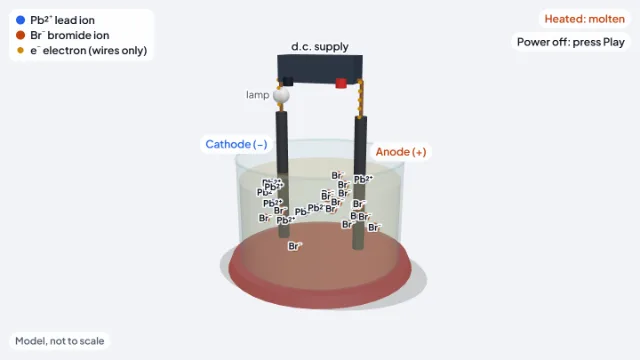
Molten lead(II) bromidePb²⁺ + 2e⁻ → Pb2Br⁻ → Br₂ + 2e⁻
Concentrated aqueous sodium chloride2H⁺ + 2e⁻ → H₂2Cl⁻ → Cl₂ + 2e⁻
Dilute sulfuric acid2H⁺ + 2e⁻ → H₂4OH⁻ → O₂ + 2H₂O + 4e⁻
Copper(II) sulfate, carbon electrodesCu²⁺ + 2e⁻ → Cu4OH⁻ → O₂ + 2H₂O + 4e⁻
Copper(II) sulfate, copper electrodesCu²⁺ + 2e⁻ → CuCu → Cu²⁺ + 2e⁻
Molten aluminium oxide (in cryolite)Al³⁺ + 3e⁻ → Al2O²⁻ → O₂ + 4e⁻

The copper anode is the odd one out: the electrode itself is oxidised, so copper atoms become ions instead of an anion being discharged. That is why the anode loses mass and the blue colour of the solution does not fade.

Worked example: oxygen from hydroxide ions (Supplement)

Question: In the electrolysis of dilute sulfuric acid, oxygen forms at the anode from hydroxide ions. Construct the ionic half-equation.

  1. Species: hydroxide ions give oxygen, and their hydrogen ends up in water: OH⁻ → O₂ + H₂O.
  2. Atoms: try four hydroxide ions. That gives four oxygen and four hydrogen atoms on the left, and one O₂ plus two H₂O molecules also hold four of each, so the atoms balance.
  3. Charge: the left is 4−, the right is 0, so four electrons are written on the right.

4 OHX−→OX2+2 HX2O+4 eX−\ce{4OH- -> O2 + 2H2O + 4e-}

  1. Type of reaction: electrons are lost, so this is oxidation, as expected at the anode.

How do half-equations explain the gas volumes? (Supplement)

Every electron released at the anode is taken up at the cathode, so the two half-equations must involve the same number of electrons over any period of time. For dilute sulfuric acid, multiply the hydrogen equation by two so both involve four electrons:

4 HX++4 eX−→2 HX2\ce{4H+ + 4e- -> 2H2}

Four electrons give two molecules of hydrogen but only one of oxygen. Equal numbers of gas molecules occupy equal volumes at the same temperature and pressure, so the hydrogen collected is about twice the volume of oxygen. In concentrated brine, hydrogen and chlorine each need two electrons per molecule, so their volumes are equal in theory, although some chlorine dissolves in the solution at first.

How do you spot errors in a half-equation? (Supplement)

Check these four things on every half-equation you write or are given:

  • Diatomic products: hydrogen, oxygen and the halogens appear as H₂, O₂, Cl₂, Br₂ and I₂, never as single atoms.
  • Charge balance: the total charge on the left equals the total on the right.
  • Electron side: electrons on the left at the cathode, on the right at the anode.
  • Metal ions: match the electron count to the ion's charge: one for Ag⁺, three for Al³⁺.

Check yourself in the simulation

Choose an electrolyte in the 3D cell, write both half-equations on paper, then press Play and compare yours with the Half equations box below the Cathode (−) and Anode (+) cards. Try Copper(II) sulfate solution with Graphite, then switch the electrodes to Copper and see how the anode equation changes. With Dilute sulfuric acid, compare the bubbles at each electrode and read the gas-volume line under the equations to see the 2 : 1 ratio predicted above. The electron transfers that made these ions in the first place can be seen in the ionic bonding model.
Common mistakes

  • (Supplement) Writing reduction at the anode. Reduction (gain of electrons) happens at the cathode; oxidation (loss of electrons) happens at the anode.
  • (Supplement) Writing single atoms such as O or Cl as the products. Oxygen and the halogens form diatomic molecules.
  • (Supplement) Balancing atoms but leaving the charges unequal. Add electrons until the total charge on each side is the same.
  • (Supplement) Forgetting the water in the hydroxide half-equation. Four OH⁻ ions give one O₂ and two H₂O, with four electrons.
  • (Supplement) Writing an anion discharge for copper(II) sulfate with copper electrodes. The copper anode itself is oxidised: Cu → Cu²⁺ + 2e⁻.
  • (Supplement) Expecting equal volumes of hydrogen and oxygen from dilute sulfuric acid. Forming one O₂ frees four electrons, while one H₂ needs only two, so the hydrogen volume is double.

Exam practice

Exam-style questions

Original questions written in the style of Cambridge IGCSE Chemistry. Try each one before you reveal the answer.

  1. 1.Molten zinc bromide is electrolysed using inert electrodes.

    1. (a)(Supplement) Construct the ionic half-equation for zinc forming at the cathode.

      2 marks
      Show the answer

      Answer: Zn²⁺ + 2e⁻ → Zn

      Marking points

      • Zn²⁺ → Zn
      • 2e⁻ on the left
    2. (b)(Supplement) Construct the ionic half-equation for bromine forming at the anode.

      2 marks
      Show the answer

      Answer: 2Br⁻ → Br₂ + 2e⁻

      Marking points

      • 2Br⁻ → Br₂
      • 2e⁻ on the right
    3. (c)(Supplement) State which electrode reaction is oxidation. Explain your answer.

      2 marks
      Show the answer

      Answer: The anode reaction, because bromide ions lose electrons.

      Marking points

      • Anode / bromide reaction
      • Electrons are lost
  2. 2.Aqueous copper(II) sulfate is electrolysed using copper electrodes. This method is used to purify copper.

    1. (a)(Supplement) Construct the ionic half-equation for the copper anode as it dissolves.

      2 marks
      Show the answer

      Answer: Cu → Cu²⁺ + 2e⁻

      Marking points

      • Cu → Cu²⁺
      • 2e⁻ on the right
    2. (b)(Supplement) Use the half-equations at both electrodes to explain why the concentration of copper(II) ions in the solution does not change.

      2 marks
      Show the answer

      Answer: At the cathode Cu²⁺ + 2e⁻ → Cu removes copper ions, and at the anode Cu → Cu²⁺ + 2e⁻ adds copper ions. Both involve two electrons, so ions are added at the same rate as they are removed.

      Marking points

      • Cu²⁺ removed at the cathode and added at the anode
      • Same number of electrons, so at the same rate
  3. 3.Dilute sulfuric acid is electrolysed and the gases are collected. The half-equation at the anode is 4OH⁻ → O₂ + 2H₂O + 4e⁻.

    1. (a)(Supplement) Construct the half-equation for the hydrogen formed at the cathode.

      2 marks
      Show the answer

      Answer: 2H⁺ + 2e⁻ → H₂

      Marking points

      • 2H⁺ → H₂
      • 2e⁻ on the left
    2. (b)(Supplement) In an experiment, 40 cm³ of hydrogen is collected. Predict the volume of oxygen collected in the same time and explain your answer using the half-equations.

      3 marks
      Show the answer

      Answer: 20 cm³. Four electrons produce two H₂ molecules at the cathode but release only one O₂ molecule at the anode, so half as many oxygen molecules form. Equal numbers of molecules occupy equal volumes, so the oxygen volume is 40 ÷ 2 = 20 cm³.

      Marking points

      • 2 electrons per H₂, 4 electrons per O₂
      • So the mole (molecule) ratio H₂ : O₂ is 2 : 1
      • 20 cm³

Quiz

Quick check

5 questions

  1. 1.(Supplement) Which ionic half-equation is correctly balanced?
  2. 2.(Supplement) For concentrated aqueous sodium chloride, which half-equation describes the anode?
  3. 3.(Supplement) What is reduction, in terms of electrons?
  4. 4.(Supplement) How many electrons are needed to balance 2O²⁻ → O₂?
  5. 5.(Supplement) Silver nitrate solution is electrolysed. Which half-equation describes the cathode?

Next step

Now see it move

Open the full electrolysis in 3d (molten and aqueous compounds, products at each electrode) simulation for every preset, graphs and the teacher tools, then test yourself.

Electrolysis in 3D simulation: a 3D electrolysis cell with labelled ions3D