Interactive 3D physics and chemistry simulations
Some ideas only really make sense in three dimensions: a coil spinning between magnets, field lines circling a wire, electrons arranged in shells, the shape of a molecule or the repeating pattern of a crystal. Turn these models with your finger or mouse, look at them from different sides, and change the settings to see what happens.
In short
Can you do physics and chemistry simulations in 3D for free?
Yes. Every 3D simulation here is free, runs in your browser on a phone or computer, and needs no download or sign-up. Drag to turn the model or use the arrow keys. The physics models are fact-checked and labelled against the GCSE, IGCSE and Punjab Class 9–10 courses. The chemistry models are new, and more are on the way.
Physics in 3D
All physics simulations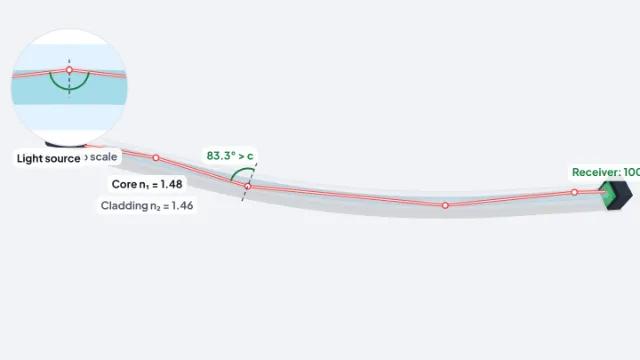 3D
Optical fibres
Aim a ray into a 3D glass fibre. Watch total internal reflection, find the critical angle with cladding or air, and bend the fibre until light leaks out.Predict: A fibre with cladding carries light round a gentle bend without losing any. Now the same fibre is bent far more tightly: the radius of the bend is only 10 times the radius of the core. The light still goes in at 6° to the axis. What happens to it at the bend?Try it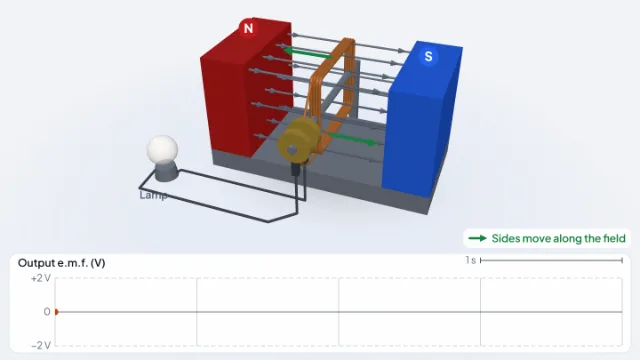 3D
AC generator in 3D (alternator and dynamo)
Turn a coil between magnet poles in 3D. Compare slip rings (a.c.) with a split ring (d.c.) and see why speed, turns and field strength change the output.Predict: The coil turns once a second, joined to the lamp by slip rings. Play runs it for one second, then turns it twice as fast for another second. Compared with the first second, what does the graph show in the second one?Try it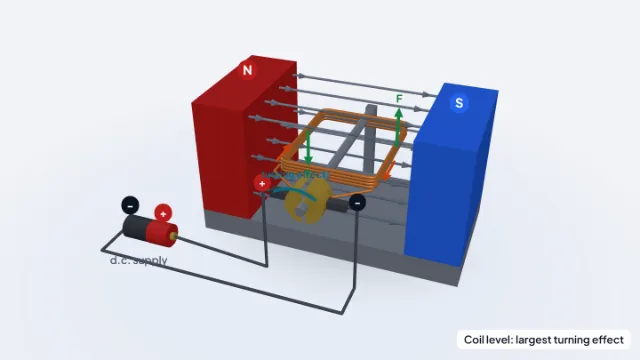 3D
DC motor in 3D
Spin a d.c. motor in 3D. See the push on both sides of the coil, why the turning effect drops to zero upright, and how the split ring keeps it turning.Predict: This motor has slip rings in place of its split ring, so each end of the coil keeps to one brush all the way round. The coil starts level, along the field lines. What will it do when Play is pressed?Try it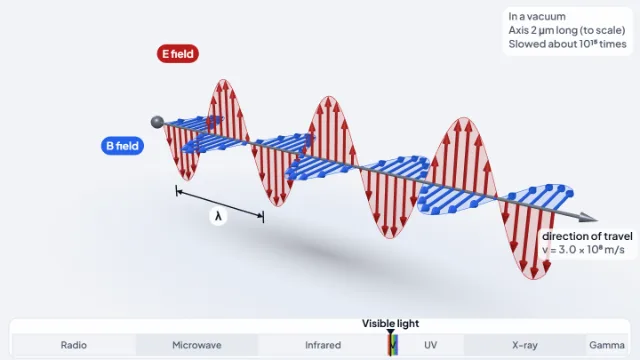 3D
Electromagnetic wave in 3D
Turn a travelling electromagnetic wave in 3D. See why it is transverse, why every region shares one speed, 3.0 × 10⁸ m/s, and how v = fλ links f and λ.Predict: Play sends orange light, wavelength 600 nm, from the source across the stage. Then it sends X-rays whose wavelength is 10 000 times shorter. Both travel through a vacuum. How does the speed of the X-rays compare with the speed of the light?Try it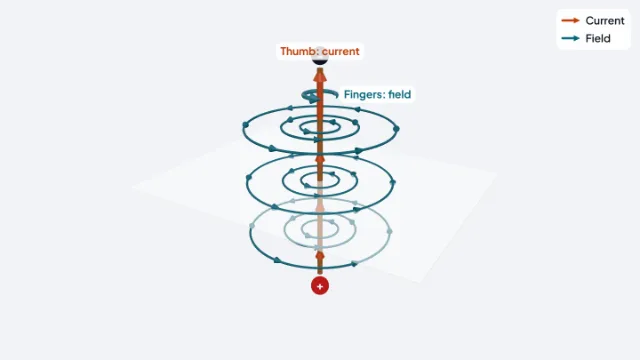 3D
Magnetic fields in 3D (wire, coil and solenoid)
Turn a 3D view round a wire, a flat coil and a solenoid. See circular field lines, apply the right-hand grip rule and find N poles with plotting compasses.Predict: A horizontal card has a long straight wire running vertically through its centre. The conventional current flows down the wire, from the + connection at the top. Looking down on the card from above, in which direction do the field lines circle the wire?Try it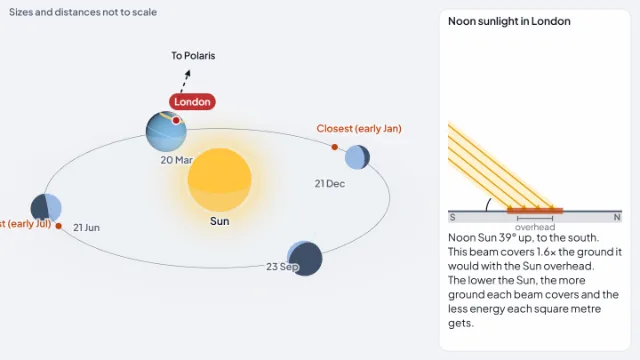 3D
Seasons in 3D
Run the Earth round the Sun in 3D. See why the 23.4° tilt, not distance, causes the seasons, and why Sydney has summer while London has winter.Predict: The marker is on Sydney, Australia (34° S), at noon on the June solstice. Play runs the Earth half-way round its orbit to the December solstice. What happens to the height of Sydney's noon Sun?Try it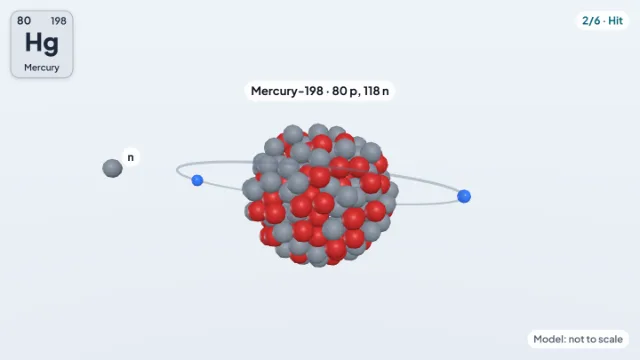 3DWow science
Turning mercury into gold in 3D (transmutation, isotopes and nuclear equations)
Fire a neutron at mercury-198 and watch it become gold-197 in 3D. Balance each nuclear equation, then see how CERN caught lead turning into gold.Predict: A fast neutron hits a mercury-198 nucleus (80 protons, 118 neutrons) and two neutrons fly out. What nucleus is left?Try it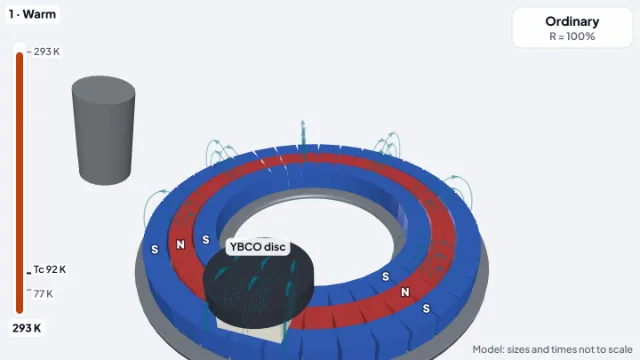 3DWow science
Superconductor levitation in 3D (a cold superconductor floating and locking above a magnet)
Cool a YBCO disc with liquid nitrogen, pull out its spacer and watch it float, lock, glide round a magnet track and hang upside down, all in 3D.Predict: Liquid nitrogen cools the YBCO disc from room temperature to 77 K. What happens to its electrical resistance as it passes about 92 K?Try it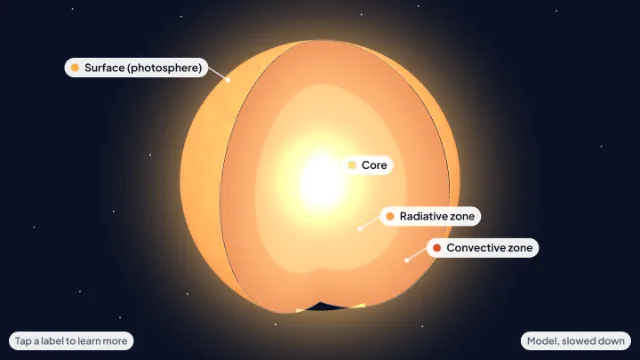 3DWow science
How the Sun makes energy in 3D (hydrogen fusing into helium)
Zoom into a cut-away 3D Sun, watch hydrogen nuclei fuse into helium step by step, see the lost mass become energy, then follow sunlight out to Earth.Predict: In the Sun's core, four hydrogen nuclei (protons) end up as one helium-4 nucleus. How does the mass that comes out compare with the mass that went in?Try it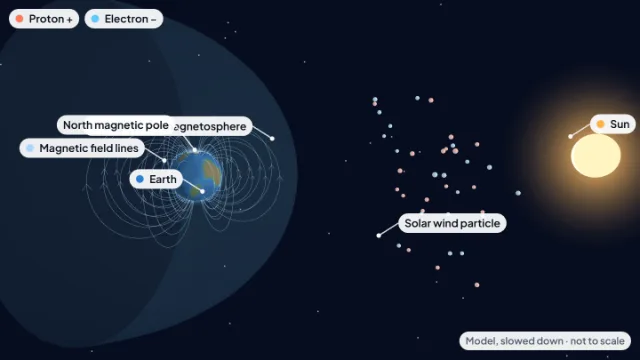 3DWow science
Northern lights in 3D (charged particles from the Sun following Earth’s magnetic field)
Northern lights in 3D: see the solar wind meet Earth's magnetic field, electrons stream to the poles, and oxygen and nitrogen glow.Predict: A stream of charged particles from the Sun, the solar wind, is heading for the Earth. What happens to most of it when it meets Earth's magnetic field?Try it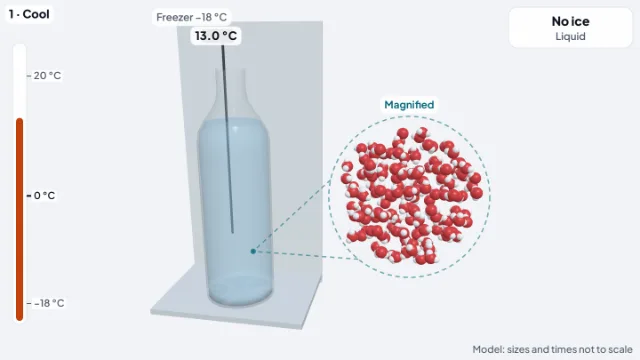 3DWow science
Instant ice in 3D (supercooled water freezing the moment it is disturbed)
Cool pure water below 0 °C without it freezing, tap the bottle and watch ice race through it in 3D, with the temperature jumping back to 0 °C.Predict: The bottle of pure water has cooled to −8 °C and is still liquid. Someone taps it, and ice crystals shoot through the water. What does the thermometer in the water do?Try it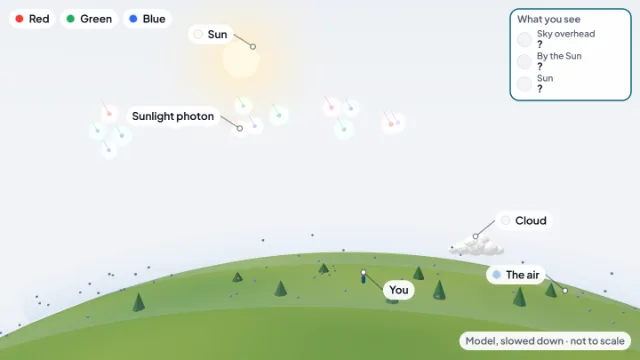 3DWow science
Why the sky is blue and sunsets are red in 3D (sunlight scattering in the air)
Why is the sky blue and the sunset red? Watch sunlight scatter off air molecules in 3D, then lower the Sun and see blue light scattered out of its path.Predict: Sunlight is a mix of all colours. As it passes through the air, tiny nitrogen and oxygen molecules knock some of it off in new directions (scattering). Which colour do they scatter the most?Try it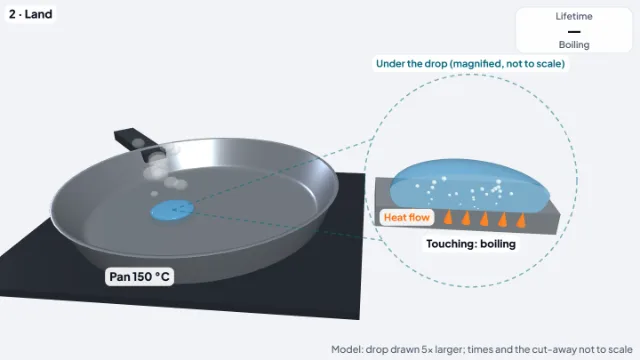 3DWow science
Leidenfrost drops in 3D (water skating on a very hot pan on a layer of steam)
Drop water on a hot pan in 3D. At 150 °C it sizzles away in seconds; past the Leidenfrost point it floats on steam and can last over a minute.Predict: On a 150 °C pan a drop of water sizzled away in about 1.5 seconds. Now the same size of drop is let fall onto the same pan at 300 °C. How long does it last?Try it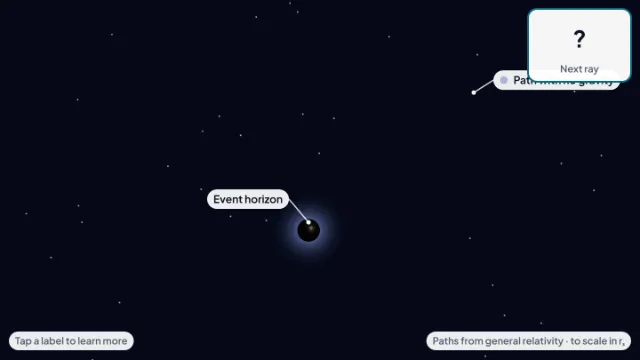 3DWow science
Black hole bending light in 3D (gravitational lensing of starlight)
Fire light past a black hole in 3D. Watch it bend, form an Einstein ring, circle the photon sphere or fall in, with paths from general relativity.Predict: A ray of light passes a black hole at 12 times the radius of its event horizon. What happens to the light?Try it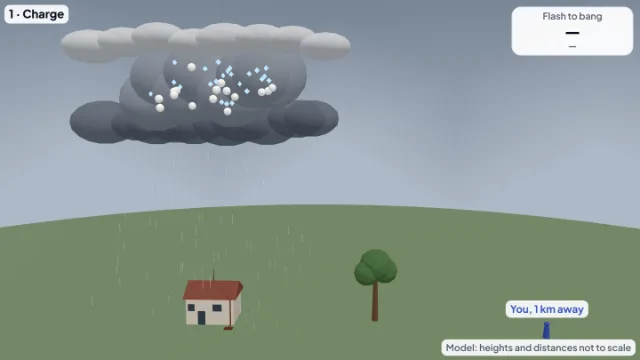 3DWow science
Lightning in 3D (how charge builds up in a storm cloud and why thunder follows the flash)
Charge a storm cloud in 3D, watch the leader meet a streamer and the flash, then count the seconds to the thunder to find how far away it struck.Predict: A storm's lightning leader is coming straight down over open ground at +10 m. A 15 m tree stands alone at +40 m, 30 m to one side. Where does the lightning strike?Try it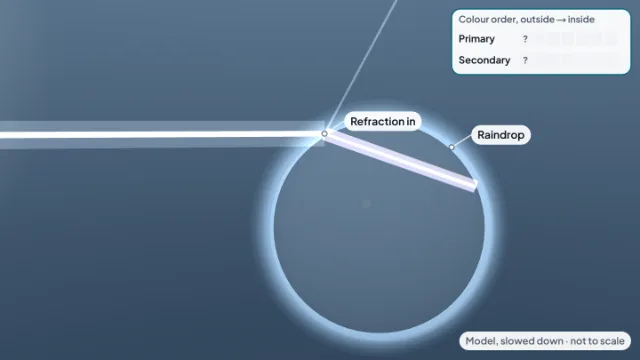 3DWow science
Rainbows in 3D (why a double rainbow has its colours reversed)
Trace sunlight through a 3D raindrop: refraction, one reflection and dispersion give a 42° bow. See why a double rainbow is reversed and rainbows curve.Predict: In water, violet light slows down a little more than red light, so violet bends a little more each time it enters or leaves a raindrop. On the main (primary) rainbow, which colour is on the outside of the arc?Try it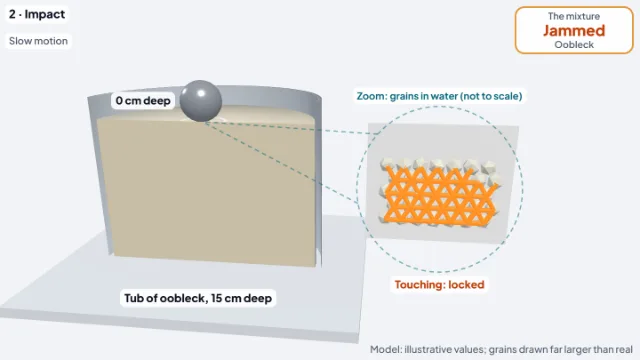 3DWow science
Oobleck in 3D (a liquid you can run across: cornflour and water)
Drop a steel ball on oobleck in 3D, then run across a pool of it. See why cornflour and water jams under a fast push but lets you sink if you stand still.Predict: A steel ball is dropped onto a tub of oobleck (cornflour stirred into water). It reaches the surface at 2 m/s, the speed it would have after falling about 20 cm. What happens in the first instant after it hits?Try it
Chemistry in 3D
All chemistry simulations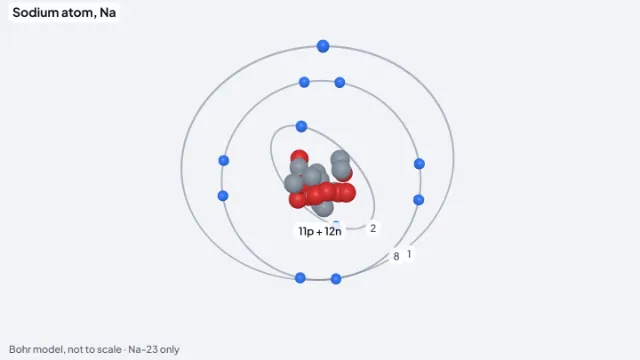 3D
Electron shells in 3D (atoms and ions up to calcium)
Build any atom from hydrogen to calcium in 3D, see its electrons fill the shells, link them to group and period, then turn it into an ion.Predict: A chlorine atom has 17 protons and 17 electrons. How are its electrons arranged in shells, starting from the shell nearest the nucleus?Try it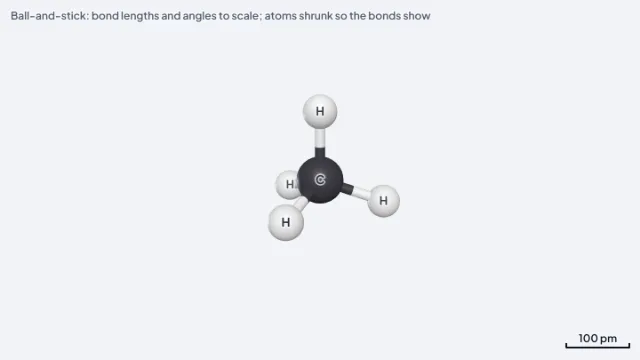 3D
Covalent molecules in 3D (ball-and-stick, space-filling and shared pairs)
Turn 11 covalent molecules in 3D: ball-and-stick, space-filling and shared-pair views, dot-and-cross diagrams, lone pairs and bond angles.Predict: A nitrogen molecule, N₂, is two nitrogen atoms joined by covalent bonding. Each nitrogen atom starts with 5 electrons in its outer shell. How many pairs of electrons do the two atoms share?Try it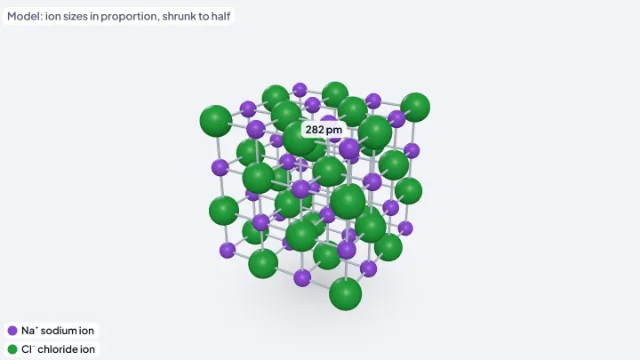 3D
Giant structures in 3D (sodium chloride, diamond, graphite and metals)
Turn sodium chloride, diamond, graphite, magnesium and silicon dioxide in 3D. Count neighbours, melt the salt, slide the layers and see what conducts.Predict: In solid sodium chloride, how many chloride ions are the nearest neighbours of each sodium ion?Try it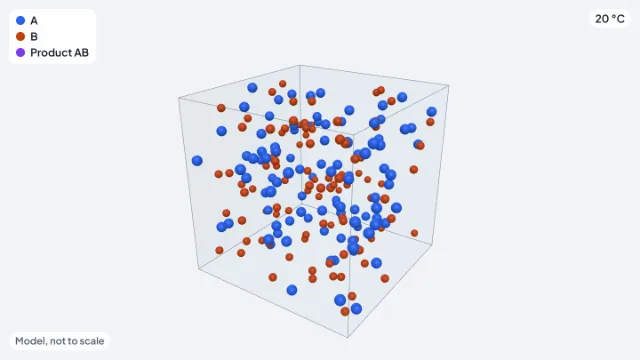 3D
Collision theory in 3D (temperature, concentration, surface area and catalysts)
Watch particles collide in a 3D vessel. Change temperature, concentration, surface area and a catalyst, and see why only some collisions react.Predict: A vessel holds 100 particles of A and 60 of B at 20 °C. Play runs it for 4 seconds, then runs the same mixture again with the B doubled to 120 particles in the same volume. In the second run, how many A–B collisions happen each second?Try it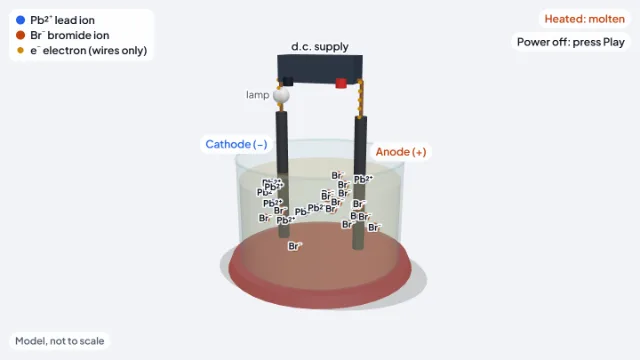 3D
Electrolysis in 3D (molten and aqueous compounds, products at each electrode)
Switch on a 3D electrolysis cell and watch ions drift to the electrodes. Compare molten and aqueous compounds and predict the product at each electrode.Predict: Concentrated sodium chloride solution is electrolysed with graphite electrodes. What forms at the cathode (the negative electrode)?Try it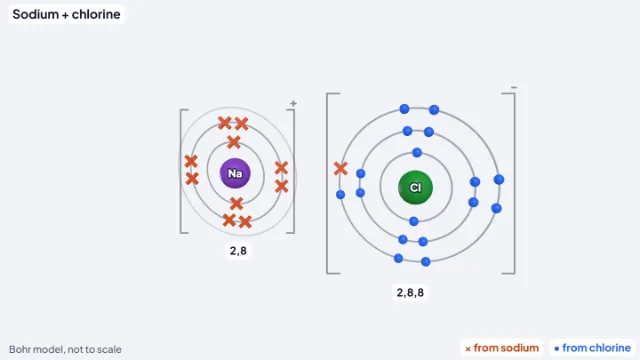 3D
Ionic bonding in 3D (electron transfer and the ions formed)
Watch metal atoms hand electrons to non-metal atoms in 3D, see the ions form with their charges, then draw the dot-and-cross diagram and the formula.Predict: Magnesium (2,8,2) reacts with oxygen (2,6) to make magnesium oxide. What charge does the magnesium ion carry?Try it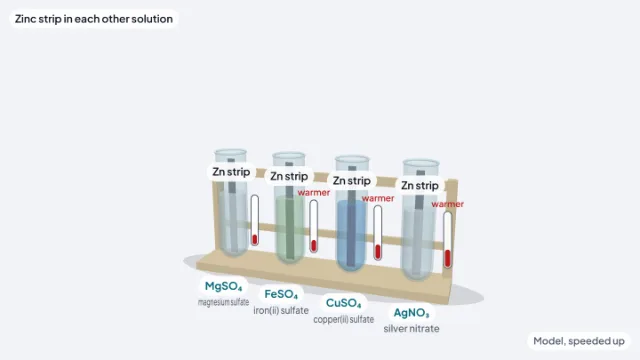 3D
Reactivity series and displacement in 3D (metals in salt solutions)
Lower metal strips into salt solutions in 3D, watch coatings form and colours change, then fill a results grid and deduce the reactivity series.Predict: A clean strip of copper is lowered into zinc sulfate solution. What happens?Try it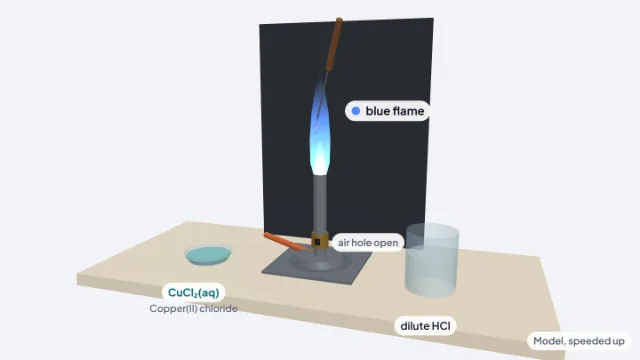 3D
Flame tests in 3D (identifying metal ions by flame colour)
Dip a nichrome loop, hold it in a 3D Bunsen flame and read the colour: lithium, sodium, potassium, calcium, barium and copper ions, plus mystery samples.Predict: A clean loop is dipped in potassium chloride solution and held in a blue Bunsen flame. What colour does the flame turn?Try it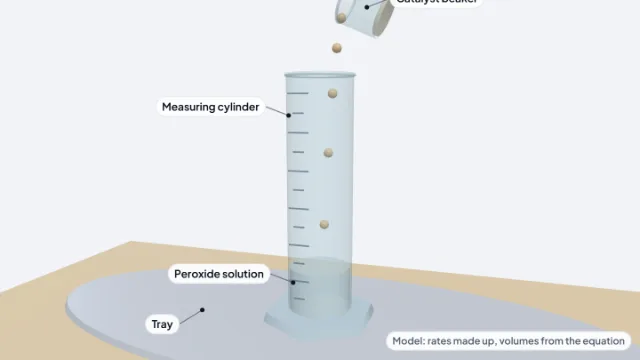 3DWow science
Elephant toothpaste in 3D (a catalyst decomposing hydrogen peroxide into a foam tower)
Why does elephant toothpaste foam so fast? Add a catalyst to hydrogen peroxide in 3D, zoom in on the molecules and graph the oxygen made over time.Predict: Potassium iodide is added as the catalyst and the hydrogen peroxide breaks down into water and oxygen. When the foam has stopped, how much of the catalyst is left?Try it
Looking for something else? Browse all physics simulations, the chemistry simulations or the virtual physics labs.
Next step
Looking for something else?
Browse every simulation by topic, or practise a required practical in a virtual lab.