Core. Exothermic reactions release thermal energy into the surroundings, which warm up; endothermic reactions absorb thermal energy from the surroundings, which cool down. Supplement: this transfer is the enthalpy change, ΔH, negative for exothermic and positive for endothermic reactions.
What are exothermic and endothermic reactions? (Core)
Picture a reaction happening in a beaker of solution. The reacting particles are one part of the picture; everything else counts as the surroundings: the water, the beaker, the thermometer and the air.
In an exothermic reaction, thermal energy passes from the reaction to the surroundings. A thermometer in the solution shows a rise in temperature.
In an endothermic reaction, thermal energy passes from the surroundings into the reaction. The thermometer shows a fall in temperature.
The thermometer never measures the energy stored in the chemicals themselves. It measures what happens to the surroundings, which is why "it got hotter" points to exothermic.
Which reactions are exothermic and which are endothermic? (Core)
Reaction or change
Type
What you notice
Burning fuels such as methane or ethanol
Exothermic
Flame; surroundings heated
Acid with alkali (neutralisation)
Exothermic
Solution warms by several degrees
Magnesium or zinc with dilute acid
Exothermic
Fizzing; test tube feels warm
Zinc powder in copper(II) sulfate solution
Exothermic
Blue colour fades; temperature rises
Respiration in cells
Exothermic
Keeps the body warm
Thermal decomposition of calcium carbonate
Endothermic
Only continues while strongly heated
Photosynthesis
Endothermic
Needs a continuous supply of light energy
Citric acid with sodium hydrogencarbonate
Endothermic
Fizzing; mixture becomes colder
Dissolving can also cause a temperature change. Ammonium nitrate dissolving in water makes the solution colder, but dissolving is a physical change, not a chemical reaction.
What is the enthalpy change, ΔH? (Supplement)
The thermal energy transferred during a reaction is called the enthalpy change, written ΔH and usually given in kJ/mol. Its sign shows the direction of the transfer, seen from the point of view of the reacting chemicals:
Exothermic
Endothermic
Energy of the chemicals
Falls (energy leaves them)
Rises (energy enters them)
Sign of ΔH
Negative, e.g. −57 kJ/mol
Positive, e.g. +178 kJ/mol
Temperature of surroundings
Increases
Decreases
A useful way to remember the sign: the chemicals lose energy in an exothermic reaction, so ΔH has a minus sign. The temperature of the surroundings going up and ΔH being negative describe the same event from two sides.
How do you measure a temperature change in the lab? (Core)
A simple method works for any reaction in solution:
Put a measured volume of one solution into a polystyrene cup, which insulates well, standing in a beaker for support.
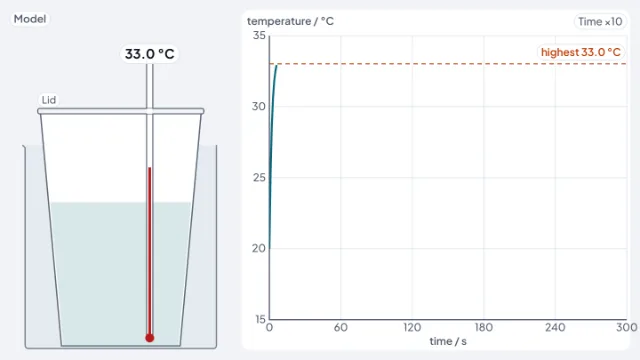
Record its starting temperature with a thermometer (a −10 to 110 °C thermometer with 1 °C divisions is typical).
Add the second reactant, stir, and record the highest temperature (or the lowest, for an endothermic reaction).
Temperature change = final temperature − starting temperature.
A lid cuts down energy exchange with the air, giving a result nearer the real value.
Worked example: classifying from results (Core and Supplement)
Question: Four experiments are carried out in a polystyrene cup. Classify each, and give the sign of ΔH.
D: change = 15 − 21 = −6 °C, so dissolving takes in energy (endothermic), though dissolving is physical, not chemical.
Watch the two different signs: a positive temperature change goes with a negative ΔH.
Try it in the simulation
In the cup simulation above, press Play with Acid + alkali and read the Temperature change card. Then try Zinc + copper sulfate and Citric acid + NaHCO₃, and predict the direction of each graph before you start. Use the Lid: on button to remove the lid and see how much smaller the change becomes. Displacement reactions like zinc with copper(II) sulfate are explored further in the reactivity series and displacement model.
!
Common mistakes
✕(Supplement) Giving an exothermic reaction a positive ΔH because the temperature went up. ΔH is measured for the chemicals, which lose energy, so it is negative.
✕Saying an endothermic reaction releases cold. It takes in thermal energy from the surroundings, which then cool down.
✕Classifying thermal decomposition as exothermic because a Bunsen burner gets hot. The reaction keeps absorbing energy from the burner, which makes it endothermic.
✕Thinking the thermometer measures the energy in the chemicals. It measures the temperature of the surroundings (mostly the water in the solution).
✕Calling dissolving ammonium nitrate a chemical reaction. The water does get colder, yet no new substance forms.
✕(Supplement) Writing ΔH without a sign. The sign is the whole point: − for exothermic, + for endothermic.
Exam practice
Exam-style questions
Original questions written in the style of Cambridge IGCSE Chemistry. Try each one before you reveal the answer.
1.A student adds magnesium ribbon to dilute hydrochloric acid in a polystyrene cup. The temperature rises from 20 °C to 34 °C.
(a)Calculate the temperature change. Is the reaction exothermic or endothermic?
2 marks
Show the answerHide the answer
Answer: 34 − 20 = 14 °C rise. Exothermic.
Marking points
14 °C (increase)
Exothermic
(b)Explain, in terms of energy transfer, why the temperature rises.
2 marks
Show the answerHide the answer
Answer: Thermal energy passes from the reacting chemicals into the solution around them, which therefore gets warmer.
Marking points
Thermal energy transferred to the surroundings
Surroundings (solution) warm up
(c)Suggest why a polystyrene cup is used rather than a glass beaker.
1 mark
Show the answerHide the answer
Answer: Polystyrene is a good thermal insulator, so less thermal energy is lost to the surroundings outside the cup.
Marking points
Polystyrene is an insulator / reduces energy loss
2.Calcium carbonate decomposes when heated strongly: CaCO₃ → CaO + CO₂. The reaction is endothermic.
(a)State what is meant by an endothermic reaction.
2 marks
Show the answerHide the answer
Answer: A reaction that absorbs thermal energy from its surroundings, making them colder.
Marking points
Takes in thermal energy from the surroundings
Surroundings cool down
(b)(Supplement) State the sign of the enthalpy change, ΔH, for this reaction. Explain your answer.
2 marks
Show the answerHide the answer
Answer: Positive, because the chemicals gain energy (thermal energy is taken in) during an endothermic reaction.
Marking points
Positive
Energy is taken in by the chemicals / endothermic
3.Some cold packs contain ammonium nitrate and water in separate compartments. Some hand warmers contain iron powder that reacts with oxygen from the air.
(a)State which product uses an exothermic change and which uses an endothermic change.
2 marks
Show the answerHide the answer
Answer: The hand warmer uses an exothermic change; the cold pack uses an endothermic change.
Marking points
Hand warmer: exothermic
Cold pack: endothermic
(b)(Supplement) The oxidation of iron in the hand warmer has a negative value of ΔH. Explain what the negative sign tells you.
2 marks
Show the answerHide the answer
Answer: The negative sign shows that the reaction is exothermic: thermal energy is released from the chemicals to the surroundings.
Open the full exothermic and endothermic reactions (temperature change and energy profiles) simulation for every preset, graphs and the teacher tools, then test yourself.