Skip to content

GCSE Chemistry — AQA (8462) · Energy changes

Reaction profiles

4.5.1.2

A reaction profile shows how energy changes as a reaction proceeds. Exothermic products sit below the reactants; endothermic ones sit above. The rise from reactants to the peak is the activation energy, the least energy colliding particles need. Higher tier: bond energies give the overall change.

Loading simulation…

Symbols match your course. Open the full exothermic and endothermic reactions (temperature change and energy profiles) simulation for more presets and teacher tools.

Where this sits in AQA chemistry

What is a reaction profile?

A reaction profile (also called an energy level diagram) is a sketch of how the energy of the reacting chemicals changes as a reaction goes from start to finish.

  • The vertical axis is energy.
  • The horizontal axis is the progress of the reaction, from reactants on the left to products on the right. It has no units and no scale.
  • A flat line on the left marks the energy of the reactants, and a flat line on the right marks the energy of the products.
  • A curved line joins them, rising to a peak before falling to the product level.

How do you draw a profile for an exothermic reaction?

  1. Draw and label both axes: "Energy" upwards, "Progress of reaction" across.
  2. Draw a short horizontal line for the reactants, about halfway up.
  3. Draw the products line lower than the reactants, because energy has been transferred to the surroundings.
  4. Join them with a smooth hump that rises well above the reactants before coming down.
  5. Draw a vertical arrow starting at the reactants level and ending at the peak; label it activation energy.
  6. Add a vertical arrow from the reactants line down to the products line and label it overall energy change (energy given out).

For an endothermic reaction the only differences are that the products line sits higher than the reactants, and the overall energy change arrow points up from the reactants to the products. The hump still starts at the reactants and rises above both levels.

How can you tell exothermic from endothermic on a profile?

Feature on the profileExothermicEndothermic
Products lineBelow the reactantsAbove the reactants
Overall energy change arrowPoints down: energy given outPoints up: energy taken in
Temperature of surroundingsRisesFalls
Activation energy arrowStarts at the reactant level, ends at the peakSame: reactant level to peak
ExamplesNeutralisation, combustionThermal decomposition

What is activation energy?

A reaction needs particles to bump into each other with enough energy behind the impact. The activation energy is the minimum energy that colliding particles must have to react. On the profile it is how far the peak rises above the reactant level.

Every reaction has an activation energy, including exothermic ones. That is why paper does not burst into flame on its own: a match must first supply enough energy for some particles to get over the hump. After that, the energy released keeps the burning going. A catalyst gives a different route with a lower hump, without moving the reactant or product levels, as shown on catalysts. For how activation energy controls the rate, see collision theory.

Worked example: values from a reaction profile

Question: On a profile, the reactants are at 150 kJ, the top of the hump is at 230 kJ and the products are at 60 kJ. Work out the activation energy and the overall change, then decide if the reaction is exothermic.

  1. Activation energy = peak − reactants = 230 − 150 = 80 kJ.
  2. Overall energy change = products − reactants = 60 − 150 = −90 kJ.
  3. The products are lower than the reactants and the change is negative, so 90 kJ is given out: the reaction is exothermic.

A common error is measuring the activation energy from the products (230 − 60 = 170 kJ). That would be the activation energy for the reverse reaction, not this one.

Why do energy changes happen? (Higher tier)

During a reaction, bonds in the reactants break and new bonds form in the products.

  • Breaking a bond always takes in energy.
  • Making a bond always gives out energy.

The overall energy change is the difference between the two totals:

energy change=energy to break bonds−energy released making bonds\text{energy change} = \text{energy to break bonds} - \text{energy released making bonds}

If making bonds releases more energy than breaking them needs, the difference goes to the surroundings and the reaction is exothermic (negative answer). If breaking needs more than making releases, the reaction is endothermic (positive answer). On a profile, this difference is the height between the reactants line and the products line. The activation energy is usually much smaller than the total for breaking every bond, because new bonds start forming while old ones are still breaking.

Worked example (HT). Hydrogen reacts with chlorine: H–H + Cl–Cl → 2 H–Cl. Use the bond energies H–H = 436 kJ/mol, Cl–Cl = 243 kJ/mol and H–Cl = 432 kJ/mol.

  1. Bonds broken: one H–H and one Cl–Cl: 436 + 243 = 679 kJ/mol.
  2. Bonds made: two H–Cl: 2 × 432 = 864 kJ/mol.
  3. Energy change: 679 − 864 = −185 kJ/mol.
  4. The answer is negative, so more energy is released than taken in: the reaction is exothermic.

Always count every bond in the balanced equation, including the 2 in front of HCl.

See the profiles in the simulation

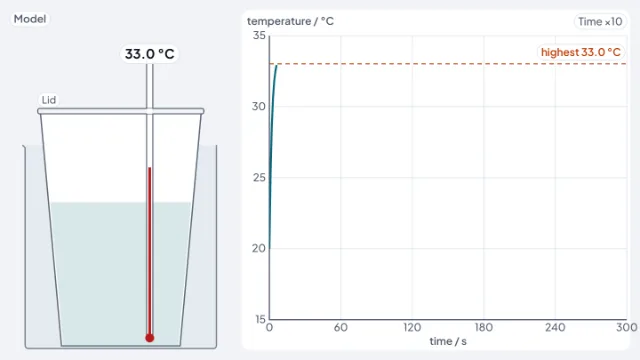
Run the cup simulation above with Acid + alkali. Once the run starts, look at the Reaction profile below the stage: the products sit lower than the reactants, matching the temperature rise. Then choose Citric acid + NaHCO₃ and compare: the products level now sits higher and the thermometer falls. The collision theory model shows the same hump from the particles' side, with a catalyst that lowers it. Temperature measurements behind these diagrams are covered on exothermic and endothermic reactions.
Common mistakes

  • Measuring the activation energy from the products to the peak. It is always measured from the reactants up to the top of the hump.
  • Drawing the hump of an endothermic profile lower than the products. The peak must be higher than both the reactant and product levels.
  • Pointing the overall energy change arrow from the products to the reactants. It starts at the reactants and ends at the products.
  • Thinking exothermic reactions need no activation energy. They still need enough energy to start, which is why fuels need a spark or flame.
  • (HT) Saying that breaking bonds releases energy. Breaking bonds always takes energy in; making bonds gives energy out.
  • (HT) Forgetting the numbers in the balanced equation when totalling bond energies, such as the 2 in 2HCl.

Exam practice

Exam-style questions

Original questions written in the style of GCSE AQA Chemistry. Try each one before you reveal the answer.

  1. 1.Hydrogen peroxide decomposes into water and oxygen. The reaction is exothermic.

    1. (a)Sketch and label a reaction profile for this reaction. Show the reactants, products, activation energy and overall energy change.

      4 marks
      Show the answer

      Answer: Axes labelled energy (vertical) and progress of reaction (horizontal). Products line drawn lower than the reactants line. A curved line rising from the reactants to a peak and falling to the products. Activation energy arrow from the reactants up to the peak; overall energy change arrow from the reactants down to the products.

      Marking points

      • Products drawn lower than reactants
      • Curved line with a hump above both levels
      • Activation energy shown from reactants to peak
      • Overall energy change shown from reactants to products
    2. (b)State what is meant by activation energy.

      1 mark
      Show the answer

      Answer: The minimum energy that particles must have when they collide for them to react.

      Marking points

      • Minimum energy (colliding) particles need to react
  2. 2.A reaction profile shows the reactants at 40 kJ, the products at 95 kJ and the top of the hump at 160 kJ.

    1. (a)Calculate the activation energy.

      1 mark
      Show the answer

      Answer: 160 − 40 = 120 kJ

      Marking points

      • 120 kJ
    2. (b)Calculate the overall energy change. Is the reaction exothermic or endothermic?

      2 marks
      Show the answer

      Answer: 95 − 40 = +55 kJ. The products end up higher in energy than the reactants, so it is endothermic.

      Marking points

      • +55 kJ (55 kJ taken in)
      • Endothermic
    3. (c)Predict what happens to the temperature of the surroundings during this reaction.

      1 mark
      Show the answer

      Answer: It falls, because energy is taken in from the surroundings.

      Marking points

      • Temperature decreases
  3. 3.(Higher tier) Hydrogen bromide forms from its elements: H–H + Br–Br → 2 H–Br. Bond energies in kJ/mol: H–H 436, Br–Br 193, H–Br 366.

    1. (a)Calculate the overall energy change for the reaction.

      3 marks
      Show the answer

      Answer: Bonds broken: 436 + 193 = 629 kJ/mol. Bonds made: 2 × 366 = 732 kJ/mol. Energy change = 629 − 732 = −103 kJ/mol.

      Marking points

      • Energy to break bonds = 629 kJ/mol
      • Energy released making bonds = 732 kJ/mol
      • −103 kJ/mol
    2. (b)Explain, in terms of bonds, why this reaction is exothermic.

      2 marks
      Show the answer

      Answer: More energy is released when the new H–Br bonds form than is needed to break the H–H and Br–Br bonds.

      Marking points

      • Energy released making bonds
      • Is greater than energy needed to break bonds

Quiz

Quick check

6 questions

  1. 1.On the reaction profile of an endothermic reaction, where are the products?
  2. 2.On a reaction profile, what does the vertical distance from the reactants up to the peak show?
  3. 3.A profile has reactants at 200 kJ, a peak at 260 kJ and products at 110 kJ. What is the overall energy change?
  4. 4.Why does a fuel need a flame or spark before it burns, even though burning is exothermic?
  5. 5.(HT) In a reaction, 1200 kJ/mol is needed to break bonds and 1500 kJ/mol is released making bonds. What is the overall energy change?
  6. 6.(HT) Which statement about bonds is correct?

Next step

Now see it move

Open the full exothermic and endothermic reactions (temperature change and energy profiles) simulation for every preset, graphs and the teacher tools, then test yourself.

Exothermic and endothermic reactions simulation: mix an acid and an alkali, add a metal or a carbonate