Skip to content

GCSE Chemistry — AQA (8462) · The rate and extent of chemical change

Factors that change the rate

4.6.1.2

Five factors change the rate of a reaction: the concentration of solutions, the pressure of gases, the surface area of solids, the temperature and a catalyst. Raising any of them speeds the reaction up. The required practical tests concentration by timing gas volume or cloudiness.

Loading simulation…

Symbols match your course. Open the full collision theory in 3d (temperature, concentration, surface area and catalysts) simulation for more presets and teacher tools.

Where this sits in AQA chemistry

Which factors affect the rate of a reaction?

AQA lists five. For each, an increase speeds the reaction up:

FactorApplies toTo speed up the reactionEveryday example
ConcentrationReactants in solutionUse a more concentrated solutionStronger bleach works faster
PressureReacting gasesRaise the pressureIndustrial gas reactions run at high pressure
Surface areaSolid reactantsUse smaller pieces or a powderPowdered indigestion tablets fizz in acid faster than whole ones
TemperatureAll reactionsHeat the mixtureFood lasts longer in a fridge because decay slows
CatalystReactions that have oneAdd a suitable catalystEnzymes in biological washing powder

Changing a factor changes how fast the products form, not how much product you get in the end. The final amount is fixed by the quantity of the limiting reactant.

How do you investigate the effect of concentration? (Required practical)

AQA asks for two different methods, both with the concentration of one reactant as the independent variable.

Method 1: measuring the volume of gas. Magnesium ribbon reacts with hydrochloric acid to give hydrogen.

  1. Put a measured volume of acid of one concentration in a conical flask, connected by a delivery tube to a gas syringe (or to an upturned measuring cylinder full of water).
  2. Add a fixed length of magnesium ribbon, seal the flask and start a timer.
  3. Record the volume of hydrogen every 10 seconds until no more gas is given off.
  4. Repeat with each of several acid concentrations, keeping everything else the same.

Method 2: a change in colour or turbidity. Sodium thiosulfate solution reacts with hydrochloric acid to form a fine yellow precipitate of sulfur, so the mixture slowly turns cloudy.

  1. Draw a black cross on paper and stand a conical flask on it.
  2. Add a measured volume of sodium thiosulfate solution, then the acid, and start the timer.
  3. Look down through the flask and stop the timer when the cross can no longer be seen.
  4. Repeat with different concentrations of thiosulfate. A shorter time means a faster reaction, so 1/time1/\text{time} is a measure of rate.
VariableGas volume methodCloudiness method
IndependentConcentration of acidConcentration of sodium thiosulfate
DependentVolume of hydrogen at each timeTime for the cross to disappear
ControlLength of magnesium, volume of acid, temperatureVolumes of both solutions, acid concentration, the same cross, the same observer, temperature

The cloudiness method relies on judging when the cross vanishes, which varies from person to person; using the same observer, or a light sensor, makes it more repeatable. Sulfur dioxide is given off, so the room should be well ventilated, and anyone with asthma should take care.

Worked example: reading a set of results

Question: In the thiosulfate method, a student's times for the cross to disappear were 80 s, 40 s and 20 s as the concentration went from 10 g/dm³ to 20 g/dm³ to 40 g/dm³. Describe the pattern and suggest a conclusion.

  1. Each time the concentration doubles, the time halves: 80→40→2080 \to 40 \to 20 s.
  2. Rate is proportional to 1/time1/\text{time}: 1/80=0.01251/80 = 0.0125, 1/40=0.0251/40 = 0.025, 1/20=0.051/20 = 0.05 per second.
  3. Doubling the concentration doubles the rate, so in this range the rate is directly proportional to the concentration of sodium thiosulfate.

A hypothesis written before the practical, such as "the higher the concentration, the faster the reaction, because there are more particles to collide", can then be tested against data like this.

How does a rate graph show the factor?

Plot gas volume up the page and time across it, and a faster reaction gives a steeper curve at the start. If the amount of the limiting reactant is unchanged, both curves level off at the same final volume, with the faster one getting there sooner. Alter the quantity of the limiting reactant as well (for example, by using more magnesium), the final volume changes, so keep that fixed. Calculating mean rates from these graphs is spec point 4.6.1.1.

Run a fair test on screen

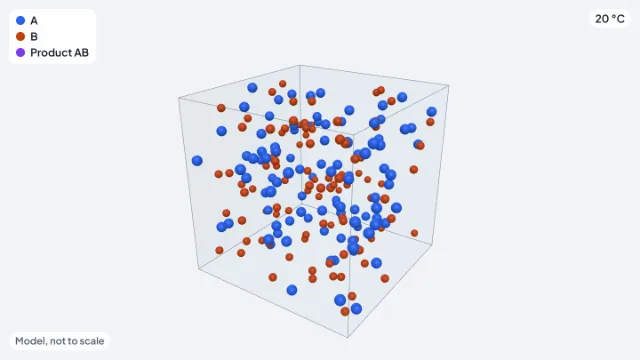
The particle model lets you run each factor as a fair test. Change Concentration of B between runs and watch the Product made against time graph get steeper at the start. Repeat with Temperature, then press Catalyst: off to switch the catalyst on, and finally choose Solid + acid to compare 1 lump with Powder. Which factors leave the Fraction that succeed card almost unchanged? The catalyst page explains why adding a catalyst does change it.
Common mistakes

  • Thinking a faster reaction makes more product. With the same amount of limiting reactant, the final amount of product is the same; it just forms sooner.
  • Using a longer time for the cross to disappear as a faster rate. A longer time means a slower reaction; rate is proportional to 1/time.
  • Changing the length of magnesium as well as the acid concentration. Only the independent variable should change in a fair test.
  • Listing 'amount of reactant' as one of the factors. AQA's factors are concentration, pressure, surface area, temperature and catalysts.
  • Saying a bigger lump has a bigger surface area so it reacts faster. For the same mass, smaller pieces have more surface exposed.
  • Applying pressure to reactions in solution. Pressure is the factor for reacting gases; for solutions use concentration.

Exam practice

Exam-style questions

Original questions written in the style of GCSE AQA Chemistry. Try each one before you reveal the answer.

  1. 1.A student investigates how the concentration of sodium thiosulfate solution affects the rate of its reaction with hydrochloric acid. The mixture turns cloudy, and the student times how long it takes for a cross under the flask to disappear.

    1. (a)Give two control variables for this investigation.

      2 marks
      Show the answer

      Answer: Any two of: volume of sodium thiosulfate solution; volume and concentration of hydrochloric acid; temperature; the same cross (same paper and flask); the same person judging when the cross disappears.

      Marking points

      • One valid control variable (e.g. volume of thiosulfate, volume or concentration of acid)
      • A second valid control variable (e.g. temperature, same cross, same observer)
    2. (b)The time at one concentration was 25 s. Calculate a value for the rate using rate = 1/time. Give the unit.

      2 marks
      Show the answer

      Answer: 1 ÷ 25 = 0.04 per second (0.04 /s).

      Marking points

      • 0.04
      • Unit: /s or s⁻¹
    3. (c)Suggest one reason why the results of this method may not be very repeatable, and one way to improve it.

      2 marks
      Show the answer

      Answer: Deciding exactly when the cross has disappeared is a judgement that varies between people. Use the same person each time, or a light sensor and data logger.

      Marking points

      • Judging when the cross disappears is subjective
      • Same observer / light sensor (colorimeter) and data logger
  2. 2.Magnesium ribbon reacts with hydrochloric acid. The hydrogen given off is collected in a gas syringe.

    1. (a)Give the dependent variable when the student investigates the effect of acid concentration.

      1 mark
      Show the answer

      Answer: The volume of hydrogen collected (in a set time, or at each time).

      Marking points

      • Volume of gas (hydrogen) collected
    2. (b)The student repeats the experiment with more concentrated acid but the same length of magnesium, with the acid still in excess. Describe how the graph of volume against time will differ.

      2 marks
      Show the answer

      Answer: The curve will be steeper at the start, showing a faster rate, but will level off at the same final volume (sooner), because the amount of magnesium is unchanged.

      Marking points

      • Steeper at the start / reaches the end sooner
      • Same final volume of gas
  3. 3.Food is often kept in a refrigerator at 4 °C instead of on a shelf at 20 °C.

    1. (a)Name the factor that slows down the reactions that make food go off in a refrigerator.

      1 mark
      Show the answer

      Answer: Temperature (a lower temperature).

      Marking points

      • Temperature
    2. (b)Name two other factors, apart from temperature and the use of a catalyst, that can change the rate of a reaction.

      2 marks
      Show the answer

      Answer: Any two of: how concentrated a dissolved reactant is; gas pressure (for gases); the surface area of a solid, for example powder instead of lumps.

      Marking points

      • One of concentration / pressure / surface area
      • A second of concentration / pressure / surface area

Quiz

Quick check

5 questions

  1. 1.Which change would slow down the reaction between marble chips and hydrochloric acid?
  2. 2.In the 'disappearing cross' experiment, the cross disappears after 50 s at one concentration and after 25 s at a higher one. How has the rate changed?
  3. 3.Which factor only applies to reactions involving gases?
  4. 4.A reaction is repeated at a higher temperature with the same amounts of reactants. What happens to the total amount of product?
  5. 5.When sodium thiosulfate solution and hydrochloric acid are mixed, what makes the mixture turn cloudy?

Related articles

Next step

Now see it move

Open the full collision theory in 3d (temperature, concentration, surface area and catalysts) simulation for every preset, graphs and the teacher tools, then test yourself.

Collision theory in 3D simulation: particles of two reactants move about a 3D vessel3D