What syllabus 6.2 expects
What changes the rate of a reaction? (Core)
The rate of reaction is how fast reactants are used up or products are made. Five changes increase it:
| Change | Applies to | Effect on rate |
|---|---|---|
| Increase the concentration | Solutions | Increases |
| Increase the pressure | Gases | Increases |
| Increase the surface area (smaller pieces, powder) | Solids | Increases |
| Increase the temperature | All reactions | Increases |
| Add a catalyst | Reactions with a suitable catalyst | Increases |
Doing the opposite (diluting, cooling, using larger lumps, removing the catalyst) slows the reaction.
What is a catalyst? (Core)
A catalyst speeds up a reaction yet is still there, chemically unchanged, once the reaction is over. Because it is not used up, its mass is the same afterwards and it can be reused. Enzymes are protein catalysts found in living things. Many work best around body temperature, and heating them too much stops them working, so for enzyme reactions "higher temperature means faster" only holds up to a point.
How can you measure the rate in the lab? (Core)
Calcium carbonate (marble chips) reacting with dilute hydrochloric acid gives off carbon dioxide, so it can be followed in two ways:
Method 1: change in mass. Stand the flask on a balance with a loose cotton wool plug in its neck, which lets the gas out but stops acid spray escaping. Record the mass every 30 s. The mass falls as carbon dioxide escapes.
Method 2: formation of a gas. Connect the flask to a gas syringe (or collect the gas over water in an upturned measuring cylinder). Record the volume of gas every 30 s.
In both, change one variable (such as the size of the chips) and keep everything else, such as the volume and concentration of acid, the mass of marble and the temperature, the same.
How do you read a rate graph? (Core)
On a graph of volume of gas (or loss in mass) against time:
- The gradient shows the rate. The steeper the line, the faster the reaction.
- The line is steepest at the start, when the reactants are most concentrated.
- It becomes less steep as the reactants are used up.
- It goes flat when one reactant has run out and the reaction has stopped.
If a change makes the reaction faster but uses the same amounts of reactants, the new curve is steeper at first but levels off at the same final volume, reaching it sooner. Using more or less of the reactant that runs out first is different: it changes the final volume.
Worked example: interpreting results (Core)
A student follows the reaction of 1.00 g of marble chips with excess acid by measuring gas volume.
| time / s | 0 | 30 | 60 | 90 | 120 | 150 | 180 |
|---|---|---|---|---|---|---|---|
| volume of gas / cm³ | 0 | 96 | 160 | 204 | 228 | 240 | 240 |
- Fastest period: 0 to 30 s, where 96 cm³ is made; only 12 cm³ appears between 120 and 150 s.
- Average rate over the first 60 s: (to 2 significant figures).
- When the reaction stops: by 150 s, since the volume no longer changes.
- Check: 1.00 g of CaCO₃ is 0.0100 mol (), which gives 0.0100 mol of CO₂, or at room temperature and pressure.
- Powdered marble of the same mass: a steeper curve at the start, finishing at the same 240 cm³ but sooner, because the acid is in excess and the amount of marble is unchanged.
How good are the two methods? (Supplement)
| Change in mass | Volume of gas | |
|---|---|---|
| Strengths | Simple; a balance reads continuously; no gas can leak from the measurement | Measures the product directly; works well for low-density gases |
| Weaknesses | Small mass changes for light gases such as hydrogen, so the balance resolution limits it; some acid spray may escape | Gas can leak at joints; some gas escapes before the bung is fitted; some gases (such as CO₂) dissolve slightly when collected over water; a syringe can stick or run out of room |
Carbon dioxide is heavy enough (44 g per mole) for the mass method to work well; for hydrogen from magnesium and acid, gas collection is the better choice.
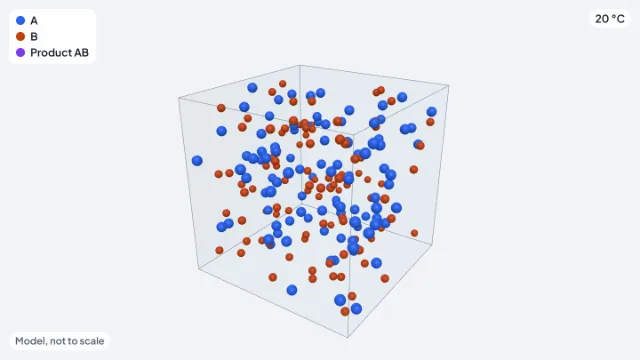
Try it in the simulation
The 3D collisions model plots Product made against time as particles react. Press Play at the default settings and watch the curve: steep at first, then flatter. Run it again after changing Concentration of B, then Temperature, then with the catalyst on. Switch to Solid + acid and step through the three Surface area of the solid settings, which keep the same mass of solid but expose different numbers of surface atoms.