Who sits this part of 6.2?
What is collision theory? (Supplement)
For two particles to react they must collide, and the collision must have at least a minimum amount of energy, the activation energy, Ea. A collision below Ea leaves the particles unchanged.
The rate of reaction therefore depends on:
- the frequency of collisions: how many collisions happen per second, which rises when there are more particles per unit volume or when the particles move faster;
- the fraction of collisions that are successful: those with energy at least Ea, which rises when the particles have more kinetic energy or when Ea is lowered.
The rate depends on the number of successful collisions per second. Each factor raises one or both of these.
How does each factor work? (Supplement)
| Factor | Particles per unit volume | Frequency of collisions | Kinetic energy of particles | Activation energy |
|---|---|---|---|---|
| Higher concentration | More | Higher | Unchanged | Unchanged |
| Higher gas pressure | More | Higher | Unchanged | Unchanged |
| Larger surface area | More exposed at the surface | Higher | Unchanged | Unchanged |
| Higher temperature | Unchanged | Higher | Higher: more collisions reach Ea | Unchanged |
| Catalyst or enzyme | Unchanged | Unchanged | Unchanged | Lower |
Why does temperature have such a large effect? (Supplement)
Heating gives the particles more kinetic energy. Two things follow. They move faster, so they collide more often. More importantly, a much larger proportion of their collisions now carry at least Ea, so a far greater share of collisions are successful. The second effect is the bigger one, which is why a modest temperature rise can make a reaction much faster. A complete answer mentions both, with the words "kinetic energy" and "activation energy".
How does a catalyst fit into collision theory? (Supplement)
A catalyst gives the reaction an alternative route with a lower activation energy. The particles' kinetic energies are unchanged and they collide just as often, but because the energy barrier is lower, more of those collisions exceed it. Enzymes work in the same way for reactions in living cells.
On a reaction pathway diagram, the catalysed pathway has a lower peak, while the reactants and products sit at the same energy levels as before. Removing the catalyst puts the original, higher Ea back, and the rate drops.
Worked example: explaining a gas-phase change (Supplement)
Question: Hydrogen and iodine react as gases. The pressure is doubled at constant temperature. Explain, using collision theory, the effect on the rate.
- Doubling the pressure squeezes the same number of molecules into half the volume, so the number of particles per unit volume doubles.
- The molecules are closer together, so the frequency of collisions increases.
- The temperature is unchanged, so the kinetic energy of the molecules and the fraction of collisions with energy at least Ea stay the same.
- With more collisions per second and the same fraction successful, there are more successful collisions per second: the rate increases.
Worked example: an enzyme (Supplement)
Question: The enzyme catalase speeds up the decomposition of hydrogen peroxide in cells. Explain how.
- Catalase provides an alternative pathway with a lower activation energy.
- The frequency of collisions and the particles' kinetic energy are unchanged.
- Now that the barrier is lower, more of the collisions clear it, so the number of successful collisions each second goes up and so does the rate.
- Catalase is unchanged at the end, so a small amount continues to work.
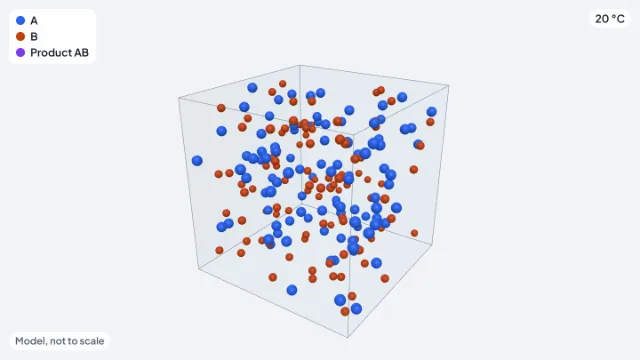
Try it in the simulation
The 3D collision model splits the two parts of the theory into two readouts. Collisions per second tracks the frequency of collisions; Fraction that succeed tracks the share with energy at least Ea. Double Concentration of B and only the first card changes much. Raise the Temperature and both rise, the fraction faster. Switch the catalyst on and only the fraction rises, while the Energy profile (model) shows Ea dropping. The model's activation energies are smaller than real ones, so its temperature effect is gentler than in a real reaction.