Skip to content

GCSE Chemistry — AQA (8462) · The rate and extent of chemical change

Collision theory and activation energy

4.6.1.3

According to collision theory, a reaction needs particles to collide carrying at least the activation energy. Higher concentration, gas pressure or surface area make collisions more frequent. Higher temperature makes them more frequent and more energetic, so a bigger fraction succeed.

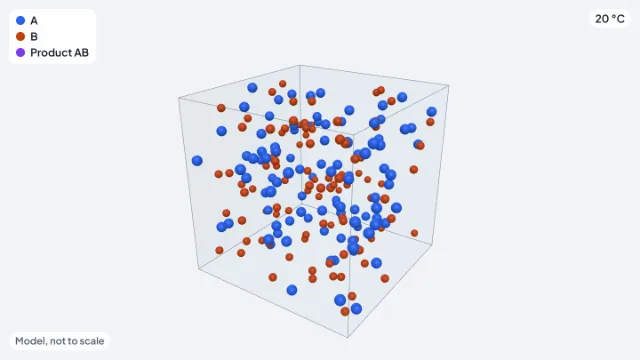
Loading simulation…

Symbols match your course. Open the full collision theory in 3d (temperature, concentration, surface area and catalysts) simulation for more presets and teacher tools.

Where this sits in AQA chemistry

What is collision theory?

Collision theory says a reaction can only happen when reacting particles collide, and only if the collision has enough energy. The minimum energy that colliding particles need for a reaction is the activation energy. Collisions with less energy than this simply bounce apart with nothing changed.

So the rate of a reaction depends on two things:

  1. How often the reacting particles collide (the frequency of collisions).
  2. What fraction of those collisions have at least the activation energy.

Anything that raises either of these raises the rate. Every exam answer on rates should name which one changes.

How does each condition change the rate?

ChangeEffect on particlesFrequency of collisionsCollisions with enough energy
Higher concentration of a solutionMore reacting particles in the same volumeIncreasesSame fraction
Higher pressure of a gasSame particles squeezed into a smaller volumeIncreasesSame fraction
Smaller pieces of solidMore particles exposed at the surfaceIncreasesSame fraction
Higher temperatureParticles move faster and have more energyIncreasesGreater fraction

Temperature is the only one of these four that works in both ways. The faster particles collide more often, and, more importantly, the collisions are more energetic, so a bigger share of them reach the activation energy. A catalyst works differently again: it lowers the activation energy, as explained on catalysts.

Why does cutting a solid up speed up a reaction?

Only particles on the surface of a solid can be hit by the other reactant. Cutting a lump into smaller pieces exposes particles that were buried inside, so the surface area to volume ratio goes up, and more collisions happen each second, even though the mass of solid is the same.

Worked example. A 2 cm cube of marble reacts with acid. It is then cut into eight 1 cm cubes.

  • One 2 cm cube: surface area 6×2×2=24 cm26 \times 2 \times 2 = 24\ \text{cm}^2, volume 8 cm38\ \text{cm}^3, ratio 24÷8=324 \div 8 = 3.
  • Eight 1 cm cubes: surface area 8×6×1×1=48 cm28 \times 6 \times 1 \times 1 = 48\ \text{cm}^2, same volume 8 cm38\ \text{cm}^3, ratio 48÷8=648 \div 8 = 6.

Halving the side of the cubes doubles the surface area to volume ratio, so the collision frequency, and the initial rate, roughly doubles. Powder takes the idea to the extreme, which is why flour dust in the air can explode.

How do you use proportion in a collision theory answer?

AQA expects simple proportion. If the concentration of acid doubles, the same volume holds twice as many acid particles, so collisions with the other reactant happen about twice as often and the initial rate roughly doubles. Halving the concentration roughly halves the rate. Temperature is not proportional in this simple way: a rise of only 10 °C can roughly double many reaction rates, because the share of collisions with enough energy grows so fast.

Worked example: a full explanation

Question: Explain why magnesium ribbon reacts faster with hydrochloric acid at 40 °C than at 20 °C.

  1. At 40 °C the acid particles move faster, so they collide with the magnesium surface more often.
  2. The particles also have more energy, so a greater proportion of the collisions reach or exceed the activation energy.
  3. Successful collisions therefore happen more often each second, and the rate rises.

The three steps (more frequent, more energetic, more successful collisions per second) are what mark schemes look for. "The particles move faster" on its own is not enough.

Test each factor in the simulation

Every collision is counted in the 3D collision counter. Press Play and read Collisions per second and Fraction that succeed. Double Concentration of B from 100 to 200 particles: the collision count roughly doubles, while the fraction stays about the same. Then drag Temperature from 10 °C to 80 °C during a run and watch the fraction climb faster than the collision count. Finally choose Solid + acid and compare 1 lump, 8 cubes and Powder. How the factors are tested in the lab is on factors that change the rate.
Common mistakes

  • Saying higher temperature only means more collisions. The bigger effect is that more collisions have at least the activation energy.
  • Writing 'more collisions' without 'per second' or 'more frequent'. Rate depends on how often successful collisions happen.
  • Saying higher concentration gives particles more energy. It only puts more particles in the same volume; their energy is unchanged.
  • Explaining powder reacting faster by saying there is more of it. Its mass is unchanged; what grows is the surface area to volume ratio.
  • Saying the particles collide harder at higher concentration. Collision energy depends on temperature, not concentration.
  • Defining activation energy as the energy given out by a reaction. It is the minimum energy colliding particles need to react.

Exam practice

Exam-style questions

Original questions written in the style of GCSE AQA Chemistry. Try each one before you reveal the answer.

  1. 1.A student reacts calcium carbonate with hydrochloric acid. The reaction produces carbon dioxide gas.

    1. (a)What does the term activation energy mean?

      1 mark
      Show the answer

      Answer: The least energy a collision between particles must have for them to react.

      Marking points

      • Minimum energy particles need (when colliding) to react
    2. (b)Explain, using collision theory, why using more concentrated acid increases the rate of reaction.

      3 marks
      Show the answer

      Answer: In more concentrated acid, extra acid particles share the same volume, which makes their collisions with the carbonate more frequent. There are more successful collisions per second, so the rate increases.

      Marking points

      • More particles in the same volume
      • More frequent collisions
      • More successful collisions per second (so faster rate)
    3. (c)The student uses powdered calcium carbonate instead of large lumps of the same mass. Explain why the reaction is faster.

      2 marks
      Show the answer

      Answer: Powder has a larger surface area to volume ratio, so more particles are exposed to the acid. This gives more frequent collisions.

      Marking points

      • Larger surface area (to volume ratio) / more particles exposed
      • More frequent collisions
  2. 2.The reaction between two gases is carried out at 25 °C and then repeated at 45 °C.

    1. (a)Explain why the reaction is faster at 45 °C.

      3 marks
      Show the answer

      Answer: At the higher temperature the particles move faster, so they collide more frequently. They also carry more energy, which lifts the share of collisions reaching the activation energy. Both lead to more successful collisions per second.

      Marking points

      • Particles move faster so collide more frequently
      • Collisions are more energetic / more particles have at least the activation energy
      • More successful collisions per second
    2. (b)Suggest one other way to increase the rate of a reaction between two gases, without changing the temperature or adding a catalyst. Explain your answer.

      2 marks
      Show the answer

      Answer: Increase the pressure. The same number of particles are in a smaller volume, so they collide more frequently.

      Marking points

      • Increase the pressure
      • Particles closer together / more in the same volume, so more frequent collisions
  3. 3.A cube of zinc with sides of 4 cm is cut into 8 smaller cubes, each with sides of 2 cm.

    1. (a)Calculate the surface area to volume ratio of the large cube and of one small cube.

      2 marks
      Show the answer

      Answer: Large cube: surface area 6 × 4 × 4 = 96 cm², volume 64 cm³, ratio 96 ÷ 64 = 1.5. Small cube: surface area 6 × 2 × 2 = 24 cm², volume 8 cm³, ratio 24 ÷ 8 = 3.

      Marking points

      • Large cube ratio 1.5
      • Small cube ratio 3
    2. (b)Predict how the initial rate of reaction with acid changes when the small cubes are used instead of the large cube. Give a reason.

      2 marks
      Show the answer

      Answer: The initial rate roughly doubles, because the surface area to volume ratio doubles, so about twice as many collisions happen each second.

      Marking points

      • Rate roughly doubles
      • Ratio (exposed surface) doubles, so collision frequency doubles

Quiz

Quick check

6 questions

  1. 1.According to collision theory, which two conditions must be met for particles to react?
  2. 2.Why does increasing the pressure of a gas increase the rate of reaction?
  3. 3.Which change makes collisions both more frequent and more energetic?
  4. 4.The concentration of an acid is halved. What happens to the initial rate of its reaction with magnesium, all else equal?
  5. 5.Which statement defines activation energy?
  6. 6.A lump of solid is ground into a fine powder of the same mass. What happens to its surface area to volume ratio?

Related articles

Next step

Now see it move

Open the full collision theory in 3d (temperature, concentration, surface area and catalysts) simulation for every preset, graphs and the teacher tools, then test yourself.

Collision theory in 3D simulation: particles of two reactants move about a 3D vessel3D