In your Chemistry 9 book
These notes match Section 5.4, How does a reaction take place?, in Chapter 5 (Energetics) of Punjab Chemistry 9: collisions between reactant molecules, the transition state, energy profile diagrams with activation energy and ΔH, and how a catalyst changes the path of a reaction. The Punjab Class 9 book has no separate chapter on rates, so this section is where collision ideas appear.
How does a reaction take place?
Take a simple reaction between two gases, . Before they mix, the molecules of each gas move randomly, colliding with one another and with the walls of the container. Not all of them have the same kinetic energy: most have energies near the average, a few have more than average (sometimes called excited molecules) and a few have less.
When A₂ and B₂ are mixed, they collide with each other. Collisions between molecules with average or below-average energy usually achieve nothing; the molecules bounce apart. Only when molecules with enough energy collide can the old A–A and B–B bonds start to break while new A–B bonds start to form. At that moment the atoms are in a short-lived, high-energy arrangement called the transition state, which then either goes on to form products or falls back to reactants.
What is activation energy?
The activation energy, Ea, is the energy that reactant molecules must absorb to reach the transition state. It is an energy barrier: only collisions with at least this much energy can lead to products. At the same temperature, a reaction with a high Ea is slow, because few collisions have enough energy, while one with a low Ea is faster.
How do you read an energy profile diagram?
An energy profile plots energy (vertical axis) against the reaction coordinate, the progress from reactants to products (horizontal axis).
| Feature | Exothermic reaction | Endothermic reaction |
|---|---|---|
| Products compared with reactants | Lower in energy | Higher in energy |
| Sign of ΔH | Negative (energy released) | Positive (energy absorbed) |
| The peak | Transition state | Transition state |
| Ea is measured | From reactants up to the peak | From reactants up to the peak |
In both cases, ΔH is the energy difference between the reactants and the products, and Ea is how far the hump rises above the reactants. For an endothermic reaction, Ea must be at least as large as ΔH, because the transition state cannot be lower than the products.
How does a catalyst work?
A catalyst is a substance that speeds up a reaction while remaining chemically unchanged at the end, so it is not used up. It works by opening a different route from reactants to products, one with a much lower activation energy. With a lower barrier, many more collisions have enough energy to reach the new, lower transition state, so reactants turn into products faster.
On the energy profile, the catalysed path has a lower peak, but reactant and product levels do not move, so ΔH does not change. A catalyst does not make a reaction more exothermic or give more product; it only gets there sooner.
Examples from industry and nature:
- Nickel catalyses the hydrogenation of vegetable oils to make banaspati ghee.
- Platinum is the catalyst your book names for making sulfuric acid. It was indeed the first catalyst used for this; most plants today use vanadium(V) oxide instead, because it is cheaper and is not poisoned as easily.
- Chlorine atoms high in the atmosphere catalyse the breakdown of ozone, which is why chlorine-containing pollutants thin the ozone layer.
- Iron catalyses the Haber process for ammonia.
- Enzymes are biological catalysts; for example, the enzymes of glycolysis break down glucose in our cells.
Worked example: reading values from a profile
Question: In an energy profile, the reactants are at 50 kJ mol⁻¹, the products at 20 kJ mol⁻¹ and the peak at 180 kJ mol⁻¹. With a catalyst, the peak falls to 110 kJ mol⁻¹. Find ΔH, Ea without and with the catalyst, and the decrease in Ea.
- : exothermic.
- Ea without catalyst .
- Ea with catalyst .
- Decrease in Ea . ΔH is still −30 kJ mol⁻¹.
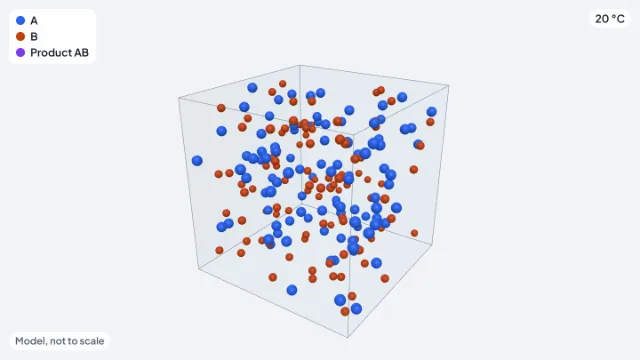
See it happen in 3D
Start the particle collision model with Play and watch most collisions bounce apart, with a yellow flash only when one has enough energy. Read Fraction that succeed. Now add the catalyst (its button reads Catalyst: off until pressed): the number of collisions stays about the same, but more of them succeed, and the Energy profile (model) shows the lower hump with reactant and product levels unchanged. Warming the mixture with the Temperature slider gives more molecules enough energy, which is the "excited molecules" idea from your book. The energy changes themselves are covered in Sections 5.2 and 5.3 of the same chapter.