In your Chemistry 9 book
These notes go with Section 5.2, Enthalpy, in the Energetics chapter (Chapter 5) of your textbook, with a little of Section 5.1 (System and Surrounding) for context. The book defines enthalpy (H) as heat content, explains that only the change, ΔH, can be measured, introduces the standard enthalpy of reaction, ΔH°, with the example of carbon monoxide burning, and compares enthalpy with heat. Exothermic and endothermic reactions follow in Section 5.3, covered on exothermic and endothermic reactions.
What are the system and the surroundings?
In energetics, the system is the part being studied: the reactants, the products and anything else taking part, such as a catalyst or solvent. Everything outside it is the surroundings, for example the beaker, the air and the burner. Your book uses the word "surrounding" for this. Energy moves between the two:
- energy passing from the surroundings into the system is an endothermic change;
- energy passing from the system out to the surroundings is an exothermic change.
What is enthalpy?
Enthalpy, symbol H, is the total heat content of a system: the energy stored in its substances, which depends on how many particles there are, what they are and how they are bonded. The total enthalpy of a system cannot be measured directly, because there is no way to find the "zero" of all that stored energy.
What can be measured is the change in enthalpy, ΔH (read "delta H"), when a reaction happens:
At constant pressure, which is how most reactions in an open beaker happen, ΔH equals the heat given out or taken in. Enthalpy changes are given in kJ mol⁻¹ (or in kJ for the amounts in a particular equation).
What does the sign of ΔH tell you?
| Heat given out (exothermic) | Heat taken in (endothermic) | |
|---|---|---|
| Enthalpy of products compared with reactants | Lower | Higher |
| Total enthalpy of the system | Decreases | Increases |
| Sign of ΔH | Negative (−) | Positive (+) |
| Temperature of surroundings | Rises | Falls |
What is the standard enthalpy of reaction, ΔH°?
The same reaction can give out slightly different amounts of heat at different temperatures and pressures, so chemists compare values measured under agreed standard conditions, with every substance in its standard state. The enthalpy change measured this way is the standard enthalpy of reaction, written ΔH°. For example:
Because ΔH° is negative, the reaction is exothermic: 566.0 kJ of heat passes to the surroundings when 2 mol of carbon monoxide burns.
How is enthalpy different from heat?
The two words are related but not the same.
| Heat | Enthalpy |
|---|---|
| Energy moving from a hot object to a cooler one, driven by the temperature gap | The heat content stored in a system |
| Exists only while it is being transferred; a system does not "contain" heat | A property of the system, set by its particles, composition and structure |
| Measured in joules (J) | Only its change, ΔH, can be measured, in kJ or kJ mol⁻¹ |
When heat flows into or out of a system at constant pressure, the system's enthalpy changes by exactly that amount. So heat is the energy on the move, and ΔH records its effect on the system.
Worked example: scaling an enthalpy change
Question: Using 2CO(g) + O₂(g) → 2CO₂(g), ΔH° = −566.0 kJ, find (a) the heat given out per mole of CO burnt, (b) the heat given out when 14 g of CO burns, and (c) ΔH° for 2CO₂(g) → 2CO(g) + O₂(g).
- (a) The equation uses 2 mol of CO, so per mole: −566.0 ÷ 2 = −283.0 kJ mol⁻¹. Heat given out = 283.0 kJ.
- (b) Molar mass of CO = 12 + 16 = 28 g mol⁻¹, so 14 g is 14 ÷ 28 = 0.50 mol. Heat given out = 0.50 × 283.0 = 141.5 kJ.
- (c) Reversing a reaction reverses the sign of ΔH: +566.0 kJ, an endothermic change.
See enthalpy change in the simulation
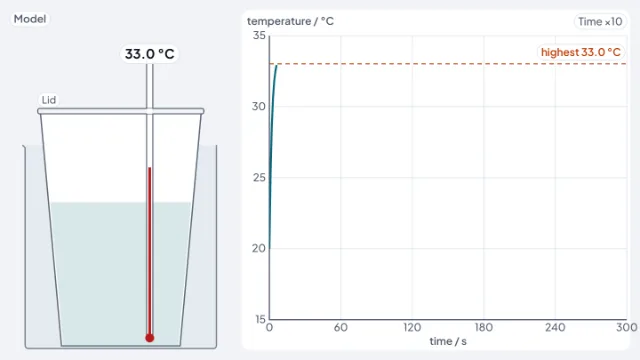
The cup simulation above shows enthalpy changes through their effect on the surroundings. Press Play with Acid + alkali: the system loses enthalpy as heat and the thermometer reading rises. Choose Citric acid + NaHCO₃ and the reverse happens. After the run begins, the energy diagram under the stage appears; the vertical distance separating reactants from products there is ΔH, drawn downwards for a negative value and upwards for a positive one.