In your Chemistry 9 book
This page follows Section 5.3, Exothermic and Endothermic Reactions, from Chapter 5 (Energetics) of the Punjab Chemistry 9 textbook. The section shows how heat is evolved or absorbed in a reaction, writes the heat of reaction either inside the equation or as ΔH, gives examples such as burning hydrogen and carbon and forming nitric oxide in lightning, and explains both kinds of reaction by bond breaking and bond formation. The ideas of system, surroundings and enthalpy come just before, in Sections 5.1 and 5.2; see enthalpy.
What are exothermic and endothermic reactions?
Almost every physical or chemical change either gives out or takes in heat. The heat evolved or absorbed is called the heat of reaction.
- An exothermic reaction evolves heat. The heat flows from the reacting system to the surroundings, so the container and its contents get hotter. ΔH is negative.
- An endothermic reaction absorbs heat. Heat flows from the surroundings into the system, so the container gets colder. ΔH is positive.
The sign of ΔH is written from the point of view of the system. In an exothermic reaction the system loses enthalpy, so ΔH is negative even though the thermometer reading goes up.
How is the heat of reaction written in an equation?
There are two ways to show the same information. For the burning of hydrogen to form liquid water:
The same reaction can also be written with "+ 571.6 kJ" on the products side, showing heat as something given out. The two forms mean the same thing; ΔH is the form you will use most in later chemistry.
Reversing a reaction reverses the sign. If forming 2 mol of liquid water releases 571.6 kJ, then decomposing 2 mol of water back into hydrogen and oxygen absorbs exactly 571.6 kJ, so ΔH = +571.6 kJ for the reverse reaction.
Examples: which way does the heat flow?
| Reaction | ΔH | Type |
|---|---|---|
| C(s) + O₂(g) → CO₂(g), burning carbon | −393.5 kJ mol⁻¹ | Exothermic |
| 2H₂(g) + O₂(g) → 2H₂O(l) | −571.6 kJ | Exothermic |
| Burning natural gas, petrol or coal | Negative | Exothermic |
| Respiration of food in the body | Negative | Exothermic |
| N₂(g) + O₂(g) → 2NO(g), during lightning | +180.6 kJ | Endothermic |
| H₂(g) + I₂(s) → 2HI(g) | +53.0 kJ | Endothermic |
| Melting ice (a physical change) | Positive | Endothermic |
Nitrogen and oxygen in air do not normally react, because the reaction absorbs so much energy. Only the enormous energy of a lightning flash, or of a hot engine, is enough to form nitric oxide.
Where do exothermic reactions help us every day?
Combustion supplies most of the energy we use. Gas, oil and coal are burnt for cooking and heating; power stations burn fuel to boil water into high-pressure steam that turns turbines; and car engines run on the combustion of petrol or diesel. Fireworks use exothermic reactions that release heat, light and sound, with metal salts adding the colours. Self-heating packs use an exothermic reaction, while self-cooling packs use an endothermic change.
Why are some reactions exothermic and others endothermic?
A reaction breaks bonds in the reactants and forms new bonds in the products.
- Breaking a bond absorbs energy (an endothermic step).
- Forming a bond releases energy (an exothermic step).
If the energy released in forming the new bonds is greater than the energy absorbed in breaking the old ones, the extra is given out and the reaction is exothermic. If breaking needs more than forming releases, the reaction is endothermic.
Worked example: hydrogen burning to gaseous water
Question: Use bond energies to find ΔH for 2H₂(g) + O₂(g) → 2H₂O(g). Take H–H = 436 kJ mol⁻¹, O=O = 498 kJ mol⁻¹ and O–H = 463 kJ mol⁻¹.
- Bonds broken: two H–H bonds and one O=O bond: (2 × 436) + 498 = 872 + 498 = 1370 kJ absorbed.
- Bonds formed: each water molecule has two O–H bonds, so two molecules have four: 4 × 463 = 1852 kJ released.
- ΔH: 1370 − 1852 = −482 kJ for 2 mol of water vapour.
- Per mole of water: −482 ÷ 2 = −241 kJ mol⁻¹.
The negative sign confirms that burning hydrogen is exothermic: the strong O–H bonds release more energy than the weaker H–H and O=O bonds need.
Try it in the simulation
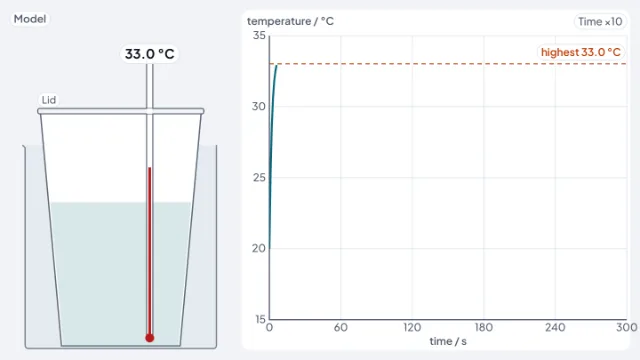
Start a run of Acid + alkali (press Play) and watch the temperature rise: an exothermic change. Then choose Citric acid + NaHCO₃ and watch it fall: an endothermic change. Once each run starts, the energy diagram appears below the stage; use it to compare the energy of the reactants and products, the same picture as an energy profile diagram in your book. Pressing Lid: on removes the lid, so you can see how much heat escapes into the room.