Where this sits in AQA chemistry
Where does the energy go in a reaction?
Energy is conserved in every chemical reaction: the total amount of energy in the universe is the same before and after. What changes is where the energy is. Chemists split the world into two parts:
- the reacting substances (sometimes called the system);
- the surroundings: everything else, including the water the chemicals are dissolved in, the beaker, the thermometer and the air.
If a reaction transfers energy to the surroundings, the products must end up with less energy than the reactants had, by exactly the amount transferred. If a reaction takes energy in, the products end up with more.
How do exothermic and endothermic reactions differ?
| Exothermic | Endothermic | |
|---|---|---|
| Energy transfer | From the reacting chemicals to the surroundings | From the surroundings into the reacting chemicals |
| Thermometer in the mixture | Reading rises | Reading falls |
| Products compared with reactants | Less energy | More energy |
| Examples | Combustion of fuels; many oxidation reactions; neutralisation; metals with acids; displacement of metals | Thermal decomposition, such as calcium carbonate into calcium oxide; citric acid with sodium hydrogencarbonate |
| Everyday uses | Hand warmers; self-heating cans of food or coffee | Instant cold packs for sports injuries |
Because the thermometer measures the surroundings, the deciding question is always the same: did the temperature of the surroundings go up or down?
How do you evaluate a use of an energy change?
Exam questions often give data about two products and ask which is better. Useful points to weigh up:
- How big is the temperature change, and how long does it last? A hand warmer is only useful if it stays warm for long enough.
- Can it be reused? Hand warmers based on the oxidation of iron powder work once. Warmers that use a supersaturated salt solution crystallising can be reset by heating in boiling water.
- Are the chemicals safe and cheap? A product that leaks a corrosive or toxic substance is a poor choice, however well it works.
- Does it need a trigger? Self-heating cans keep the water and calcium oxide apart until a button breaks the seal between them.
How do you carry out required practical 4?
The practical investigates a variable that affects the temperature change. A typical plan for acid and alkali:
- Stand a polystyrene cup inside a glass beaker so it cannot tip over. Polystyrene is a good insulator.
- Measure 25 cm³ of dilute hydrochloric acid into the cup with a measuring cylinder and record its starting temperature.
- Measure 25 cm³ of sodium hydroxide solution of the same concentration.
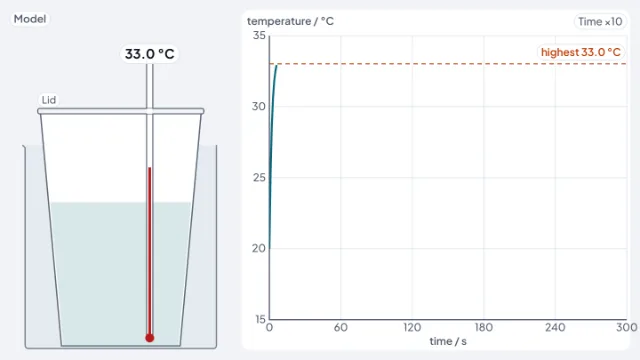
- Tip in the alkali, replace the lid, stir gently and note the highest temperature the thermometer shows.
- Work out the temperature change and repeat to get a mean.
- Change one variable, such as the concentration of both solutions, and repeat.
Other versions use metal powders, carbonates or displacement reactions in the cup instead. The method in AQA's practical handbook starts with 30 cm³ of hydrochloric acid in the cup and adds the sodium hydroxide in 5 cm³ portions until 40 cm³ has gone in. After each addition you record the highest temperature, then plot temperature against volume added. Two straight lines of best fit, one rising and one falling, cross at the largest temperature change.
Control variables: the volumes of both solutions, the starting temperature, the type of cup and lid, and how long you stir. Safety: wear eye protection; sodium hydroxide solution can badly damage eyes.
Worked example: does concentration affect the temperature rise?
A student mixes 25 cm³ of acid with 25 cm³ of alkali of the same concentration, using three different concentrations and two runs at each.
| Concentration / mol/dm³ | Run 1 rise / °C | Run 2 rise / °C | Mean rise / °C |
|---|---|---|---|
| 0.5 | 3.2 | 3.4 | 3.3 |
| 1.0 | 6.5 | 6.3 | 6.4 |
| 2.0 | 12.9 | 12.5 | 12.7 |
- Means: for 1.0 mol/dm³, (6.5 + 6.3) ÷ 2 = 6.4 °C.
- Pattern: each time the concentration doubles, the mean rise roughly doubles (3.3 → 6.4 → 12.7 °C).
- Explanation: twice the concentration means twice as many acid and alkali particles react in the same volume of solution, so about twice as much energy is released into the same mass of water.
- Uncertainty: at 2.0 mol/dm³ the two runs differ by 0.4 °C, so the mean is 12.7 ± 0.2 °C.
- Classification: every rise is positive, so neutralisation is exothermic.
The true rises are a little larger, because some energy escapes from the cup to the air before the highest reading. That is why a lid and an insulated cup matter.
Try it in the simulation
Start the cup simulation above with Acid + alkali and press Play. When the run ends, read the Temperature change card. Then set Concentration of the acid and the alkali to 0.5, 1.0 and 2.0 mol/dm³ in turn to check the doubling pattern from the worked example. Then choose Citric acid + NaHCO₃ and watch the graph go down instead, and take the lid off with the Lid: on button to see how much energy leaks away. For the energy diagrams behind these changes, read reaction profiles. The displacement reactions model shows displacement, another exothermic change, from the particles' point of view.