Skip to content

GCSE Chemistry — AQA (8462) · The rate and extent of chemical change

Catalysts

4.6.1.4

A catalyst speeds up a reaction without being used up. Its alternative route has a lower activation energy, so a larger share of collisions can react. It is not in the balanced equation, and enzymes are the catalysts in living things.

Loading simulation…

Symbols match your course. Open the full collision theory in 3d (temperature, concentration, surface area and catalysts) simulation for more presets and teacher tools.

Where this sits in AQA chemistry

What does a catalyst do?

A catalyst changes the rate of a chemical reaction but is not used up. At the end of the reaction the same mass of catalyst is left, chemically unchanged, so a small amount can be used again and again. Different reactions need different catalysts: there is no all-purpose catalyst. In living things, enzymes are the catalysts, speeding up reactions such as digestion at body temperature.

How does a catalyst speed up a reaction?

A catalyst opens up an alternative route for the reaction, one whose activation energy is lower. The reacting particles collide just as often as before, but with a lower energy barrier to get over, a bigger fraction of those collisions now have enough energy to react. More successful collisions per second means a faster reaction.

Notice what stays the same. With a catalyst present, particles move no faster, gain no extra energy, and the final amount of product is unchanged. It also does not change the overall energy change of the reaction: reactant and product energy levels match with or without it.

What does a reaction profile with a catalyst look like?

A reaction profile plots energy (up the page) against the progress of the reaction (across). For an exothermic reaction:

FeatureWithout catalystWith catalyst
Energy of reactantsSameSame
Energy of productsSame (lower than reactants)Same
Height of the hump above the reactantsActivation energySmaller: lower activation energy
Overall energy changeSameSame

When you draw it, start both curves at the same reactant level and finish them at the same product level. Only the peak of the catalysed curve is lower. Label the activation energy as an arrow from the reactant line up to the top of each peak. Exothermic and endothermic profiles are covered in their own topic, reaction profiles (4.5.1.2).

How can you tell that a substance is a catalyst?

Two kinds of evidence:

  1. Rate: the reaction is faster when the substance is added.
  2. Mass and the equation: the substance is still there, unchanged in mass, at the end, so it does not appear in the balanced equation.

Hydrogen peroxide decomposing is the classic example. On its own it breaks down very slowly; with a little manganese(IV) oxide, oxygen fizzes off quickly. The black powder can be filtered off, dried and weighed afterwards with no loss of mass, and it is not written among the reactants or products:

2 HX2OX2(aq)→2 HX2O(l)+OX2(g)\ce{2H2O2(aq) -> 2H2O(l) + O2(g)}

Worked example: comparing catalysts

Question: A student adds 0.5 g of three different metal oxides to separate 25 cm³ samples of the same hydrogen peroxide solution and measures the volume of oxygen collected in 60 s. Oxide A: 12 cm³. Oxide B: 48 cm³. Oxide C: 30 cm³. Without any oxide, less than 1 cm³ is collected.

  1. Mean rate = volume of gas ÷ time. Oxide B: 48÷60=0.8 cm3/s48 \div 60 = 0.8\ \text{cm}^3/\text{s}.
  2. Oxide A: 12÷60=0.2 cm3/s12 \div 60 = 0.2\ \text{cm}^3/\text{s}. Oxide C: 30÷60=0.5 cm3/s30 \div 60 = 0.5\ \text{cm}^3/\text{s}.
  3. All three speed up the reaction compared with no oxide, so all three may be catalysts. B is the most effective, which suggests its pathway has the lowest activation energy.
  4. To confirm they are catalysts, filter, dry and reweigh each oxide: the mass should still be 0.5 g.

This is a fair test only if the volume, concentration and temperature of the peroxide, and the mass and particle size of each oxide, are kept the same.

Why do catalysts matter in industry?

A catalyst lets a reaction run quickly at a lower temperature, saving energy and fuel costs, and because it is not used up, a small amount works for a long time. Industrial catalysts are often transition metals or their compounds, spread thinly over a support to give a large surface area.

Try it in the simulation

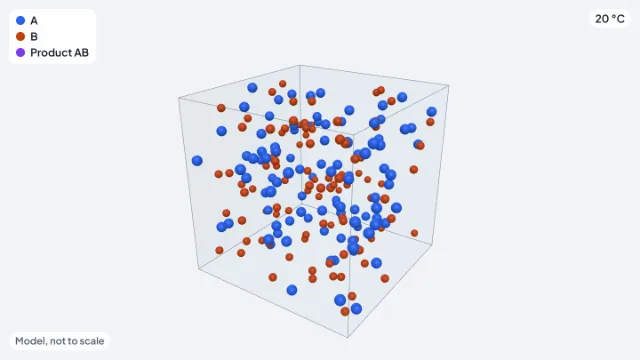
Run the 3D collision model with Play and write down the readings on Collisions per second and Fraction that succeed. Next, tap Catalyst: off, which turns the catalyst on. The collision count stays about the same, but the fraction that succeed rises. The Energy profile (model) next to the graph shows why: the catalysed hump is lower, while the reactant and product levels have not moved. Compare this with the effect of heating on the collision theory page.
Common mistakes

  • Thinking a catalyst energises the particles. Their energies are unchanged; the energy barrier (activation energy) is what drops.
  • Saying a catalyst makes the particles collide more often. The frequency of collisions is about the same; a bigger fraction of them succeed.
  • Drawing the catalysed reaction profile with the products at a different energy. Only the peak is lower; the overall energy change is unchanged.
  • Writing the catalyst into the balanced equation as a reactant. It is not used up, so it is left out (sometimes written over the arrow).
  • Thinking one catalyst works for every reaction. Different reactions need different catalysts.
  • Claiming a catalyst increases the amount of product. It only makes the product form faster.

Exam practice

Exam-style questions

Original questions written in the style of GCSE AQA Chemistry. Try each one before you reveal the answer.

  1. 1.Hydrogen peroxide decomposes slowly to form water and oxygen. Adding manganese(IV) oxide makes the reaction much faster. The equation is 2H₂O₂(aq) → 2H₂O(l) + O₂(g).

    1. (a)Give two pieces of evidence that manganese(IV) oxide acts as a catalyst in this reaction.

      2 marks
      Show the answer

      Answer: It increases the rate of the reaction. It is not used up: it is not in the equation, and its mass is the same at the end.

      Marking points

      • It increases the rate of reaction
      • It is not used up / not in the equation / same mass at the end
    2. (b)Explain, in terms of activation energy, how manganese(IV) oxide increases the rate.

      3 marks
      Show the answer

      Answer: It provides a different reaction pathway with a lower activation energy. As a result, more of the collisions carry enough energy to react. This gives more successful collisions per second.

      Marking points

      • Offers a different reaction route
      • Whose activation energy is lower
      • More collisions have enough energy / more successful collisions per second
  2. 2.A reaction is exothermic. A student draws its reaction profile and then adds a second curve to show the same reaction with a catalyst.

    1. (a)Describe how the catalysed curve should differ from the uncatalysed curve.

      2 marks
      Show the answer

      Answer: It should start at the same reactant energy and end at the same product energy, but its peak should be lower, so that its activation energy is smaller.

      Marking points

      • Same start (reactants) and end (products) levels
      • Lower peak / smaller activation energy
    2. (b)State whether the catalyst changes the overall energy change of the reaction.

      1 mark
      Show the answer

      Answer: No. The energies of the reactants and products are unchanged, so the overall energy change is the same.

      Marking points

      • No change in overall energy change
  3. 3.Enzymes are biological catalysts. Amylase is an enzyme that speeds up the breakdown of starch.

    1. (a)What is a catalyst?

      2 marks
      Show the answer

      Answer: Any substance that alters (usually raises) the rate of a reaction while not itself being used up.

      Marking points

      • Changes / increases the rate of reaction
      • Is not used up (chemically unchanged at the end)
    2. (b)In a test, starch was broken down in 6 minutes without amylase and in 40 seconds with amylase. Explain why only a small amount of amylase is needed.

      2 marks
      Show the answer

      Answer: The amylase is not used up in the reaction. So each enzyme molecule can catalyse the breakdown of starch over and over again.

      Marking points

      • The enzyme / catalyst is not used up
      • It can be used again and again

Quiz

Quick check

5 questions

  1. 1.How does a catalyst increase the rate of a reaction?
  2. 2.Why is a catalyst not shown in the balanced equation for a reaction?
  3. 3.On a reaction profile, what does adding a catalyst change?
  4. 4.What are enzymes?
  5. 5.Adding a catalyst to a reaction mixture has which effect on the collisions?

Related articles

Next step

Now see it move

Open the full collision theory in 3d (temperature, concentration, surface area and catalysts) simulation for every preset, graphs and the teacher tools, then test yourself.

Collision theory in 3D simulation: particles of two reactants move about a 3D vessel3D