Skip to content

GCSE Chemistry — AQA (8462) · Chemical analysis

Paper chromatography

4.8.1.3

Paper chromatography separates a mixture because each substance is shared differently between the stationary phase (paper) and the mobile phase (solvent). Its Rf value, the spot's distance divided by the solvent's distance, is always below 1. A pure compound gives one spot in every solvent.

Loading simulation…

Symbols match your course. Open the full paper chromatography (solvent front, spots and rf values) simulation for more presets and teacher tools.

Where this sits in AQA chemistry

What is paper chromatography?

Chromatography separates the substances in a mixture and helps identify them. Every type of chromatography has two parts:

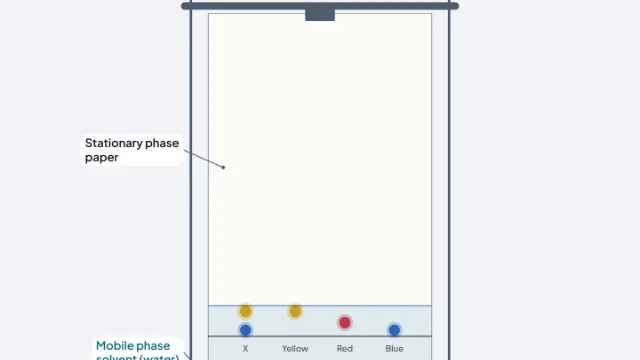
  • the stationary phase, which stays put. In paper chromatography this is the paper;
  • the mobile phase, which moves through the stationary phase. Here this is the solvent, such as water or ethanol, soaking up the paper.

A spot of the mixture is put on a pencil line near the bottom of the paper, and the bottom edge is dipped in solvent. As the solvent rises, it carries the dissolved substances up with it.

How does chromatography separate a mixture?

Each substance in the spot is shared out between the two phases. At any moment, part of it is dissolved in the moving solvent and part of it is held back on the paper.

  • A substance that is very soluble in the solvent and weakly attracted to the paper spends most of its time moving, so it travels far up the paper.
  • A substance that is strongly attracted to the paper, or only slightly soluble, spends more time standing still, so it travels a shorter distance.

Because each substance has its own balance between the two phases, the mixture spreads out into separate spots. A substance that does not dissolve in the solvent at all stays on the start line.

How do you calculate an Rf value?

Rf=distance moved by substancedistance moved by solventR_f = \frac{\text{distance moved by substance}}{\text{distance moved by solvent}}

Both lengths start at the start line (the origin). For the substance, measure up to the centre of its spot; for the solvent, measure up to the solvent front. Rf has no unit and is always less than 1, because nothing can travel further than the solvent that carries it.

In the same solvent and conditions, a given compound always has the same Rf value, so Rf values help identify unknown substances. Change the solvent and the Rf values change.

Worked example: identifying the dyes in an ink

Question: A black ink is spotted beside three known dyes, A, B and C, and run in water. The solvent front is 8.0 cm above the start line. The ink gives two spots, with centres 2.4 cm and 5.6 cm above the line. The known dyes have Rf values of 0.30 (A), 0.52 (B) and 0.70 (C) in water. Which dyes are in the ink?

  1. Lower spot: Rf = 2.4 ÷ 8.0 = 0.30.
  2. Upper spot: Rf = 5.6 ÷ 8.0 = 0.70.
  3. Compare: 0.30 matches A and 0.70 matches C. Nothing in the ink matches B.
  4. Conclusion: the ink is a mixture containing dyes A and C.

Both distances were given to 2 significant figures, so the Rf values are given to 2 significant figures as well.

How can chromatography show whether a substance is pure?

To a chemist, a pure substance contains just one element or one compound, with nothing else mixed in. That is different from the everyday sense, where "pure orange juice" just means nothing has been added.

What the chromatogram showsWhat it tells you
Two or more spots from one sampleThe sample is a mixture (impure)
One spot in one solventPossibly pure, but not proved: two substances may share an Rf value in that solvent
One spot in every solvent triedGood evidence that it is a pure compound
A spot level with a known substance in the same runThe sample probably contains that substance
A spot that never leaves the originIt does not dissolve in the chosen solvent

A sharp melting point is another sign of purity, which AQA covers in 4.8.1.1.

How do you carry out required practical 6?

  1. Draw a start line in pencil about 2 cm from the bottom of the chromatography paper. Ink would dissolve and run.
  2. Use a capillary tube or fine dropper to put a small, concentrated spot of each sample on the line, well spaced out. Let each dry and add more on top for a stronger colour.
  3. Pour solvent (water in AQA's food colouring method) into a beaker to a depth of about 1 cm, below the start line, so the spots are not washed off into the solvent.
  4. Hang the paper from a spill so its bottom edge dips into the solvent without touching the sides, and leave the beaker undisturbed. A lid stops solvent evaporating from the paper as it climbs; it helps most with a volatile solvent such as ethanol.
  5. Remove the paper when the solvent has climbed most of the way, but before it reaches the top, and mark the solvent front in pencil straight away.
  6. Let the paper dry, then measure the distances and calculate each Rf value.

Ethanol and similar solvents catch fire easily, so no Bunsen burners should be nearby.

Try it in the simulation

Press Play in the chromatography simulation above with Food dye selected. When the solvent nears the top, press Take out and match the unknown's spots to the reference lanes. Turn off Show distances and Rf values to measure with the ruler yourself, then switch to Ethanol and watch the Rf values change while the matches stay the same. Finally choose Pure or not? and decide which sample is pure by running it in both solvents.
Common mistakes

  • Drawing the start line in pen. The ink is a mixture of soluble dyes, so it runs up the paper and confuses the results; use pencil.
  • Measuring distances from the bottom edge of the paper. Both lengths should start at the pencil start line, not the paper's edge.
  • Measuring to the top of a spot. Measure to its centre, or the Rf value comes out too large.
  • Calling a sample pure because it gives one spot in one solvent. Two substances can travel together in one solvent; it must give a single spot in every solvent.
  • Getting an Rf value greater than 1. A substance cannot move further than the solvent, so the solvent distance goes on the bottom of the fraction.
  • Comparing Rf values measured in different solvents. A substance's Rf changes from one solvent to another, so compare values only within one solvent.

Exam practice

Exam-style questions

Original questions written in the style of GCSE AQA Chemistry. Try each one before you reveal the answer.

  1. 1.A student uses paper chromatography to investigate a green food colouring. The solvent is water.

    1. (a)Name the mobile phase and the stationary phase.

      2 marks
      Show the answer

      Answer: Mobile phase: water (the solvent). Stationary phase: the paper.

      Marking points

      • Mobile phase is the water / solvent
      • Stationary phase is the paper
    2. (b)The solvent front moved 7.5 cm. A blue spot moved 4.8 cm. Calculate the Rf value of the blue dye. Give your answer to 2 significant figures.

      2 marks
      Show the answer

      Answer: Rf = 4.8 ÷ 7.5 = 0.64

      Marking points

      • 4.8 ÷ 7.5
      • 0.64
    3. (c)Explain why the blue dye and a yellow dye in the food colouring separate.

      3 marks
      Show the answer

      Answer: Each dye is distributed differently between the solvent and the paper. One dye is more soluble in the water (or less attracted to the paper), so it spends more time in the mobile phase and moves further up the paper.

      Marking points

      • Dyes are distributed differently between the two phases
      • Different solubility in the solvent / different attraction to the paper
      • So they travel different distances
  2. 2.A student sets up the chromatography practical but makes some errors.

    1. (a)The solvent level is above the start line. Explain what will happen.

      2 marks
      Show the answer

      Answer: The samples wash off the paper into the solvent pool rather than travelling up the paper, so no chromatogram forms.

      Marking points

      • Samples wash off into the solvent
      • So they do not move up the paper / no separation
    2. (b)The student leaves the paper in until the solvent reaches the top edge. Explain why Rf values cannot then be calculated.

      2 marks
      Show the answer

      Answer: The true distance moved by the solvent is unknown, because the front has gone as far as the paper allows (solvent may have kept moving or evaporating), so the denominator of the Rf calculation cannot be measured.

      Marking points

      • Cannot tell how far the solvent travelled / the front cannot be marked
      • Distance moved by solvent is needed to calculate Rf
  3. 3.Samples P and Q are run in three different solvents. P gives one spot in each solvent. Q gives one spot in the first solvent but two spots in the second and third.

    1. (a)Which sample is most likely to be pure? Explain your answer.

      2 marks
      Show the answer

      Answer: P, because a pure compound gives a single spot in all solvents. Q separates into two substances in some solvents, so it is a mixture.

      Marking points

      • P
      • Single spot in all solvents (Q gives two spots, so is a mixture)
    2. (b)Explain why Q gave only one spot in the first solvent.

      1 mark
      Show the answer

      Answer: The two substances in Q have the same (or very similar) Rf values in that solvent, so they move together.

      Marking points

      • Same / similar Rf values in that solvent, so they do not separate

Quiz

Quick check

5 questions

  1. 1.A spot moves 3.0 cm and the solvent front moves 12.0 cm. What is the Rf value?
  2. 2.In paper chromatography, what is the stationary phase?
  3. 3.One dye travels much further up the paper than another in the same solvent. What is the most likely reason?
  4. 4.Which result shows that a sample is a mixture?
  5. 5.Why is a lid placed on the beaker during chromatography?

Next step

Now see it move

You have reached the last topic guide in this course so far. Open the full simulation, then test yourself.

Paper chromatography simulation: spots of a food colouring, an ink or test samples on a start line beside reference dyes