Chemistry10 min read
Factors Affecting the Rate of Reaction: Collision Theory, Activation Energy and Rate Graphs
Learn what collision theory says, why temperature, concentration, gas pressure, surface area and catalysts change the rate of a reaction, what activation energy is, how to calculate a mean rate and read rate graphs and tangents, with worked examples and the usual exam traps.
Published
On this page
- What is the rate of a reaction?
- What does collision theory say?
- How does temperature affect the rate of reaction?
- How do concentration and pressure affect the rate?
- How does surface area affect the rate?
- What does a catalyst do?
- What is activation energy on a reaction profile?
- How do you measure the rate of a reaction?
- How do you read a rate of reaction graph?
- Common mistakes
- Quick answers
- Key points
In short
The rate of a reaction goes up when reacting particles collide more often, or when more of their collisions have enough energy to react. That is collision theory. Five factors change the rate: temperature, the concentration of a solution, the pressure of a gas, the surface area of a solid and the presence of a catalyst. Higher concentration, pressure and surface area all give more frequent collisions. A higher temperature gives more frequent collisions and, far more importantly, more energetic ones. A catalyst lowers the activation energy, the minimum energy a collision needs, so a bigger share of collisions succeed.
What is the rate of a reaction?
Rate measures speed: how fast a reactant disappears, or how fast a product builds up. Either one works:
The amount is usually a mass in grams or a gas volume in cm³, so rates come out in g/s or cm³/s. AQA Higher tier also uses amounts in moles, giving mol/s.
Worked example 1: a mean rate
Marble chips (calcium carbonate) react with hydrochloric acid and give off carbon dioxide:
A gas syringe collects 90 cm³ of carbon dioxide in the first 30 s. What is the mean rate over that time?
Equation: mean rate = volume of product formed ÷ time taken
Substitution: mean rate = 90 cm³ ÷ 30 s
Answer: 3.0 cm³/s
What does collision theory say?
Collision theory explains every rate change with two ideas:
- Particles must collide. Reactant particles can only react when they meet.
- The collision must have enough energy. Bonds have to start breaking before new ones form, and that takes energy. The smallest energy a collision needs to cause a reaction is the activation energy, written Ea. Collisions below it just bounce apart.
So the rate depends on two things: how many collisions happen each second (the collision frequency) and what fraction of those collisions reach Ea. Each factor works through one or both.
| Change | Collisions per second | Fraction of collisions with at least Ea | Rate |
|---|---|---|---|
| Raise the temperature | a little higher | much higher | increases a lot |
| Increase the concentration of a solution | higher | unchanged | increases |
| Increase the pressure of a gas | higher | unchanged | increases |
| Increase the surface area of a solid | higher | unchanged | increases |
| Add a catalyst | unchanged | higher, because Ea is lower | increases |
How does temperature affect the rate of reaction?
Heating a reaction mixture gives its particles more kinetic energy, and that has two effects:
- The particles move faster, so they collide a little more often.
- Many more of the collisions now carry at least the activation energy, so a much bigger fraction succeed.
The second effect is by far the larger one. Exam answers that mention only "more collisions" usually miss a mark. As a rough guide, many reactions near room temperature go about twice as fast for every 10 °C rise, which is why food lasts longer in a fridge and why cooking speeds up the chemistry in an egg.
How do concentration and pressure affect the rate?
Concentration tells you how many particles are packed into each unit of volume of a solution. Make an acid more concentrated and there are more acid particles in each cm³, so the other reactant meets them more often. The energy of each collision does not change, so the fraction that succeed stays the same, but more collisions each second means more successful ones each second.
Pressure does the same job for gases. Squeezing a gas into a smaller volume, or pumping more in, packs its particles closer together, so they collide more often.
AQA asks you to use proportion here. If you double the concentration of one reactant, you roughly double the number of collisions it has each second, so the rate at the start roughly doubles too.
How does surface area affect the rate?
When a solid reacts with a liquid or gas, only particles on the surface of the solid can be hit. Particles buried inside must wait until the outer layers have reacted away. Breaking the solid into smaller pieces exposes more particles, so collisions happen more often.
Worked example 2: cutting up a cube
A cube of calcium carbonate has sides of 2 cm. It is cut into eight cubes with sides of 1 cm. Compare the surface area to volume ratios.
Large cube, surface area: 6 faces × (2 cm × 2 cm) = 24 cm²
Large cube, volume: 2 × 2 × 2 = 8 cm³, so the ratio is 24 : 8 = 3 : 1
Small cubes, surface area: 8 cubes × 6 faces × (1 cm × 1 cm) = 48 cm²
Small cubes, volume: still 8 cm³ in total, so the ratio is 48 : 8 = 6 : 1
Answer: the same mass now has twice the surface exposed, so the acid collides with it about twice as often and the reaction starts about twice as fast. Grind it to powder and the ratio climbs much further.
That is why fine powders can be dangerous: flour or coal dust spread through the air has such a huge surface area that a spark can make it burn explosively.
What does a catalyst do?
A catalyst makes a reaction go faster and is still all there when the reaction ends. At the end you have the same mass of catalyst you started with, so it is not written as a reactant in the equation. It works by opening up a different route for the reaction, one with a lower activation energy. Collision frequency stays as it was; what changes is that a larger share of those collisions clear the lower barrier.
Different reactions need different catalysts:
- Manganese(IV) oxide speeds up the breakdown of hydrogen peroxide into water and oxygen.
- Iron speeds up the Haber process, which makes ammonia.
- Platinum and rhodium in a car's catalytic converter help turn harmful exhaust gases into less harmful ones.
- Enzymes are biological catalysts. Amylase in your saliva, for example, starts breaking down starch.
Catalysts save energy and money in industry, because a reaction can run fast enough at a lower temperature.
What is activation energy on a reaction profile?
A reaction profile plots energy upwards against the progress of the reaction from left to right. It starts with a flat line for the reactants, climbs over a hump and ends with a flat line for the products. For an exothermic reaction the products finish lower than the reactants.
- The activation energy is the height from the reactants' line up to the top of the hump.
- With a catalyst, the hump is lower, but the reactants and products stay at the same levels. The overall energy change of the reaction is not altered.
- The Punjab book calls the arrangement of atoms at the very top of the hump the transition state.
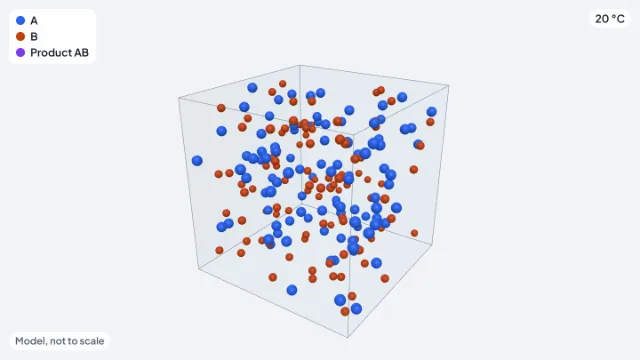
You can watch all of this in the collision theory in 3D simulation. Start the run, then move the Temperature control all the way from 10 °C to 80 °C: the Collisions per second card rises a little, but the Fraction that succeed card climbs much faster. Switch the catalyst on and the energy profile beside the graph shows a lower hump. In Solid + acid mode, try 1 lump, then 8 cubes, then Powder, and watch the collision count.
How do you measure the rate of a reaction?
Pick something that changes as the reaction goes on, and record it against time:
- Volume of gas given off, collected in a gas syringe or an upturned measuring cylinder, for example the hydrogen from magnesium and acid.
- Loss in mass on a balance, as a gas such as carbon dioxide escapes from an open flask.
- A change in colour or cloudiness. Sodium thiosulfate and hydrochloric acid slowly form a pale yellow solid, sulfur, that hides a cross drawn under the flask. Timing how long the cross takes to vanish gives a measure of the rate: the shorter the time, the faster the reaction.
How do you read a rate of reaction graph?
On a graph of product formed against time, the gradient (steepness) is the rate.
- Steepest at the start, because the reactants are at their most concentrated, so collisions are most frequent.
- Gets less steep, as reactant particles are used up and collisions become rarer.
- Flat at the end, because one reactant has run out. The reaction has stopped.
When two runs are drawn on the same axes:
- The steeper curve is the faster reaction. Higher temperature, higher concentration, a powder in place of lumps or an added catalyst all give a steeper start.
- When both runs start with equal amounts of the limiting reactant (the one used up first), the two curves flatten out at the same final height. Powdered marble with the same acid gives a steeper curve but the same total volume of gas.
- If that reactant is halved, the final height halves too.
Worked example 3: the gradient of a tangent
For the rate at a single instant, rule a tangent, a straight line grazing the curve at that time without cutting across it. Then find its gradient.
In another run, a tangent drawn at 20 s passes through the points (0 s, 15 cm³) and (50 s, 90 cm³). What is the rate at 20 s?
Rise: 90 − 15 = 75 cm³
Run: 50 − 0 = 50 s
Gradient: 75 cm³ ÷ 50 s
Answer: the rate at 20 s is 1.5 cm³/s
Pick two points on the tangent that are far apart. It makes your reading errors matter less.
Common mistakes
- "Heating only makes particles collide more." What matters most is the jump in the share of collisions energetic enough to react.
- "A catalyst gives particles more energy." It provides a route that needs less energy instead.
- "A catalyst makes more product." It makes the same product faster; the final amount is unchanged.
- "Concentration makes particles move faster." Their speed depends on temperature. Concentration changes how many there are in each volume.
- "Powder is faster because there is more of it." Use the same mass. The powder has more surface, not more substance.
- Dividing the wrong way. Rate = amount ÷ time, so 90 cm³ in 30 s is 3.0 cm³/s, not 0.33.
- Saying the reaction speeds up near the end. The curve flattens, so the rate is falling.
Quick answers
Why does increasing temperature increase the rate of reaction?
Particles gain kinetic energy. They collide slightly more often, and far more of those collisions now reach or exceed the activation energy, so successful collisions each second rise steeply.
Does a catalyst change the activation energy?
Yes. The catalysed route has a lower energy barrier than the uncatalysed one, while the energies of the reactants and products stay exactly the same.
Why does a rate graph level off?
One reactant has been completely used up, so no more collisions between reacting particles can happen and no more product forms.
Key points
- Reactions need collisions with at least the activation energy.
- Concentration, gas pressure and surface area raise the collision frequency.
- Temperature raises the collision frequency a little and the share of energetic collisions a lot.
- A catalyst opens up a different route needing less activation energy, and it is still all there at the end.
- Mean rate = amount used or formed ÷ time. On a graph, rate is the gradient.
- Rate graphs start steep, then level off once the limiting reactant is gone.