Chemistry10 min read
Covalent Bonding and Dot-and-Cross Diagrams: Water, Ammonia, Methane, CO₂, O₂ and N₂ Step by Step
A step-by-step method for drawing dot-and-cross diagrams of covalent molecules, with a table of shared pairs and lone pairs for eleven molecules, worked examples for water, carbon dioxide and nitrogen, double and triple bonds, and the checks that catch most mistakes.
Published
On this page
- Why do non-metal atoms share electrons?
- What is the method for any covalent molecule?
- What are the shared pairs and lone pairs in common molecules?
- How do you draw the dot-and-cross diagram for water?
- How do you show a double bond in a dot-and-cross diagram?
- How do you show a triple bond?
- How do you check that your diagram is right?
- What do dot-and-cross diagrams leave out?
- Common mistakes
- Quick answers
- Key points
In short
In a covalent bond, two atoms (usually non-metals) hold a pair of electrons in common. Each atom gives one electron to the pair, and both nuclei attract it, which holds the atoms together. A dot-and-cross diagram shows this sharing: one atom's electrons are drawn as dots, the other's as crosses, and each shared pair sits where the two atoms' outer shells overlap.
The rule that makes every diagram work: after sharing, hydrogen has 2 electrons in its shell and almost every other atom has 8 in its outer shell. One shared pair is a single bond, two shared pairs a double bond (as in O₂ and CO₂) and three a triple bond (as in N₂). Any outer electrons left out of the sharing remain on their own atom, grouped as lone pairs.
Why do non-metal atoms share electrons?
Non-metal atoms are short of a full outer shell. When two of them meet, neither will give up electrons easily, because both attract electrons strongly. They can still reach a full shell by sharing. A shared pair counts towards the outer shell of both atoms at once.
Take two chlorine atoms, each 2,8,7. Each needs one more electron. If each puts one electron into a shared pair, both now count 8 in the outer shell: their own 6 unshared electrons plus the 2 in the pair. That is the Cl₂ molecule.
The bond is strong because both nuclei pull on the same pair of electrons. Covalent bonds hold the atoms inside a molecule together. The forces between separate molecules are much weaker, which is a separate idea covered in ionic, covalent and metallic bonding compared.
What is the method for any covalent molecule?
Use this method for any small molecule:
- Count the outer electrons of each atom. The group number gives it: carbon 4, nitrogen 5, oxygen 6, chlorine 7, and hydrogen 1.
- Work out how many bonds each atom needs. Hydrogen needs 1 more electron, so it makes 1 bond. Other atoms need (8 − outer electrons): carbon 4, nitrogen 3, oxygen 2, chlorine 1.
- Put the atom that needs the most bonds in the middle. It is carbon in CH₄ and CO₂, nitrogen in NH₃ and oxygen in H₂O.
- Draw overlapping circles for the outer shells, with the central atom joined to each outer atom.
- Place the shared pairs in the overlaps, drawing every pair as a dot beside a cross.
- Add the lone pairs: every remaining outer electron goes on its own atom, outside the overlaps, in pairs.
- Check: count 2 round each hydrogen and 8 round every other atom, and make sure the total number of dots and crosses equals the total number of outer electrons you started with.
Only outer-shell electrons are usually drawn. The inner shells do not take part in bonding.
What are the shared pairs and lone pairs in common molecules?
| Molecule | Bonds (line drawing) | Shared pairs | Lone pairs |
|---|---|---|---|
| Hydrogen, H₂ | H–H | 1 | none |
| Chlorine, Cl₂ | Cl–Cl | 1 | 3 on each Cl |
| Hydrogen chloride, HCl | H–Cl | 1 | 3 on Cl |
| Water, H₂O | H–O–H | 2 | 2 on O |
| Ammonia, NH₃ | three N–H | 3 | 1 on N |
| Methane, CH₄ | four C–H | 4 | none |
| Oxygen, O₂ | O=O | 2 (one double bond) | 2 on each O |
| Nitrogen, N₂ | N≡N | 3 (one triple bond) | 1 on each N |
| Carbon dioxide, CO₂ | O=C=O | 4 (two double bonds) | 2 on each O, none on C |
| Ethene, C₂H₄ | C=C plus four C–H | 6 | none |
| Methanol, CH₃OH | three C–H, C–O, O–H | 5 | 2 on O |
A useful pattern sits in the middle rows. Carbon, nitrogen and oxygen each finish with 8 outer electrons, but they split them differently: CH₄ has 4 bonds and no lone pairs, NH₃ has 3 bonds and 1 lone pair, and H₂O has 2 bonds and 2 lone pairs. In each case, bonds + lone pairs = 4 pairs = 8 electrons.
How do you draw the dot-and-cross diagram for water?
Worked example 1: water, H₂O
Outer electrons: oxygen has 6 and each hydrogen has 1, so 6 + 1 + 1 = 8 to place
Bonds needed: oxygen needs 2 more electrons, so it makes 2 bonds. Each hydrogen makes 1
Centre: oxygen, with a hydrogen on each side
Shared pairs: in each O–H overlap, put one dot (from oxygen) and one cross (from hydrogen)
Lone pairs: oxygen has 6 − 2 = 4 dots left, which form 2 lone pairs on the oxygen
Check: oxygen counts 4 shared + 4 lone = 8. Each hydrogen counts 2. Total drawn = 8, as expected
The flat drawing often puts the hydrogens at 180° to each other, but the real molecule is bent. The two lone pairs push the bonds closer together, giving an angle of about 104.5°.
How do you show a double bond in a dot-and-cross diagram?
A double bond is two shared pairs between the same two atoms, so you draw four electrons in that overlap: two dots and two crosses.
Worked example 2: carbon dioxide, CO₂
Outer electrons: carbon 4, each oxygen 6, so 4 + 6 + 6 = 16 to place
Bonds needed: carbon needs 4, each oxygen needs 2
Centre: carbon, between the two oxygens
Shared pairs: carbon cannot make four bonds to two atoms with single bonds, so it forms a double bond to each oxygen. Each C=O overlap holds 2 crosses from carbon and 2 dots from oxygen
Lone pairs: each oxygen has 6 − 2 = 4 electrons left, so 2 lone pairs. Carbon has used all 4 of its electrons, so it has none
Check: carbon counts 4 + 4 = 8. Each oxygen counts 4 shared + 4 lone = 8. Total drawn: 8 shared + 8 lone = 16
The oxygen molecule, O₂, works the same way. Each oxygen atom needs 2 more electrons, so they share two pairs and each keeps 2 lone pairs: 4 + 4 = 8.
How do you show a triple bond?
A triple bond is three shared pairs, so six electrons sit in one overlap.
Worked example 3: nitrogen, N₂
Outer electrons: 5 + 5 = 10 to place
Bonds needed: each nitrogen needs 3 more electrons, so the two atoms share 3 pairs
Shared pairs: the overlap holds 3 dots and 3 crosses
Lone pairs: each nitrogen has 5 − 3 = 2 electrons left, which is 1 lone pair each
Check: each nitrogen counts 6 shared + 2 lone = 8. Total drawn: 6 + 4 = 10
The N≡N triple bond is one of the strongest bonds in chemistry. That is why nitrogen gas, which makes up about 78% of the air, is so unreactive.
How do you check that your diagram is right?
Three quick checks catch almost every error:
- Shell totals. 2 round every hydrogen, 8 round every other atom here.
- Electron total. All dots and crosses together equal the sum of the outer electrons. For NH₃ that is 5 + 1 + 1 + 1 = 8.
- Bond count. Carbon makes 4 bonds, nitrogen 3, oxygen 2, and hydrogen and chlorine 1 each. A double bond counts as 2 and a triple bond as 3.
Explore all eleven molecules from the table in the covalent molecules in 3D simulation. Pairs 2D gives the flat diagram you draw in an exam, and Pairs 3D shows the same dots and crosses sitting in overlapping shells around the real 3D molecule. Switch to Ball+stick to see each double bond as two sticks and each triple bond as three, and read the shared-pair and lone-pair counts from the cards. If you are unsure why oxygen starts with 6 outer electrons, build it in the electron shells in 3D simulation.
What do dot-and-cross diagrams leave out?
Every model of a molecule hides something. AQA asks you to describe these limits:
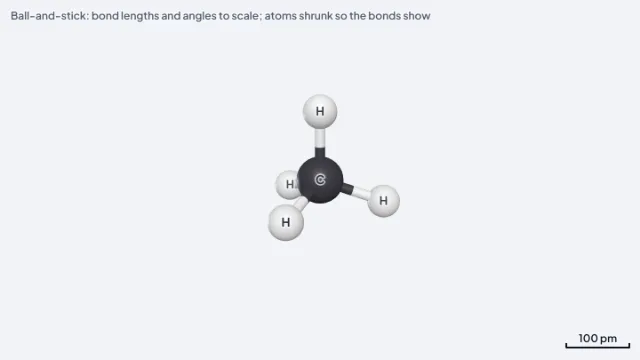
- Dots and crosses show which atom each electron came from, but every electron is identical. They also suggest a flat molecule. Methane is really a tetrahedron, with bond angles of 109.5°.
- Line drawings (displayed formulae) show which atoms are bonded and how many bonds join them, but not the lone pairs or the shape.
- Ball-and-stick models get the shape and angles right, but atoms are not tiny balls and bonds are not rods.
- Space-filling models show how much room a molecule takes up, but hide the bonds.
Common mistakes
- Mixing up electrons and pairs. The triple bond in N₂ is 3 shared pairs, made of 6 electrons.
- Drawing all the electrons. Only the outer shell takes part. Oxygen shows 6, not 8.
- Leaving out lone pairs. Water's oxygen has two, and the shell total is wrong without them.
- Giving hydrogen 8. Hydrogen's only shell is full with 2.
- Single bonds in CO₂ or O₂. With single bonds, oxygen would have only 7. Each C=O and O=O is a double bond.
- Putting a lone pair on carbon in CO₂. Carbon uses all 4 of its electrons in the two double bonds.
- Thinking dots and crosses are different particles. They are the same; the symbols only record where each electron came from.
Quick answers
How many lone pairs does ammonia have?
One. Nitrogen has 5 outer electrons, uses 3 of them in the three N–H bonds, and keeps the other 2 as a lone pair.
What is the difference between a single, double and triple bond?
The number of shared pairs. A single bond shares 1 pair of electrons, a double bond 2 pairs and a triple bond 3 pairs. Between the same two atoms, more shared pairs pull the atoms closer together and make the bond stronger.
Do you draw the circles in a dot-and-cross diagram?
Both styles are common. Overlapping circles make the sharing easy to see, while diagrams without circles just group the pairs between the symbols. Either way, every outer electron must be shown in the right place.
Key points
- Covalent bonding means two atoms, usually non-metals, sharing electrons in pairs.
- After bonding, hydrogen has 2 outer electrons and the other atoms here have 8.
- Carbon makes 4 bonds, nitrogen 3, oxygen 2, hydrogen and chlorine 1.
- O₂ and CO₂ contain double bonds (2 shared pairs). N₂ has a triple bond (3 shared pairs).
- Unshared outer electrons form lone pairs: 1 on nitrogen in NH₃ and 2 on oxygen in H₂O.
- Check every diagram by counting each shell and the total number of outer electrons.