Where this sits in AQA chemistry
What is a covalent bond?
Atoms joined by a covalent bond hold a pair of electrons in common, normally one from each atom. Both nuclei are attracted to the shared electrons, and that attraction holds the two atoms together strongly. Covalent bonding happens between non-metal atoms: in most non-metal elements, such as chlorine, and in compounds made only of non-metals, such as water.
Sharing lets each atom count the shared electrons as part of its own outer shell. Hydrogen ends with 2 electrons, like helium; the other atoms in AQA's list end with 8.
How many bonds does each atom make?
An atom forms as many single bonds as it needs electrons to complete its outer shell.
| Atom | Outer electrons | Electrons needed | Usual number of bonds |
|---|---|---|---|
| H | 1 | 1 (to reach 2) | 1 |
| Cl | 7 | 1 | 1 |
| O | 6 | 2 | 2 |
| N | 5 | 3 | 3 |
| C | 4 | 4 | 4 |
Two oxygen atoms each need two electrons, so O₂ has a double bond: two shared pairs, drawn O=O. Two nitrogen atoms each need three, so N₂ has a triple bond, N≡N. Electrons that are not shared stay on their atom as lone pairs.
How do you draw dot and cross diagrams for AQA's eight molecules?
Draw the outer shell of each atom as a circle, and let the circles overlap where atoms bond. Put the shared pairs in the overlap, one dot and one cross for each pair, and the lone pairs on the rest of the circle.
| Molecule | Shared pairs | Lone pairs | Displayed formula |
|---|---|---|---|
| H₂ | 1 | 0 | H–H |
| Cl₂ | 1 | 3 on each Cl | Cl–Cl |
| HCl | 1 | 3 on Cl | H–Cl |
| H₂O | 2 | 2 on O | H–O–H |
| NH₃ | 3 | 1 on N | N joined to three H |
| CH₄ | 4 | 0 | C joined to four H |
| O₂ | 2 (double bond) | 2 on each O | O=O |
| N₂ | 3 (triple bond) | 1 on each N | N≡N |
A quick check that catches most errors: count the electrons inside each circle, including every shared pair that touches it. Hydrogen must have 2, every other atom 8.
Worked example: the ammonia molecule
Question: Show the outer electrons of ammonia, NH₃, in a dot and cross diagram.
- Nitrogen has 5 outer electrons (crosses). Each hydrogen has 1 (dots).
- Nitrogen needs 3 more, so it shares one pair with each of three hydrogen atoms. Each overlap holds one dot and one cross.
- Nitrogen has used 3 of its 5 electrons. The other 2 stay on nitrogen as one lone pair.
- Check: nitrogen's circle holds 3 × 2 + 2 = 8 electrons; each hydrogen holds 2.
What kinds of covalent substance are there?
The bonds are always strong, but the substances they build are very different:
- Small molecules, such as water, ammonia and methane: a few atoms each. You should recognise these from their formulae.
- Polymers: very large molecules, long chains drawn as a repeating unit in brackets with a large number n after it.
- Giant covalent structures: every atom bonded into one network, as in diamond or silica (SiO₂). See diamond, graphite, graphene and fullerenes.
Small molecules boil easily even though the bonds inside them are strong; the reason belongs to spec point 4.2.2.4.
What do the different models leave out?
- A dot and cross diagram records the origin of every electron, yet tells you nothing about shape or size.
- A displayed formula with lines shows which atoms are joined, but not the lone pairs or the 3D shape.
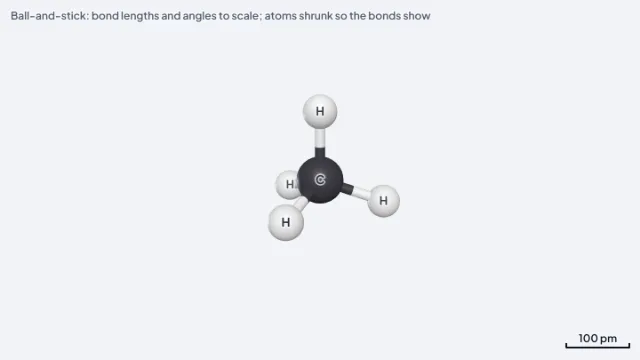
- A ball and stick model shows the shape and the bond angles, but makes bonds look like solid rods and the atoms too small and far apart.
- A space-filling model gives a fair idea of how much room the molecule takes up, at the cost of hiding its bonds.
To deduce a molecular formula from any of these, count each kind of atom: a model with one carbon ball and four hydrogen balls is CH₄, however the sticks are drawn.
Build the eight molecules in 3D
The 3D molecule viewer holds all eight of AQA's molecules. Choose NH₃ and switch between Ball+stick and Pairs 3D: in the second view, check that each overlap holds one electron from each atom, and find the lone pair. Then press Pairs 2D to compare with the flat exam diagram. Step through Cl₂, O₂ and N₂ and watch the Shared pairs card go from 1 to 2 to 3.