Physics6 min read
The Learning Styles Myth, and What Really Helps: Dual Coding for Science
Why matching lessons to a 'visual', 'auditory' or 'kinaesthetic' style is not backed by evidence, what a fair test of the idea looks like, and what does help everyone: words and pictures together, and simulations used actively by predicting first, then testing.
Published
On this page
- How many people believe in learning styles?
- What is the learning-styles idea?
- What did Pashler and colleagues find?
- Why does the myth feel true?
- What is dual coding?
- How do you dual code your science revision?
- Why do simulations help when you use them actively?
- Common mistakes
- Are learning styles completely made up?
- Is dual coding the same as being a visual learner?
- Do I need to be good at drawing?
- Are 3D simulations always better than 2D?
In short
There is no good evidence that you learn better when teaching is matched to a "visual", "auditory" or "kinaesthetic" learning style. A major 2008 review found that almost no studies had tested the idea fairly, and several of the few fair tests went against it; what does help nearly everyone is dual coding, learning from words and pictures together, especially when you work with the picture actively.
How many people believe in learning styles?
Most teachers, according to one survey. In 2012, Sanne Dekker and colleagues (Frontiers in Psychology) surveyed 242 teachers in the UK and the Netherlands who were interested in how the brain learns. They were asked whether people learn better when they get information in their preferred learning style, such as auditory, visual or kinaesthetic. 93% of the UK teachers and 96% of the Dutch teachers agreed.
If you have filled in a questionnaire at school and been told you are a "visual learner", you are in good company. The trouble is what happened when researchers checked.
What is the learning-styles idea?
The idea has two parts. First, each person has a preferred way to take in information: seeing, hearing or doing. Second, and this is the key claim, teaching matched to your style helps you learn more than teaching that is not matched. Researchers call this second part the meshing hypothesis.
The first part is partly true: people do have preferences. The second part is the one that matters, and it is the one that fails.
What did Pashler and colleagues find?
Harold Pashler, Mark McDaniel, Doug Rohrer and Robert Bjork reviewed the evidence in 2008 for the journal Psychological Science in the Public Interest. They began by setting out what a fair test needs.
Picture it with a physics topic. Take students who say they are visual learners and students who say they are auditory learners. Split each group at random: half learn about transformers from labelled diagrams, half from a recorded talk. Then test everyone the same way. If meshing is real, the visual learners must do better with the diagrams and the auditory learners must do better with the talk. Plotted on a graph, the two lines have to cross.
The reviewers found very few studies that used a design like this. Of those that did, several showed results that flatly contradicted meshing. They concluded that there was no adequate evidence to justify using learning-styles assessments in general education.
A later fair test by Laura Rogowsky, Barbara Calhoun and Paula Tallal (2015, Journal of Educational Psychology) sorted adults into auditory and visual learners with a standard questionnaire, then gave them the same non-fiction text as an audiobook or as an e-text. Comprehension had no link with whether the format matched the person's style, either straight after or later.
Why does the myth feel true?
Because preferences are real and pleasant. You may honestly enjoy diagrams more than talks. But enjoying a format is not the same as learning more from it.
There is also a hidden cost. The best format usually depends on the content, not the learner. A ray diagram is visual for everyone, a mnemonic chant is sound for everyone, and a required practical is hands-on for everyone. A student told "you are an auditory learner" might skip the very diagrams that physics depends on.
What is dual coding?
Dual coding comes from the psychologist Allan Paivio, set out in his books Imagery and Verbal Processes (1971) and Mental Representations (1986). He proposed that the mind has two linked systems, one for words and one for images. Words that call up a picture, such as "magnet", are easier to remember than abstract ones, such as "efficiency". Something stored both as words and as a picture has two routes back into memory.
Richard Mayer built on this in his research on multimedia learning (summed up in his book Multimedia Learning, second edition 2009). His multimedia principle says that people learn better from words and pictures than from words alone. That holds for learners in general, not just for self-described visual learners.
The pictures have to earn their place, though. Mayer's work also shows that:
- decorative pictures and extras can hurt, because they use up attention;
- labels belong on or next to the picture, not in a separate block of text;
- reading the same words that you are hearing tends to add little, or even hold you back.
How do you dual code your science revision?
- Draw it while you say it. Sketch a ray diagram through a converging lens as you say each rule aloud.
- Pair each equation with a graph. Beside the equation for acceleration, sketch a velocity–time graph and mark its gradient.
- Turn paragraphs into a labelled diagram from memory, then check it: the national grid, the particle model, a dot-and-cross diagram.
- Use a timeline for stories: the atomic models from Dalton to Chadwick.
- Keep diagrams simple. Boxes, arrows and labels beat artwork.
Why do simulations help when you use them actively?
A simulation is a moving diagram with words attached, so it is dual coding by design. But watching is not enough.
Catherine Crouch, Adam Fagen, Paul Callan and Eric Mazur (2004, American Journal of Physics) compared ways of showing classroom physics demonstrations to university students. Students who just watched a demonstration understood it no better than students who never saw it. Students who first predicted what would happen did significantly better.
That is why many of our sims open with predict-first questions. You commit to an answer, the sim runs that case, and then the explanation appears. Try these:
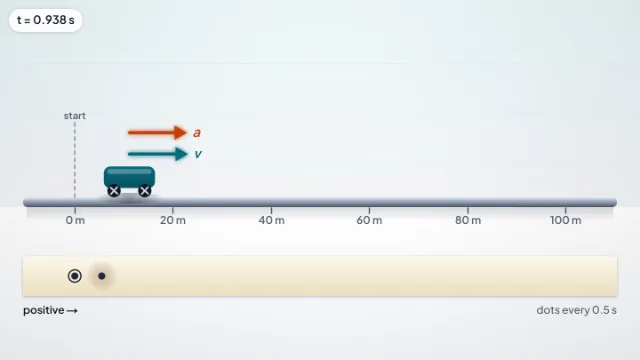
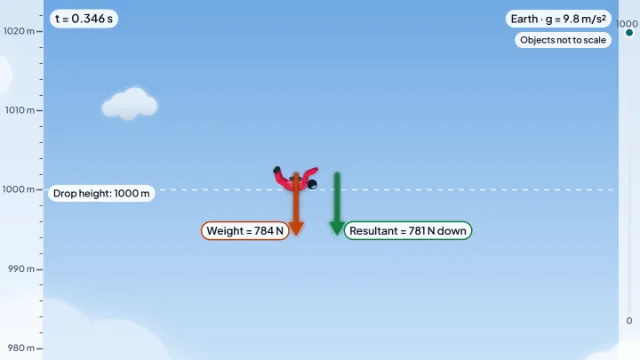
- the hammer and feather on the Moon in the free fall simulation;
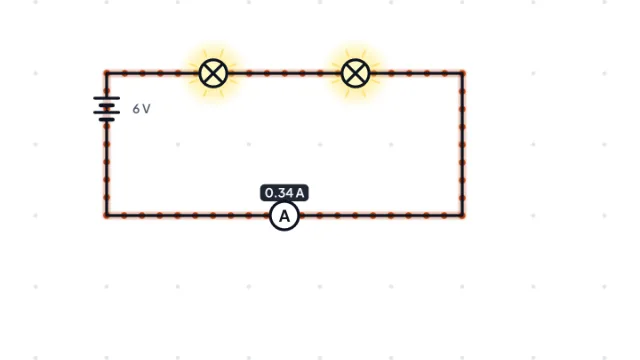
- whether a second lamp in series gets less current, in the circuit builder;
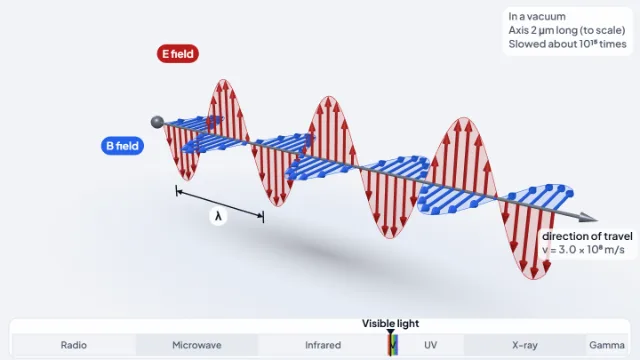
- whether radio waves or gamma rays travel faster, in the electromagnetic spectrum simulation.
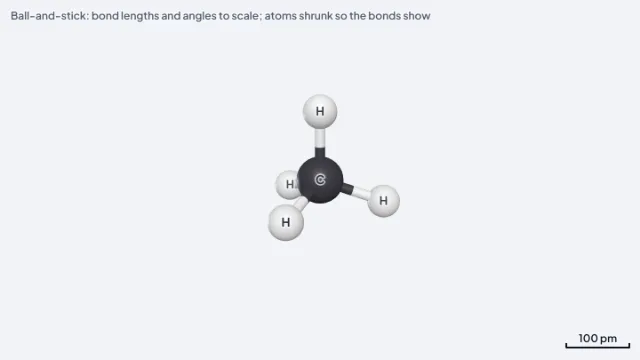
Some ideas are hard to grasp from a flat page because the real thing is three-dimensional. In electromagnetic waves in 3D, you can turn the stage and watch the electric and magnetic fields swing at 90° to one another, and both at 90° to the way the wave moves. In molecules in 3D, you can count the lone pairs on the oxygen in water before you check. The 3D simulations page lists the rest.
Common mistakes
- Choosing study methods by your "style". Choose them by the content and the evidence.
- Copying out notes in colourful pens. It looks visual, but it is still copying.
- Watching a sim without predicting. Decide what will happen first, even if you guess.
- Crowding a page with pictures. One clear diagram beats five decorative ones.
Are learning styles completely made up?
Preferences are real, and different people do have different strengths. What is not supported is the claim that matching teaching to a style makes people learn more.
Is dual coding the same as being a visual learner?
No. Dual coding helps everyone by combining words with pictures. It does not sort people into types.
Do I need to be good at drawing?
No. Stick figures, boxes and arrows are enough. What matters is that the picture shows how the parts connect.
Are 3D simulations always better than 2D?
Not always. 3D helps most when the thing itself is 3D, such as a molecule's shape or the field round a wire; for a graph, flat is clearer. For the methods to pair with dual coding, see which revision techniques work best.