Physics7 min read
Interleaving: Why Mixed Practice Beats Blocks of the Same Question in Physics and Chemistry
What interleaving is, two studies where mixed practice lost during practice but won on the later test, why choosing the method is the skill exams really test, when to block and when to mix, and a mixed-question routine using our chapter MCQ pages.
Published
On this page
- What is the difference between blocked and interleaved practice?
- Why does mixing questions work?
- Does interleaving work in a real classroom?
- When should you block, and when should you mix?
- A mixed-question routine with chapter MCQs
- Common mistakes
- Is interleaving the same as spaced repetition?
- Should I mix physics and chemistry in the same session?
- How many topics should I mix at once?
- Does interleaving work for definitions and facts?
In short
Interleaving means mixing different kinds of question in one practice session, such as a speed question, then a density question, then a resistance question, instead of doing ten of one kind in a row. It feels harder and you get more wrong while you practise, but in controlled studies it led to much higher scores on tests taken a week or a month later.
The odd thing about interleaving is that it looks like a bad idea while you are doing it. In 2007, Doug Rohrer and Kelli Taylor at the University of South Florida taught 18 university students to find the volumes of four unusual solids, including a "wedge" and a spheroid (Instructional Science). One group practised in blocks: all the wedge problems, then all the spheroid problems, and so on. The other group worked exactly the same problems, shuffled together.
During practice, the block group was far ahead: 89% correct against 60%. A week later, on new problems, the result flipped. The mixed group scored 63%. The block group scored 20%.
What is the difference between blocked and interleaved practice?
Blocked practice is the classic textbook exercise: a lesson on one method, then a page of questions that all need that method. Interleaved practice mixes questions that need different methods, so any question could need any of them.
| Feature | Blocked practice | Interleaved practice |
|---|---|---|
| Order of questions | AAAA, BBBB, CCCC | A, C, B, A, B, C, … |
| Do you know the method before you read the question? | Yes, the exercise heading tells you | No, you have to work it out |
| How it feels | Smooth and fast | Slower, with more mistakes |
| Score while practising (2007 study) | 89% | 60% |
| Score on the test a week later (2007 study) | 20% | 63% |
Why does mixing questions work?
In a block, you never have to decide which method to use, because the exercise has already decided for you. An exam paper does not. A stopping-distance question can sit straight after one on specific heat capacity, and often the hardest step is spotting which equation fits.
Interleaving trains exactly that choice. Each question makes you look at what you are given and what you are asked for, then pick a method. Rohrer and his colleagues argue this is the main reason it helps. You learn to tell apart problems that look alike but need different methods, and you link each kind of problem to its own method.
There is a second reason. When topics are mixed, each one comes back after a gap, so interleaving also spaces out your practice. Our spaced repetition guide explains why those gaps help memory.
Does interleaving work in a real classroom?
It does, at least in maths. In 2015 Rohrer, Robert Dedrick and Sandra Stershic reported a three-month study with 126 seventh-grade students in Florida, most of them 12 years old (Journal of Educational Psychology). Each student practised two skills: drawing the graph of a straight-line equation, and finding the slope of a line through two points. Every student had one skill on blocked homework and the other on interleaved homework, so each was compared with themselves.
Both versions used the same problems. For both, the first four problems on a skill came straight after its lesson. With blocking, the other eight came at once. With interleaving, they were spread across later homework among other topics. After a review lesson, students sat a surprise test either 1 day or 30 days later.
| Test | Skill learned with interleaving | Skill learned with blocking |
|---|---|---|
| 1 day later | 80% | 64% |
| 30 days later | 74% | 42% |
Over the month, the interleaved scores barely fell. The blocked scores dropped by about a third.
A big 2013 review of study methods by John Dunlosky and colleagues rated interleaving as moderate utility, a step below self-testing and spacing. Most of the evidence came from maths and from motor skills such as sports, so the strongest case is for calculations. For learning facts and definitions, self-testing matters more. The science of revising guide puts all the methods side by side.
When should you block, and when should you mix?
Block a little first. Both studies taught each method and gave a few straight practice questions before any mixing. If a method is brand new, do a short block until you can use it alone. Then mix.
Mix problems that look alike. The gain is biggest when questions look similar but need different methods. In physics, try mixing:
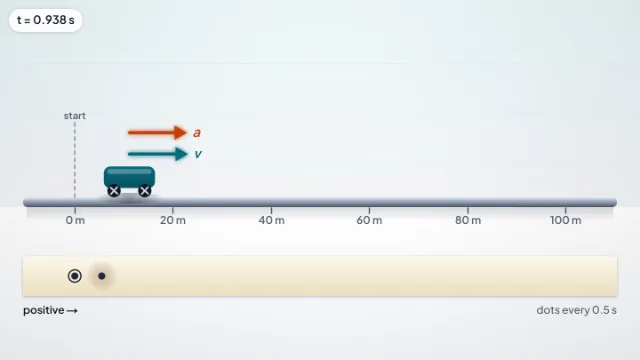
- , and : all motion, three different methods (the SUVAT equations simulation lets you check answers);
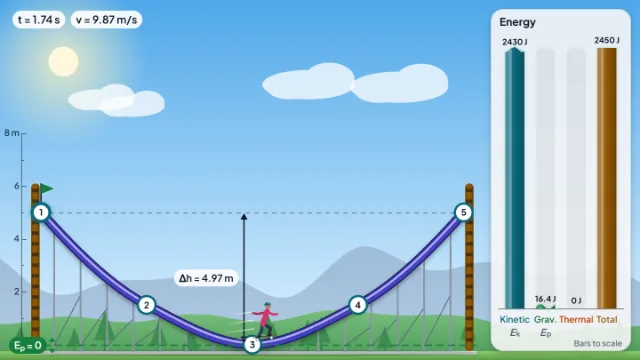
- for heating, for moving things, for lifting: all energy in joules, different situations (try the energy skate track simulation);
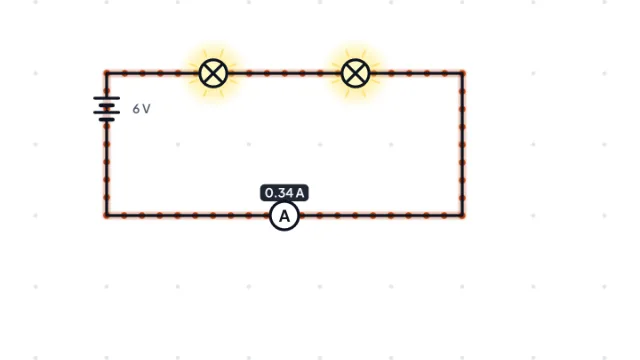
- , and : all electricity, easy to mix up (build the circuit in the circuit builder simulation).
In chemistry, mix:
- moles from a mass and moles from a solution's concentration and volume;
- deciding whether a substance has ionic, covalent or metallic bonding;
- choosing the right test for an ion, such as a flame test or a hydroxide precipitate.
Mix subjects across the week. A session can also swap between physics and chemistry. The weekly plan in the science of revising guide does this on purpose.
A mixed-question routine with chapter MCQs
Each of our chapter MCQ pages holds every multiple-choice question from one chapter, with an explanation for each answer. One page on its own is a block. Three pages used together become interleaved practice.
- Pick three chapters you have already studied (about 1 minute). Choose ones with calculations that look alike.
- Open each in its own tab.
- Rotate for 15 to 20 minutes. Answer two questions from the first tab, two from the second, two from the third, then go back to the first.
- Name the method before you answer. Say which idea or equation the question needs. That choice is the skill you are training.
- Read every explanation, even when you are right. Add each miss to your mistakes list.
- Finish on paper. Write one calculation from each chapter with no notes, then check your rearranging with a calculator such as the kinetic energy calculator.
Some mixes to start with:
- AQA GCSE Physics: energy, electricity and forces and motion MCQs;
- Cambridge IGCSE Physics: motion, energy, work and power and electrical quantities MCQs;
- AQA GCSE Chemistry: atomic structure, bonding and chemical changes MCQs;
- Punjab Class 10 Physics: waves, light and electricity MCQs.
Common mistakes
- Mixing before you can do any of them. If every question is a guess, go back to a short block on one method.
- Judging by your practice score. More mistakes during mixed practice are normal. In the 2007 study the mixed group got only 60% right while practising and still won the test.
- Only doing end-of-topic questions. Those are blocked by design. Keep them for learning a method, then mix.
- Mixing topics that need no choice. Three chapters of pure definitions give you little to tell apart. Interleaving pays off most with calculations and methods.
- Skipping the explanation. A wrong choice of equation is the most useful mistake you can make, but only if you find out why.
Is interleaving the same as spaced repetition?
No, but they overlap. Spacing is about the gaps between visits to a topic. Interleaving is about mixing different kinds of question in one session. Mixing creates gaps, so interleaving gives you some spacing as well.
Should I mix physics and chemistry in the same session?
You can, and swapping subjects during the week helps. For training the choice of method, though, mixing similar problems inside one subject, such as three kinds of energy calculation, gives you more to tell apart.
How many topics should I mix at once?
Three or four is a good start. The 2007 study mixed four kinds of problem. More than that makes it hard to cycle back to each one often enough.
Does interleaving work for definitions and facts?
There is less evidence for that. For facts, self-testing and spacing are the better-supported tools: see the retrieval practice guide. Use interleaving mainly for calculations and for choosing a method. All nine revision guides are listed on our study skills page.