Charges on the move
Every metal wire is packed with free electrons. They are the outer electrons of the metal atoms, held so loosely that they wander through the whole piece of metal instead of staying with one atom. With no battery connected they dart about at random, as many going one way as the other, so there is no overall flow.
Connect the wire to a cell and an electric field is set up along it. The free electrons now drift steadily towards the positive terminal while they keep jiggling. This steady drift of charge is an electric current. In a metal the moving charges are electrons; in the liquid inside a battery, positive and negative ions move in opposite directions and both carry the current.
Current as a rate of flow of charge
Electric current is the amount of charge that passes through any cross-section of a conductor in one second. If a charge flows past a point in time ,
Rearranged, and . Charge is measured in coulombs (C) and time in seconds, so the SI unit of current is the coulomb per second, called the ampere (A):
For small currents we use the milliampere, where .
Conventional current and electronic current
Scientists were drawing circuits long before the electron was discovered, and they guessed that positive charge flowed out of the positive terminal, round the circuit and back into the negative terminal. That direction is still used on every circuit diagram and is called conventional current.
We now know that in a wire the electrons move in the reverse direction, leaving the negative terminal and arriving at the positive one. This is the electronic current. Negative charge travelling one way is equivalent to positive charge travelling the opposite way, so both descriptions give the same answers. Arrows on circuit diagrams always show conventional current.
Direct current and alternating current
- Direct current (d.c.) never changes direction. A cell or battery gives a steady d.c.: on a graph of current against time it is a flat line on one side of zero.
- Alternating current (a.c.) keeps reversing. It rises to a peak one way, falls through zero, peaks the other way and returns, over and over. Most power stations supply a.c., and the mains in Pakistan has a frequency of 50 Hz.
At 50 Hz, one complete cycle takes . Within each cycle the current changes direction twice, so it reverses 100 times every second. A big advantage of a.c. is that transformers can step its voltage up for long cables, which cuts the energy wasted in transmission.
Measuring current with an ammeter
An ammeter is always placed in series, so that the current you want to know goes through the meter itself. Its own resistance is tiny, so putting it in the loop barely alters that current.
- An analogue ammeter has a pointer moving over a printed scale. It is easy to see a current rising or falling, but you must read the scale straight on.
- A digital ammeter shows the value as figures, which is quicker to read and usually more precise.
Both kinds come with several ranges, for example 0–100 mA and 0–10 A. Start on the highest range and switch down until the reading is a sensible size: a current too large for the range can damage the meter, while a tiny current on a big range gives a reading with too few useful figures.
Worked numerical 1: a mobile on charge
A charger feeds a steady 2.0 A into a mobile phone for 45 minutes. What charge enters its battery?
Data: , ,
Worked numerical 2: a torch bulb
In 3.0 minutes, 72 C of charge passes through the bulb of a torch. Find the current in milliamperes.
Data: , ,
Current in the simulation
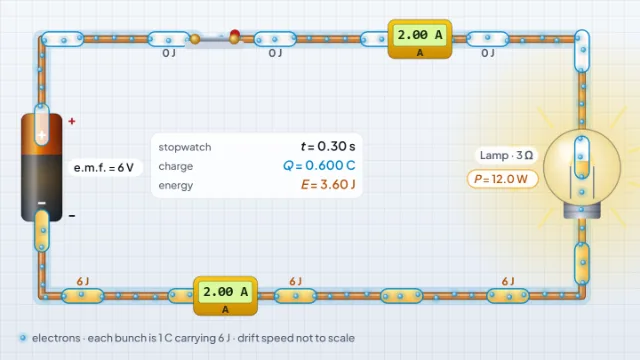
The simulation above puts a battery, a switch, two ammeters and a component in one loop.
- Press Play. The switch starts closed, and both ammeters show exactly the same reading: the lamp does not consume any of the current. What the lamp takes from each coulomb is energy, not charge. Press Switch off and both readings drop to zero together.
- Turn on Conventional current arrows (+ to −) to see the arrows run the opposite way to the drifting electrons.
- From the examples, pick the one with 2 A for 30 s, then press Play. Once the stopwatch halts at 30 s, the Charge passed card shows 60 C, matching .
To compare a steady d.c. trace with an alternating one, open the oscilloscope simulation for a.c. and d.c.