Skip to content

Punjab Board Class 10 Physics · Chapter 16: Electricity

Ohm's law

Section 16.3

Ohm's law: at constant temperature and with other physical conditions unchanged, a conductor's current rises in proportion to the p.d. applied to it. The constant ratio V/I is its resistance R, so V = IR. Resistance is measured in ohms (1 Ω = 1 V A⁻¹). A filament lamp does not obey the law.

Loading simulation…

Symbols match your course. Open the full i–v characteristics simulation for more presets and teacher tools.

Pushing harder, getting more current

Connect a short piece of nichrome wire to one cell and an ammeter shows a small current. Add a second cell, doubling the p.d. across the wire, and the reading doubles too. Three cells give three times the current. The German scientist Georg Simon Ohm made careful measurements like these with metal wires in the 1820s and found a very simple pattern.

Ohm's law

Ohm's law: provided a conductor's temperature and other physical conditions (its length, thickness and material) do not change, the current in it varies in direct proportion to the p.d. between its ends.

In symbols, I∝VI \propto V. Turning the proportion into an equation brings in a constant, the resistance RR of the conductor:

VI=RorV=IR\frac{V}{I} = R \qquad \text{or} \qquad V = IR

To find a current, divide the p.d. by the resistance; to find a resistance, divide the p.d. by the current.

Resistance tells you how strongly a conductor opposes the current. A large resistance means a small current for a given p.d.

The ohm

The SI unit of resistance is the ohm, written Ω\Omega. A conductor has a resistance of one ohm when a p.d. of one volt across it drives a current of one ampere through it:

1 Ω=1 V A−11\ \Omega = 1\ \text{V A}^{-1}

Bigger resistances are given in kilohms and megohms: 1 kΩ=103 Ω1\ \text{k}\Omega = 10^{3}\ \Omega and 1 MΩ=106 Ω1\ \text{M}\Omega = 10^{6}\ \Omega.

Testing a conductor in the laboratory

To check whether a wire obeys Ohm's law:

  1. Set up the wire in series with an ammeter, a switch and a variable d.c. supply (or a rheostat with a battery), and connect a voltmeter across the wire.
  2. Increase the p.d. in steps and record the ammeter and voltmeter readings each time. Open the switch after each pair of readings to stop the wire heating.
  3. Plot the current II on the vertical axis against the p.d. VV on the horizontal axis.

For a metal wire kept at a steady temperature, the plotted points form a straight line passing through (0, 0). This is the sign of an ohmic conductor. Dividing any pair of readings, V÷IV \div I, gives the same answer, the resistance. With current plotted upwards, a steeper slope belongs to a lower resistance: each volt pushes more amperes through.

When Ohm's law does not hold

Ohm's law is not a law of nature that every component must obey. It describes metals at a fixed temperature.

A filament lamp is the usual example of a non-ohmic component. As the current grows, the thin tungsten coil gets very hot. Its metal ions vibrate more violently and get in the way of the drifting electrons more often, so its resistance rises. The II–VV graph starts almost straight, then bends over towards the VV axis: every further volt buys a smaller rise in current. A typical lamp has several times more resistance when glowing white-hot than when cold.

Components made of semiconductors, such as thermistors and diodes, are also non-ohmic, and you meet them later in the chapter and in the electronics chapter.

Worked numerical 1: finding a resistance

When a p.d. of 12 V is applied across a heating coil, a current of 0.40 A flows. Find its resistance.

Data: V=12 VV = 12\ \text{V}, I=0.40 AI = 0.40\ \text{A}, R=?R = ?

R=VI=12 V0.40 A=30 ΩR = \frac{V}{I} = \frac{12\ \text{V}}{0.40\ \text{A}} = 30\ \Omega

Worked numerical 2: current through a kilohm resistor

A 2.2 kΩ resistor in a radio is connected across 9.0 V. What current flows through it, in milliamperes?

Data: V=9.0 VV = 9.0\ \text{V}, R=2.2 kΩ=2200 ΩR = 2.2\ \text{k}\Omega = 2200\ \Omega

I=VR=9.02200=4.1×10⁻³ A=4.1 mAI = \frac{V}{R} = \frac{9.0}{2200} = 4.1 \times 10^{-3}\ \text{A} = 4.1\ \text{mA}

Worked numerical 3: is this wire ohmic?

A student records these readings for a length of constantan wire.

p.d. V (V)current I (A)V ÷ I (Ω)
1.50.1015
3.00.2015
4.50.3015
6.00.4015

Every ratio is 15 Ω, so doubling the p.d. doubles the current: the wire obeys Ohm's law and its resistance is 15 Ω.

Ohm's law in the simulation

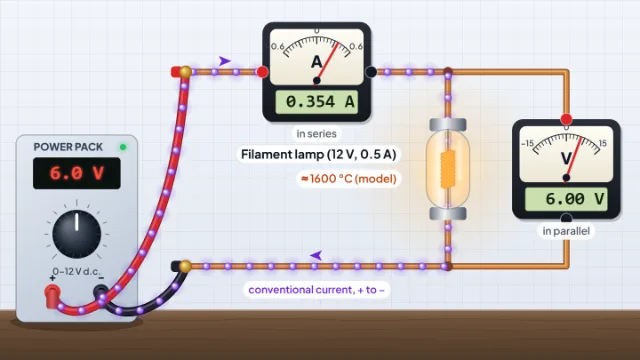
Above is a practical bench: a power pack feeds the component, with an ammeter in the loop and a voltmeter connected over the part being tested.

  1. With Resistor chosen, use Take a full set of readings. The supply is turned up and down automatically, both ways round, and every point lines up on one straight line through the origin. The Resistance card gives the same value at every point.
  2. Change the component to Filament lamp and take a full set again. The graph curves, and the Filament temperature card climbs as the p.d. rises, while the resistance grows.
  3. In the results table, select a row at a low p.d. and then one at a high p.d., and read the Resistance at a point box each time. Only the resistor gives the same V÷IV \div I at both.

Formula sheet

Equations

  • Potential difference, current and resistance

    Learn this

    V=IR

    potential difference = current × resistance

Common mistakes

  • Leaving out the condition. Ohm's law only holds while the temperature and the other physical conditions of the conductor stay the same.
  • Thinking a lamp has no resistance because it is non-ohmic. It has a resistance at every reading; that resistance just rises as the filament heats up.
  • Reading the gradient of an I–V graph as the resistance. With I on the vertical axis, a steeper line means a smaller resistance.
  • Forgetting to change kΩ into Ω (or mA into A) before using V = IR.
  • Rearranging V = IR wrongly as R = I/V. Resistance is p.d. divided by current.
  • Leaving the circuit switched on between readings, so the wire warms up and its resistance drifts.

Exam practice

Exam-style questions

Original questions written in the style of Punjab board exams. Try each one before you reveal the answer.

  1. 1.Ayesha connects a 50 cm length of constantan wire to a variable supply and measures the current for several values of the p.d.

    1. (a)State Ohm's law.

      2 marks
      Show the answer

      Answer: The current is directly proportional to the potential difference applied across the conductor, as long as its temperature and other physical conditions are unchanged.

      Marking points

      • Current directly proportional to p.d.
      • Temperature / physical state kept constant
    2. (b)Sketch and describe the I–V graph the student should expect for the wire.

      2 marks
      Show the answer

      Answer: A straight line passing through the origin, showing that I is directly proportional to V.

      Marking points

      • Straight line
      • Through the origin
    3. (c)At 5.4 V the ammeter shows 0.36 A. Find the resistance of the wire.

      2 marks
      Show the answer

      Answer: Resistance = 5.4 V ÷ 0.36 A = 15 Ω.

      Marking points

      • R = V/I
      • 15 Ω
  2. 2.When it is lit normally from a 12 V battery, a motorcycle headlamp bulb has 2.4 Ω of resistance.

    1. (a)Work out the current drawn by the bulb when it is lit.

      2 marks
      Show the answer

      Answer: Current = 12 V ÷ 2.4 Ω = 5.0 A.

      Marking points

      • I = V/R
      • 5.0 A
    2. (b)Explain why the resistance of the cold filament is much less than 2.4 Ω.

      2 marks
      Show the answer

      Answer: Resistance of a metal rises with temperature. When the filament is cold its ions vibrate less, so the electrons pass through more easily and the resistance is smaller.

      Marking points

      • Resistance of metal increases as temperature rises
      • Hot ions vibrate more and obstruct electrons
    3. (c)Is the bulb an ohmic conductor? Give a reason.

      1 mark
      Show the answer

      Answer: No: its resistance changes with the current, so I is not proportional to V and its I–V graph is a curve.

      Marking points

      • No, because V/I is not constant (graph curves)
  3. 3.A 470 Ω resistor in an electronic circuit has a current of 25 mA through it.

    1. (a)Find the p.d. across the resistor.

      2 marks
      Show the answer

      Answer: 25 mA = 0.025 A. V = IR = 0.025 × 470 = 11.75 V, which is about 12 V.

      Marking points

      • Converts 25 mA to 0.025 A
      • V = 11.75 V (about 12 V)
    2. (b)Define the ohm.

      1 mark
      Show the answer

      Answer: The resistance of a conductor through which a current of 1 A flows when a p.d. of 1 V is applied across it.

      Marking points

      • 1 V across it drives 1 A (1 Ω = 1 V A⁻¹)

Quiz

Quick check

6 questions

  1. 1.Which unit is the same as the ohm?
  2. 2.A 9.0 V supply drives 0.45 A through a resistor. Its resistance is:
  3. 3.The p.d. across an ohmic resistor is tripled. Its current:
  4. 4.Why does a filament lamp give a curved current–voltage graph?
  5. 5.Ohm's law applies to a metal wire only when:
  6. 6.Two resistors P and Q are tested. On the same I–V axes (I vertical), P's line is steeper than Q's. This means:

Related articles

Next step

Now see it move

Open the full i–v characteristics simulation for every preset, graphs and the teacher tools, then test yourself.

I–V characteristics simulation: a practical bench with a power pack