Skip to content

Punjab Board Class 10 Physics · Chapter 16: Electricity

Resistor colour codes

Section 16.7

On a four-band resistor, the first two bands give two digits, the third band says how many zeros to add (the multiplier) and the fourth gives the tolerance: gold ±5 %, silver ±10 %, no band ±20 %. Red, violet, orange, gold means 27 000 Ω ± 5 %.

Loading simulation…

Symbols match your course. Open the full circuit builder simulation for more presets and teacher tools.

Reading a resistor without a meter

Most small resistors are far too tiny to have a number printed on them. Instead they carry coloured bands. Once you know what each colour means, you can read a resistor's value at a glance, without a multimeter. Section 16.7 explains the common four-band code.

What the four bands mean

Hold the resistor so that the group of three bands close together is on your left and the separate band (usually gold or silver) is on your right. Then read from left to right:

  1. Band 1: the first digit of the value.
  2. Band 2: the second digit.
  3. Band 3: the multiplier, the power of ten the two digits are multiplied by.
  4. Band 4: the tolerance.
R=(first digit second digit)×multiplierR = (\text{first digit}\ \text{second digit}) \times \text{multiplier}

Tolerance: how far the real resistance may be from the value shown by the bands, given as a percentage of that value.

A 100 Ω resistor with ±5 % tolerance may really be anywhere from 95 Ω to 105 Ω. Making every resistor exactly right would be expensive, and most circuits work perfectly well with a small spread.

The colour table

ColourDigitMultiplierTolerance
Black0× 1 (10⁰)–
Brown1× 10 (10¹)± 1 % *
Red2× 100 (10²)± 2 % *
Orange3× 1000 (10³)–
Yellow4× 10⁴–
Green5× 10⁵–
Blue6× 10⁶–
Violet7× 10⁷–
Grey8× 10⁸–
White9× 10⁹–
Gold–× 0.1 (10⁻¹)± 5 %
Silver–× 0.01 (10⁻²)± 10 %
No colour––± 20 %

The rows marked * (brown and red as tolerance bands) are used on precision resistors and go beyond the book. For a four-band resistor, the tolerance you will nearly always meet is gold or silver.

A neat pattern helps: the multiplier colour is simply "the digit of that colour, as the number of zeros". Orange is 3, so an orange third band means "add three zeros".

A memory sentence

The digit colours in order are black, brown, red, orange, yellow, green, blue, violet, grey, white. One way to remember them is a sentence whose word initials follow the colours, for example:

Big Brown Rabbits Often Yawn Gently Beneath Violet Grey Willows.

Notice also that red, orange, yellow, green, blue, violet (2 to 7) run in rainbow order.

Worked numerical 1: decoding a resistor

A resistor has bands yellow, violet, red, silver. Find its value and the range it could lie in.

  • yellow = 4, violet = 7, so the digits are 47;
  • red multiplier = × 100;
  • silver = ± 10 %.
R=47×100=4700 Ω=4.7 kΩR = 47 \times 100 = 4700\ \Omega = 4.7\ \text{k}\Omega

10 % of 4700 Ω is 470 Ω, so the true value lies between

4700−470=4230 Ωand4700+470=5170 Ω4700 - 470 = 4230\ \Omega \quad \text{and} \quad 4700 + 470 = 5170\ \Omega

Worked numerical 2: a small value

Bands: yellow, violet, gold, gold.

Digits 47, multiplier gold = × 0.1, tolerance ± 5 %:

R=47×0.1=4.7 Ω±5 %R = 47 \times 0.1 = 4.7\ \Omega \pm 5\ \%

Values below 10 Ω always need a gold or silver third band.

Worked numerical 3: choosing the colours

What bands would a 2.2 kΩ resistor with ± 5 % tolerance carry?

2.2 kΩ=2200 Ω=22×1002.2\ \text{k}\Omega = 2200\ \Omega = 22 \times 100

  • first digit 2: red;
  • second digit 2: red;
  • multiplier × 100: red;
  • ± 5 %: gold.

So the bands are red, red, red, gold.

Worked numerical 4: using the value with Ohm's law

A resistor marked red, red, brown, gold is connected to a 4.4 V supply. Find the current.

The bands give 22×10=220 Ω22 \times 10 = 220\ \Omega. Using Ohm's law from section 16.3:

I=VR=4.4220=0.020 A=20 mAI = \frac{V}{R} = \frac{4.4}{220} = 0.020\ \text{A} = 20\ \text{mA}

Because of the ± 5 % tolerance, a measured current a little above or below 20 mA would still be normal.

Resistor values in the simulation

There are no colour bands in the circuit builder, but you can test what a decoded value does in a real circuit.

  1. From Starting circuits, choose Diode. Tap the resistor: the Resistance slider shows 220 Ω. Which four colours would it carry with ± 5 % tolerance?
  2. Change the Resistance to 470 Ω (yellow, violet, brown) and watch the Current reading in the selected part's box fall.
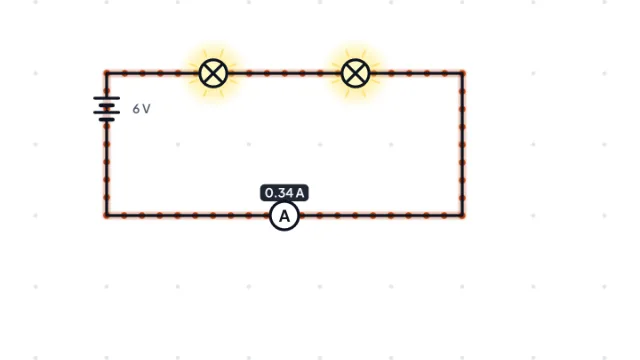
  3. Choose Empty, add a Resistor and an Ammeter in a loop with the battery, and set the resistor to 330 Ω (orange, orange, brown). The slider goes up to 1000 Ω. Compare the Current with V÷RV \div R for the 6 V battery.

Common mistakes

  • Reading the resistor from the wrong end. Start from the end with the group of bands; the gold or silver tolerance band goes on the right.
  • Treating the third band as a third digit. On a four-band resistor it is the multiplier: the number of zeros to add.
  • Swapping the gold and silver multipliers: gold means × 0.1, silver means × 0.01.
  • Mixing up brown (1) and black (0), or violet (7) and grey (8).
  • Working out the tolerance as a fixed number of ohms. It is a percentage of the value shown by the bands.
  • Forgetting to convert the answer to sensible units: 47 000 Ω is better written as 47 kΩ.

Exam practice

Exam-style questions

Original questions written in the style of Punjab board exams. Try each one before you reveal the answer.

  1. 1.Resistors are often marked with four coloured bands.

    1. (a)State what each of the four bands shows.

      3 marks
      Show the answer

      Answer: Bands 1 and 2 give the first and second digits, band 3 gives the multiplier, and band 4 gives the tolerance.

      Marking points

      • First two bands: digits
      • Third band: multiplier
      • Fourth band: tolerance
    2. (b)Explain what is meant by the tolerance of a resistor.

      2 marks
      Show the answer

      Answer: It is how far the actual resistance may differ from the marked value, given as a percentage of the marked value.

      Marking points

      • Allowed difference between real and marked value
      • Expressed as a percentage
  2. 2.A resistor has the bands blue, grey, red, gold.

    1. (a)Work out its marked resistance.

      2 marks
      Show the answer

      Answer: Blue = 6, grey = 8, red multiplier = × 100, so R = 68 × 100 = 6800 Ω (6.8 kΩ).

      Marking points

      • Digits 68
      • 6800 Ω
    2. (b)Find the smallest and largest values its real resistance could have.

      2 marks
      Show the answer

      Answer: Gold means ± 5 %. 5 % of 6800 Ω is 340 Ω, so the range is 6460 Ω to 7140 Ω.

      Marking points

      • 5 % of 6800 = 340 Ω
      • 6460 Ω to 7140 Ω
  3. 3.A technician needs a 10 kΩ resistor with ± 10 % tolerance for a circuit with a 12 V supply.

    1. (a)Give the four colours of the resistor in order.

      2 marks
      Show the answer

      Answer: 10 kΩ = 10 × 1000, so brown, black, orange, then silver for ± 10 %.

      Marking points

      • Brown, black, orange
      • Silver
    2. (b)Calculate the current through it when connected alone across the 12 V supply.

      2 marks
      Show the answer

      Answer: I = V/R = 12 ÷ 10 000 = 1.2 × 10⁻³ A (1.2 mA).

      Marking points

      • R = 10 000 Ω used
      • 1.2 × 10⁻³ A

Quiz

Quick check

6 questions

  1. 1.On a four-band resistor, the third band gives the:
  2. 2.A resistor reads brown, black, red, gold. Its value is:
  3. 3.Which tolerance band shows ± 10 %?
  4. 4.The colours of a 330 Ω resistor are:
  5. 5.A 1000 Ω resistor has a tolerance of ± 10 %. Its real resistance could be:
  6. 6.What is the value of a resistor marked brown, green, yellow, silver?

Related articles

Next step

Now see it move

Open the full circuit builder simulation for every preset, graphs and the teacher tools, then test yourself.

Circuit builder simulation: build any circuit you like