Why the joule is too small for a bill
A single 1500 W iron used for one hour transfers joules. A whole household uses many millions of joules every day, so a bill written in joules would be full of enormous numbers. Electricity companies use a much larger unit instead.
The kilowatt-hour
One kilowatt-hour (kWh) is the electrical energy transferred by an appliance of power one kilowatt when it works for one hour.
Converting it to joules:
Keep in mind that the kWh measures energy, not power, even though it contains the word "kilowatt". On electricity bills in Pakistan, one kWh is simply called one unit.
Counting the units
Energy in kWh = power in kW × time in hours. If the power is given in watts, divide by 1000 first:
For several appliances, work out the units for each one and add them. For a whole month, multiply the daily total by the number of days.
The electricity meter in a house counts kilowatt-hours continuously. The units used in a billing period are the new reading minus the previous reading.
Working out the cost
Once the number of units is known:
The price per unit in the examples below is chosen to make the arithmetic clear. Real tariffs in Pakistan change often, depend on how many units a home uses, and bills add taxes and fixed charges, so check a recent bill for the actual figures.
Worked numerical 1: a ceiling fan for a month
A 75 W ceiling fan runs for 12 hours every day for 30 days. Find the units used and the cost at Rs. 40 per unit.
Worked numerical 2: a family's daily use
In one day a family uses two 12 W LED bulbs for 6 hours each, a 1000 W iron for half an hour and a 1.2 kW water pump for 45 minutes. Find the units used in the day.
LED bulbs:
Iron:
Pump:
Total for the day: , or about 1.5 units. Notice how little the two bulbs add compared with the iron and pump, which have far higher power.
Worked numerical 3: reading the meter
At the start of a month the meter shows 04512 kWh and at the end it shows 04738 kWh. Find the units consumed, the energy in joules and the bill at Rs. 38 per unit.
Saving units at home
Because cost depends on power × time, the biggest savings come from high-power appliances that run for long periods: heaters, geysers, irons, air conditioners and old refrigerators. Switching from filament or tube lights to LED bulbs also helps, because an LED gives the same light for a small fraction of the power.
The bill in the simulation
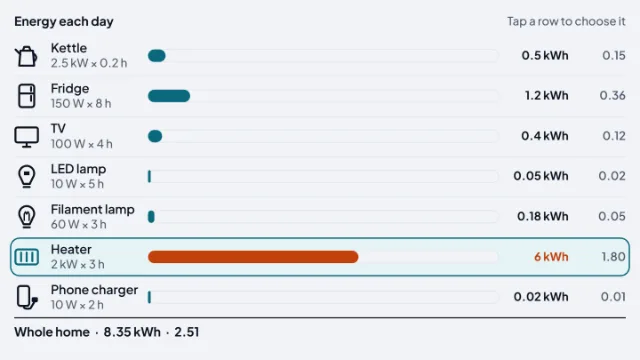
The simulation above is a small home with real appliances, an electricity meter and a lamp comparison. Prices on the Pakistan setting are in rupees per unit, and you can change the price.
- In the Home view, set how long each appliance runs every day. The cards give the energy in kWh, the same energy in joules and the cost each day.
- Choose the Kettle or lamp? guided set-up and predict which uses more energy in a day before pressing Run: a 2.5 kW kettle for 6 minutes or a 60 W lamp for 5 hours.
- Try A week of meter. The meter starts at one reading and ends at another; subtracting them gives the units used, just as on a real bill.
- In LED or filament?, two lamps give the same light, but the filament lamp uses several times the energy.