Skip to content

Punjab Board Class 10 Physics · Chapter 16: Electricity

Resistivity and the effect of temperature on resistance

Section 16.5

A wire's resistance is proportional to its length and inversely proportional to its cross-sectional area: R = ρL/A. The resistivity ρ, in ohm-metres (Ω m), depends on the material and temperature. Heating raises the resistance of a metal but lowers that of a semiconductor such as a thermistor.

Loading simulation…

Symbols match your course. Open the full resistance of a wire simulation for more presets and teacher tools.

What decides a wire's resistance?

Resistance is the opposition a conductor offers to the flow of current. Two wires can have very different resistances even at the same temperature, and four things decide the value:

  1. Length LL. Drifting electrons in a longer wire meet more vibrating ions on the way, so doubling the length doubles the resistance: R∝LR \propto L.
  2. Cross-sectional area AA. A thicker wire offers more room for charge to pass side by side, like a wider road carrying more traffic. Doubling the area halves the resistance: R∝1AR \propto \dfrac{1}{A}.
  3. Material. Copper and silver let charge through easily; nichrome makes it much harder.
  4. Temperature, discussed further down.

The resistivity equation

Putting the length and area effects together, R∝LAR \propto \dfrac{L}{A}. The constant that turns this into an equation depends only on the material (at a given temperature). It is called the resistivity ρ\rho (the Greek letter rho):

R=ρ LAR = \rho\,\frac{L}{A}

Rearranged to find the resistivity, ρ=RAL\rho = \dfrac{RA}{L}. Its SI unit comes straight from this: ohms multiplied by square metres, divided by metres, which is the ohm-metre, Ω m\Omega\ \text{m}.

A useful picture: if a block of the material were a cube 1 m along each edge, ρ\rho would be the resistance measured between two opposite faces of that cube.

Good conductors and poor conductors

A low resistivity means a good conductor; a high resistivity means a poor conductor. Approximate values near room temperature:

MaterialResistivity (Ω m)Typical use
silver1.6 × 10⁻⁸contacts in quality switches
copper1.7 × 10⁻⁸house wiring, cables
aluminium2.8 × 10⁻⁸overhead power lines (light and cheap)
tungsten5.6 × 10⁻⁸lamp filaments
nichrome1.1 × 10⁻⁶heater and iron elements

Nichrome's resistivity is roughly sixty-five times copper's. That is exactly what a heater needs, because a short length of it gives a large enough resistance to glow red-hot, while the copper leads that feed it stay cool.

How temperature changes resistance

In a metal, heating makes the lattice ions vibrate with larger amplitude. Drifting electrons now bump into them more frequently, the current meets more opposition, and the resistance goes up. A tungsten lamp filament shows this strongly: its resistance when white-hot is many times its value when cold.

Semiconductors such as silicon behave the other way. Warming them frees extra charge carriers, and the extra carriers more than make up for the stronger vibrations, so their resistance falls as their temperature rises. A thermistor is a semiconductor resistor designed to make use of this effect, and it is used as a temperature sensor.

Worked numerical 1: a copper extension lead

One core of an extension lead is copper wire 25 m long with a cross-sectional area of 0.50 mm². Find its resistance. Take ρ=1.7×10⁻⁸ Ω m\rho = 1.7 \times 10^{-8}\ \Omega\ \text{m}.

Data: change the area to square metres first: 1 mm2=10−6 m21\ \text{mm}^2 = 10^{-6}\ \text{m}^2, so A=0.50×10⁻⁶ m2A = 0.50 \times 10^{-6}\ \text{m}^2.

R=ρ LA=1.7×10−8×250.50×10−6=0.85 ΩR = \rho\,\frac{L}{A} = 1.7 \times 10^{-8} \times \frac{25}{0.50 \times 10^{-6}} = 0.85\ \Omega

Worked numerical 2: designing a heater element

A heater element must have a resistance of 44 Ω. It is to be made from nichrome wire with A=2.0×10⁻⁷ m2A = 2.0 \times 10^{-7}\ \text{m}^2 and ρ=1.1×10⁻⁶ Ω m\rho = 1.1 \times 10^{-6}\ \Omega\ \text{m}. What length of wire is needed?

L=RAρ=44×2.0×10−71.1×10−6=8.0 mL = \frac{RA}{\rho} = \frac{44 \times 2.0 \times 10^{-7}}{1.1 \times 10^{-6}} = 8.0\ \text{m}

The wire is wound into a tight coil so that 8 m fits inside the heater.

Worked numerical 3: changing the shape

A wire has a resistance of 6.0 Ω. A second wire of the same metal is twice as long and has half the cross-sectional area. Find its resistance.

Doubling LL doubles RR, and halving AA doubles it again:

R2=6.0×2×2=24 ΩR_2 = 6.0 \times 2 \times 2 = 24\ \Omega

Resistivity in the simulation

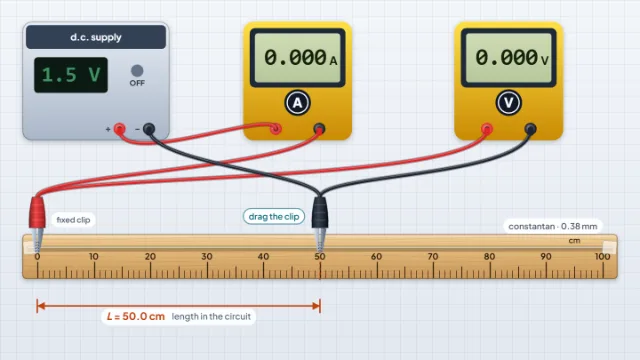
A test wire is taped along a metre rule, with a sliding crocodile clip and a voltmeter across the part of the wire in use.

  1. Press Switch on, record a reading, move the clip and record again. Each point lands on the resistance–length graph, and the line of best fit passes close to the origin: R∝LR \propto L.
  2. From the Examples, choose Double the length. The clip moves from 25 cm to 50 cm and the resistance doubles.
  3. Choose Half the diameter. At the same length the resistance becomes four times as large, because the area is now a quarter.
  4. Try Supply left on (nichrome). With the current left flowing, the wire warms, its resistance creeps up and the current falls, which is why readings should be taken quickly.
Common mistakes

  • Using an area in mm² inside R = ρL/A. Multiply by 10⁻⁶ to change mm² into m² before substituting.
  • Treating diameter as if it were area. Halve the diameter and the area drops to one quarter, which makes R four times bigger.
  • Writing the unit of resistivity as Ω/m or Ω m⁻¹. Rearranging ρ = RA/L gives Ω × m² ÷ m = Ω m.
  • Saying that resistivity changes when a wire is stretched or cut. The wire's resistance changes; its resistivity belongs to the material and stays the same at a fixed temperature.
  • Stating that every material's resistance rises with temperature. That is true for metals, but semiconductors such as thermistors conduct better when warm.
  • Thinking a thicker wire has more resistance because it contains more metal. More area gives more paths for charge, so the resistance is smaller.

Exam practice

Exam-style questions

Original questions written in the style of Punjab board exams. Try each one before you reveal the answer.

  1. 1.Electricians choose copper for house wiring but nichrome for the element of an electric iron.

    1. (a)What is meant by the resistivity of a material? Write down its SI unit.

      2 marks
      Show the answer

      Answer: Resistivity is the constant ρ in R = ρL/A, a property of the material: numerically the resistance between opposite faces of a one-metre cube of it. Its unit is the ohm-metre (Ω m).

      Marking points

      • ρ = RA/L, a property of the material (resistance of a 1 m cube between opposite faces)
      • Ω m
    2. (b)Explain the choice of each material.

      2 marks
      Show the answer

      Answer: Copper has a very low resistivity, so the wiring wastes little energy and stays cool. Nichrome has a high resistivity, so a short coil has enough resistance to become hot and heat the iron.

      Marking points

      • Copper: low resistivity, little heating in wires
      • Nichrome: high resistivity, large resistance in a short length so it heats up
  2. 2.A spool holds 50 m of aluminium wire of cross-sectional area 1.4 × 10⁻⁶ m². The resistivity of aluminium is 2.8 × 10⁻⁸ Ω m.

    1. (a)Find the resistance of the whole length of wire.

      2 marks
      Show the answer

      Answer: R = ρL/A = 2.8 × 10⁻⁸ × 50 ÷ (1.4 × 10⁻⁶) = 1.0 Ω.

      Marking points

      • Correct substitution in R = ρL/A
      • 1.0 Ω
    2. (b)Ten metres are cut off. What is the resistance of the remaining wire?

      1 mark
      Show the answer

      Answer: 40 m is four fifths of the length, so R = 4/5 × 1.0 = 0.80 Ω.

      Marking points

      • 0.80 Ω
    3. (c)Would the resistivity of the remaining wire be different? Explain.

      1 mark
      Show the answer

      Answer: No. Resistivity depends only on the material and its temperature, not on the length of the piece.

      Marking points

      • No: property of the material, not of the dimensions
  3. 3.A filament lamp and an NTC thermistor are both warmed up.

    1. (a)Describe and explain what happens to the resistance of the lamp's tungsten filament as it gets hotter.

      2 marks
      Show the answer

      Answer: It increases. The metal ions vibrate more strongly, so drifting electrons hit them more frequently and are held back more.

      Marking points

      • Resistance increases
      • Ions vibrate more, more collisions with electrons
    2. (b)State how the thermistor behaves differently and why.

      2 marks
      Show the answer

      Answer: Its resistance falls. It is a semiconductor, and heating releases more free charge carriers, which outweighs the extra vibration.

      Marking points

      • Resistance decreases
      • More charge carriers released in the semiconductor

Quiz

Quick check

6 questions

  1. 1.The SI unit of resistivity is:
  2. 2.A lab wire is swapped for a piece of identical metal and thickness, three times longer. Its resistance becomes:
  3. 3.Which change makes the resistance of a copper wire four times smaller?
  4. 4.Nichrome is used for heater elements because it has:
  5. 5.As the temperature of a metal conductor rises, its resistance:
  6. 6.A wire of resistance 12 Ω is stretched evenly to twice its length, so that its area halves. Its new resistance is:

Related articles

Next step

Now see it move

Open the full resistance of a wire simulation for every preset, graphs and the teacher tools, then test yourself.

Resistance of a wire simulation: a wire taped to a metre rule, with a crocodile clip you slide along it