How a house is wired
Electricity reaches a home through a cable from the street, then passes the meter, the main switch and a distribution board of fuses or circuit breakers before it reaches the lights and sockets. Inside the house every appliance is connected in parallel with the supply.
Wiring in parallel has three big advantages:
- every appliance gets the full mains voltage (about 220 V in Pakistan), which is what it was designed for;
- each one has its own switch and can be turned on or off without affecting the others: the kitchen light can be switched off while the television keeps working;
- one fault does not black out the whole house: if a bulb breaks, the other branches still form complete circuits.
If the bulbs of a house were wired in series instead, the 220 V would be shared between them, so each would glow dimly, and switching off or losing one lamp would turn every lamp off.
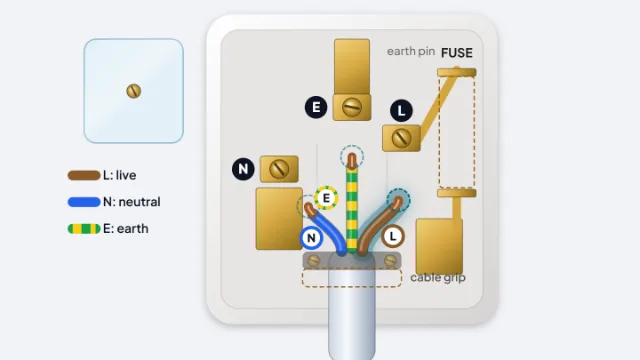
Live, neutral and earth
A mains cable to an appliance normally has three wires:
- the live (line) wire carries the alternating supply to the appliance; its voltage swings between large positive and negative values;
- the neutral wire completes the circuit back to the supply; it stays close to 0 V;
- the earth wire is a safety wire. It is joined to the metal body of the appliance at one end and to a metal plate or rod buried in the ground at the other. Normally no current flows in it.
The book does not give wire colours, but in modern wiring the cores are colour-coded, commonly brown for live, blue for neutral and green with yellow stripes for earth.
Common hazards
Most electrical accidents come from one of a few causes:
- Damaged insulation. Old, cracked or cut insulation can expose a live conductor. Touching it can give a shock, and two bare wires touching make a short circuit.
- Overheating cables. A wire carrying more current than it is designed for heats up () and can melt its insulation or start a fire.
- Overloading. Plugging a heater, an iron and a kettle into one socket or extension board makes it draw a total current far greater than it can carry safely.
- Damp conditions. Water conducts, so wet hands, wet floors or water near sockets make shocks far more likely.
- Poor maintenance and misuse, such as loose connections, missing earth wires or the wrong fuse.
Fuses and trip switches
A fuse is a short, thin wire inside a holder. Normally it carries the current without trouble, but if a fault makes the current rise above its rating, the wire heats up and melts, breaking the circuit. A blown fuse must be replaced after the fault has been found.
A trip switch (miniature circuit breaker, MCB) does the same job automatically. When the current becomes too large, it opens a switch inside itself (going beyond the book: an electromagnet or a bimetallic strip does this). It responds more quickly than a fuse wire, and after the fault has been put right you just switch it back on.
Choosing a rating. Find the normal working current from , then pick the fuse or breaker with the next rating above it. Too low a rating and it blows during normal use; too high and it will not break the circuit before a cable overheats.
Why in the live wire? Fuses, breakers and switches are always placed in the live wire. When they open, the appliance is cut off from the high voltage. If a fuse were in the neutral wire, a blown fuse would stop the appliance working, but its internal parts would still be connected to the live supply, and anyone opening it could get a shock.
Earthing and double insulation
Suppose a loose live wire inside a washing machine touches its metal case.
- With an earth wire, the case has a path of tiny resistance to the ground. A big surge of current rushes down the earth wire, which blows the fuse or trips the breaker at once and disconnects the live supply. The case never stays at a dangerous voltage.
- Without an earth wire, the case sits at mains voltage, waiting. The next person to touch it becomes the path to earth and receives a shock.
That is why the outer casing of every appliance must either be earthed or be double insulated. Double-insulated appliances, such as many hair dryers, phone chargers and power drills, have a plastic case that cannot conduct, with the live parts insulated twice over, so they need no earth wire. They are marked with a square inside a square.
Worked numerical 1: choosing a fuse
A 2.0 kW room heater runs from a 220 V supply. The shop sells fuses rated 2 A, 6 A, 10 A and 16 A. Which one suits it?
The 10 A fuse is the next rating above 9.1 A. A 6 A fuse would blow as soon as the heater is switched on; a 16 A fuse would allow a dangerous fault current before it melted.
Worked numerical 2: an overloaded extension board
A 220 V extension board is rated 13 A. A 1500 W kettle, a 1200 W iron and a 450 W washing machine are all plugged into it. Is it overloaded?
Yes: 14.3 A is more than the 13 A rating, so its cable and contacts will overheat.
Safety in the simulation
On the Punjab course the simulation opens on household wiring, with three scenes: Home, Faults and Fuse.
- In Faults, run Live touches an earthed case: the earth wire carries the fault current and the fuse blows. Then run The same fault with no earth wire and see the case left live.
- Try Fuse wrongly in the neutral. The fuse blows and the kettle stops, yet its parts are still connected to the live wire.
- In Home, choose Kettle and heater on together to overload a circuit, or A short circuit, and watch which trip switch opens.
- In Fuse, match a fuse rating to an appliance by working out its normal current first.